Showing posts with label culture. Show all posts

Tradition to Transition: Dietary Shifts in Immigrant Patients (Rayas, 8/7/2024)

Muchas gracias to Dr. Lourdes "Lulu" Rayas for a wonderful presentation this week on food customs and Habits in our Mexican immigrant patient population. She titled the presentation, From Traditional to Transitional: Dietary Shifts with Immigration.  

A recording of her wonderful (and tasty) presentation is available HERE

***

My notes:

16% of our population in Sonoma County is foreign born.

Chronic disease is more prevalent  in the Latinx population. In fact, compared to non-Hispanic whites,

  • Hispanic adults 70% more likely be diagnosed with DM2
  • Hispanics are 1.3x more likely to die from diabetes 
  • Hispanics have 2x risk of being hospitalized with ESRD
Of note, the immigrant paradox is a statistical pattern that shows first-generation immigrants may have better health outcomes than native-born people of the same age, race, and gender, even if they have lower socioeconomic status. This pattern has been observed for cardiovascular disease, mental health, and mortality. However, recent research suggests that immigrants may experience a decline in cardiovascular health over time. 

Some of this paradox may be explained by dietary acculturation-- the notion that, over time, immigrants gradually abandon eating habits from their native countries, ultimately increasing fats, sugary beverages, and decreasing fruits and vegetables. 


Children of immigrants have also been noted to have less physical activity (than native born children) and less healthy diets. 

In a study of Latinx immigrants, people were asked to share the pros and cons of their eating habits and food access in their country of origin as compared to the USA. You can see these lists in the images below. I was most struck by the notion that many immigrants literally do not have the time to cook like they did when they lived in their country of origin -- this is likely due to long work hours and less flexible home schedules. Also note, that people report eating more legumes (and less meat) in their country of origin. 


So what can we do as primary care providers? 
Dr. Lulu encouraged us to adhere to three principles: 1) have a culturally competent approach to nutrition 2) help patients find a community that shares valued and traditions, and 3) connect patients to food access resources. 

Culturally competent nutrition
Traditional Mexican cooking, Dr. Rayas, pointed out, contains tons of fresh fruits and vegetables and very little processed foods. We can encourage our patients to carry forward traditional family  menus and discourage processed foods. Commonly used foods used in Mexican cooking have well-documented health benefits:
  • tomato (jitomate) has evidence that it lowers lipids, decreases blood pressure and general inflammation
  • peppers (chiles) help with glucose metabolism 
  • avocado (aguacate) decreases CVD, cancer, and works on the GLP system
  • corn (elote) has been shown to be anti-inflammatory, anti-angiogenesis properties, and anti-carciongenic. (And, btw, corn is the foundation of the Mexican diet). 
  • cactus (nopales) also has anti-inflammatory properties, hypoglycemic (one study showed 85gm of nopales daily demonstrated a 20% reduction in glucose levels), and anti-microbial. 
  • hibiscus (jamaica) can decrease blood pressure (in one study from 134 to 112 SBP it drunk BID x 1 month)

Help patients find community
Many of our immigrants patients are isolated and need help accessing community services and opportunities. Don't forget about some of our amazing community resources, including:
  • Bayer Farms: a community garden space, sponsored by Land Paths, they offer garden space, herbal medicine classes, and a great park/playground
  • The Botanical Bus: featuring bilingual health promotoras bringing a mobile herb clinic all around Sonoma County
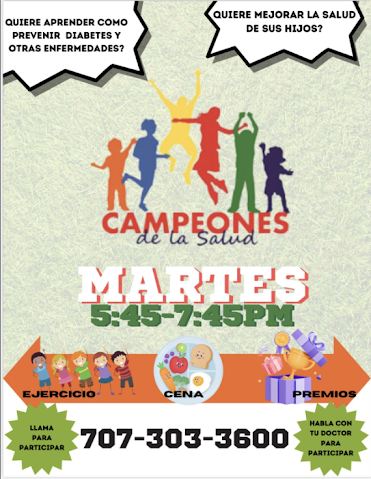
  • Campeones de Salud, a 6 week program run by SRCH for families to improve healthy eating and exercise (SRCH referral SA260 Dutton)
  • Center for Well-Being, which offers nutrition classes in English and Spanish (SRCH providers can refer via EpiC)
Connecting patients with food access resources, including:
  • WIC, a food supplementation program for pregnant women, post partum and breastfeeding, and children up to age 5.  
  • Ceres Community Project, free medically tailored meals for patients with chronic illness, including heart failure, cancer, and diabetes. 
  • Redwood Empire Food Bank, which comes to Vista Clinic every Monday from 11am-12pm. 
A poster with text and images of children jumping

Description automatically generated

Healing through Strengths, Movement, and Culture (Fleg, 1/10/2024)

 A recording of this presentation is available HERE.

***

Deep gratitude for today's Grand Rounds, an impactful presentation by Dr. Anthony Fleg from  University of New Mexico in Albuquerque, about changing the way we assess and treat patients by assessing for their strengths, rather than their deficits. 

I would say this is a presentation better watched and absorbed than summarized, but here are my notes for those of you who prefer them.

Dr. Fleg encouraged us from the beginning of his presentation to consider how we are trained in medicine to assess and manage patients by understanding their "problems" or "deficits" rather than to understand their strengths. 

To begin, he asked us to consider one of the patients we may have struggled to serve effectively in recent weeks and to list out their problems. After about a minute, he then asked us to list out this same patient's strengths. Once we were done with the exercise, he made us do a self-assessment.

  • What was our ratio of problems to strengths for our patient? (on average, he said, physicians are able to list 6 problems to 1 strength)
  • Did we have trouble thinking of strengths? It wouldn't be surprising, we aren't trained to look for them.
  • How might we care for our patients differently if we ask "what is right with you?" instead of always "what is wrong with you"?          
  • How can we possibly ask patients to use those strengths if we do not know what they are? 
  • How can we change even very complex medical situations into achievable goals for patients -- particularly for historically marginalized patients, e.g. BIPOC patients, but really for everyone?    

Dr. Fleg spoke about how social workers are trained to do something called "asset mapping" with their clients, which is exactly what it sounds like -- looking for people's strengths, even under challenging conditions. The idea is that, by understanding assets, we  empower people in communities to build on what they do well in order to improve their health. 

Take, for example, Dr. Fleg's wife's 95 year old Navajo grandfather, a traditional medicine man, who died of COVID early in the pandemic. This person, Grandad Bahe Manybeads, looked at from a traditional medical model -- a deficit perspective -- had many things stacked against him: low English proficiency, low educational attainment, minimal eye contact, hard to communicate with, doesn't share, geriatric. But what happens if we flip his deficits into strengths: he is Navajo speaking, culturally competent and highly educated in Navajo culture, a recognized community healer, humble and modest, stoic and strong, wise elder, a physical strong healer who still performs all night healing ceremonies well-into his nineties. How does that lens change how we treat his medical illness?


By not focusing on strengths, Dr. Fleg argues, we perpetuate racism, lose key chances to empower patients to heal from within, dehumanize patients and ourselves, and feed into our own burnout. Deep breath. Take that for consideration. Consider how focusing on patient strengths may actually feed you and sustain your practice.

***


Dr. Fleg ended his thought-provoking presentation on leading with strength on a reminder of  the decimation of the Indigenous people in California (from the state of CA court's website):

  • From 1840-1870, the California indigenous population decreased from 200,000 people>> 12,000 due to disease, removal and death. This was not accidental.
  • Even still, CA has the largest Native American population in the country (12% of all Native Americans in the US live in California)
    • Over 1/2 of California's indigenous people are descendants of those displaced due to mass relocation to urban centers (SF and LA)
  • Systematic oppression, codified by law:
    • Any Indian declared vagrant could be thrown in jail 
    • Indian children were allowed to be sold as slaves
    • Laws explicitly prohibited Indians from testifying in court against a white person
  • While there are currently >100 tribes recognized in CA, there are also tribes that were erased by federal policy. Be careful with each individual's identity and passing value judgements without understanding
In summary, while we may be medically proficient, we may also be culturally and historically deficient in understanding people's contexts. Be sure to consider be peoples contexts and make an effort each day to care for people, rather than treat patients.

I'll end on a state from Dr. Fleg that was particularly poignant for me: "We decolonize ourselves when we are strength-based and that is good for ourselves and for every single person we care for."

Inflammatory Bowel Disease (Memel, 8/19/26)

A recording of this presentation is available  HERE .