Showing posts with label climate change. Show all posts

Climate Change in Medicine (Murphy, 4/24/2024)

Thanks so much for a wonderful Grand Rounds this week -- a somber and thought provoking and hopeful presentation-- from SRFMR Alumnus Dr. Sarah Murphy on Climate Change in Medicine. A recording of the presentation can be found HERE

My notes:

Dr. Murphy began her presentation with the concept of Planetary Health and the question What if the planet were our patient? As family doctors, we can definitely all understand this question because anyone, really anyone, can be our patient, and the interconnectedness of the health of families and communities and our world are central to the work we do every day. 

Consider these thought-provoking statements about the relationship between human health, our planet's health, and health professionals' role:

  • “Human health and the health of our planet are inextricably linked, and our civilization depends on human health, flourishing natural systems, and the wise stewardship of natural resources.” (2015 Rockefeller Foundation-Lancet Commission on Planetary Health)
  • “Health professionals have an essential role in the achievement of planetary health: working across sectors to integrate policies that advance health and environmental sustainability, tackling health inequities, reducing the environmental impacts of health systems, and increasing the resilience of health systems and populations to environmental change.”
Climate change in 10 words, From Yale Program on Climate Change

Scientists agree.
It's real.
It's us.
It's bad.
. . . There's hope.

Climate change has a direct impact on human health across many different domains. Here are just a few concrete examples:
  1. Extreme heat>>dehydration, heat stress (particularly children, elders), MI/CVA, altered mental status, food insecurity, higher food costs, etc.
  2. Outdoor air quality>>smoke, high pollen counts, short and long-term health effects (including small and large particles that can cause acute disease, but also smaller particles that cross alveoli and can lead to long-term impacts on IQ, heart disease, obesity, etc. And then there's indoor air quality. . .
  3. Flooding>>rising sea levels, more intense precipitation, hurricanes, leading to displacement, water-borne diseases, drowning, etc.
  4. Vector born infection>>rising temperatures change the range of vectors, increasing Lyme disease distribution, mosquito-born illness (e.g. dengue) and increasing risk particularly for children, who are outside playing close to the earth often at dawn and dusk
  5. Food born infection>> toxic algae blooms, increase rates of campylobacter, cholera crypto. Increased diarrheal disease
  6. Mental health. Dr. Murphy introduced the idea of "eco-anxiety" or "eco-grief" that has three components: 1) acute or past physical ecological loss, 2) the loss of environmental knowledge and 3) anticipated future loss.
Ecological grief and anxiety
What kind of ecological grief do you see around you? What kind of climate change (aka eco-anxiety) do you personally experience or see in your clinical practice? How do we support patients in dealing with this kind of grief?

Participants at Grand Rounds shared their own grief and anxiety after the 2017 Tubb's wildfire, concerns about family lands destroyed by flooding in India, loss of salmon runs in Alaska. And more. We all have stories.

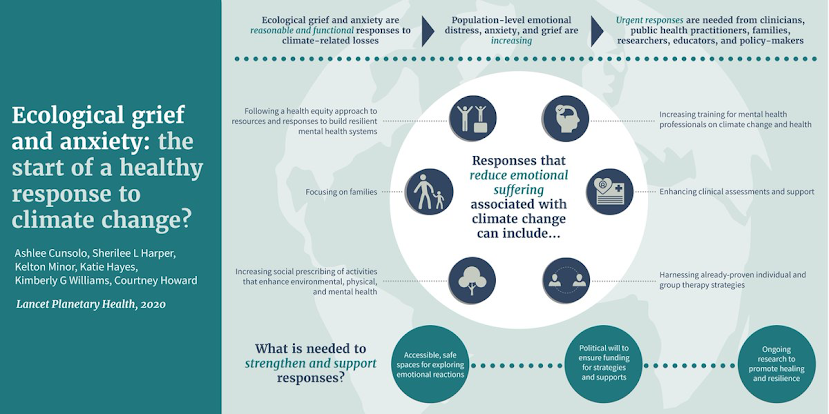
Graphic with text saying ecological grief and anxiety are reasonable and functional responses to climate-related losses, and that population level distress, anxiety and grief are increasing, thus urged responses are needed from clinicians, public health practitioners, families, researches, educators, and policy-makers. Responses that reduce emtotional suffering could include: 
Focus on Families
Increase social prescribing of activities that enhance physical, environmental and mental health
Use individual and group therapy strategies
Enhance clinical assessments/support
Increase training for mental health professionals on climate change and health
Follow a health equity approach to resources and responses.
Graphic from paper: Ecological grief and anxiety: the start of a healthy response to climate change?

Dr. Murphy urged us rather than think about these responses as pathological, perhaps we reframe them as reasonable and functional responses. The key is what do we do with these feelings? Do we acknowledge them in ourselves? Do we ask patients about them? Do we have outlets to build community and affect change driving by the need to respond to these emotions? 

Climate change, health disparities and inequities
Unsurprising to those of us who practice in the safety net, there is intersection between social determinants of health and social vulnerability. Our most vulnerable populations suffer the greatest health impacts of climate change. 


For more information, check out the CDC+UCSF Pediatric Environmental Toolkit available at:  https://www.atsdr.cdc.gov/emes/health_professionals/pediatrics.html

https://peht.ucsf.edu/index.php


There is a subset of the toolkit that focuses on environmental exposures linked to climate change and gives providers key information and good tips on anticipatory guidance in well-child checks

The healthcare system's direct impact on Planetary Health Don't forget that the healthcare industry, in general, and hospitals, specifically, contribute a tremendous amount of waste and greenhouse gases that only compound climate change. 8.5% of US total waste is healthcare sector waste. If healthcare were our own nation, we would rank 13th in greenhouse gas emissions. This also doesn't take into account supply chain waste, single use waste, water and sanitation issues.

And yet, even still there is hope.
Hope you say?
Yes.

Yet among this crisis we have an opportunity: Our best science tells us that the The severity of climate-related health risks is highly dependent on how well health systems can protect people.

With timely, proactive and effective adaptation many risks for human health and wellbeing can be reduced and some potentially avoided (very high confidence) 


Read this article from UW: Hope Health and the Climate Crisis (Frumkin, 2022). Frumkin tells s that hopeful people feel better, hope leads to action, and hope is empirically justified.
What can healthcare providers do?
  • We can vote with our wallet (spend money where it matters and buy things that are good for the planet)
  • OR Buy LESS (se second hand, repurporse)
  • Talk with patients about the health impact, their actions, and their eco-grief
  • Enjoy the outdoors -- having a relationship with our planet will help us protect our planet
  • Join a group that is doing advocacy

Take the examples of Dr. Plastic Picker (a Kaiser pediatrician in southern CA who is modeling beach cleanup and climate change action), Climate Health Now (Drs. McLure and Millstein, CA advocacy group) or anesthesiologists who are advocating to decresae their use of gases.

Looking for more resources. Here are a TON!!

Global Consortium on Climate and Health Education:
https://www.publichealth.columbia.edu/research/global-consortium-climate-and-health-education

Medical Society Consortium on Climate and Health
https://medsocietiesforclimatehealth.org/

Healthcare Without Harm Physician & Nurse Network
https://noharm-uscanada.org/HealthyClimate

Practice Greenhealth
https://practicegreenhealth.org/topics/climate-and-health/climate-and-health

Health Care Climate Challenge – for hospitals & health systems

Climate Resources for Health Educ - https://climatehealthed.org/

U of CO Climate & Health Program – diplomat/fellowship
https://medschool.cuanschutz.edu/climateandhealth

Citizens’ Climate Lobby
Project Drawdown: The World’s Leading Resource for Climate Solutions

Films/videos/books
Solving for Zero
Braiding Sweetgrass – Robin Wall Kimmerer
This Changes Everything - Documentary
Talking about Climate Change: https://ourclimateourfuture.org/video/secret-talking-climate-change/
Katharine Hayhoe TED Talk: The Most Important thing you can do about Climate Change? Talk about it!

Aftermath of the 2017 Wildfires: WHAT-now-CA* Study Results on Needs, Respiratory Health, and Mental Health (Hertz-Picciotto, 11/3/2020)

Great thanks to Dr. Irva Hertz-Picciotto and graduate student in public health, Diego Rivera, from UC Davis' Environmental Health Sciences Core Center for their update this week on the WHAT-now-CA* StudyAftermath of the 2017 Wildfires. 

Their research team is following a cohort of people who lived through the Northern California fires of 2017 (including Tubbs, Nuns, Atlas, and Redwood Valley fires). They are studying both the short and long-term health impacts of these fires. The study features data from several counties, but the bulk of participants in their cohort are from Sonoma County.

Diego Rivera presented data on physical and mental health needs in 2018 and 2019, and Dr. Hertz-Picciotto presented health impact data, including respiratory and mental health, from year 1 (2018). 

(By Phoenix7777 - Own workData source: VIIRS-AF Active Fire Detections for CONUS - 10/07/2017 through 10/14/2017 0200 MDT)
For many of us who lived through the 2017 fires and the ensuing years of smoke, fire and more evacuations, the study findings are not terribly surprising: greatest reported needs in year 1 (2018) included: clean air, clean up, insurance help, finding housing, and help with refurnishing homes

  • greatest reported needs in year 2 (2019) included: mental health, improved health, clean air
  • people with underlying pulmonary issues experienced increased respiratory symptoms after fire and smoke exposure; some with no underlying lung disease also had respiratory symptoms
  • mental health needs increased after the first year's needs (e.g. housing, clean up, insurance issues) were addressed.

Mental Health Impacts of Fire 

There is a paucity of literature on the impact of wildfires on mental health, but a few studies that have been reported recently from fires in Canada and Australia have found high rates of PTSD in the early months following a fire event, as well as high rates of generalized anxiety and depression.

In the WHAT-now-CA study, adults and children are asked to report rates of agitated behavior, anxiety and stress, depressed moods, difficulty concentrating, loss of appetite, trouble sleeping/nightmares, as well as substance use (including alcohol, smoking, vaping). 

Dr. Hertz-Picciotto's team found high rates of all of the above symptoms in fire survivors, extra high rates of anxiety and stress and trouble sleeping/nightmares in children. They also have found a very strong correspondence between an adult in the home having mental health symptoms and children having these symptoms. Mental health symptoms were more frequent in children ages 12-17 than younger children, also more frequent for those who have experienced multiple evacuations, and those whose home was destroyed. 

I look forward to seeing ongoing data collection from Dr. Hertz-Picciotto--  perhaps if we can have concrete data demonstrating the long-term physical and mental health impacts of these fires on our community, we can actually help to do something about them. . . and eventually heal.

Be safe all, the rains are close.


(*Wildfires and Health-Assessing the Toll in Northern California)


Diagnosis and Management of Osteoporosis (Hamann 7/23/2026)

 A recording of this presentation is available HERE .  *** Thanks so much to Dr. Kendal Hamann, SMGR Endocrinologist, for an outstanding Gra...