Showing posts with label training. Show all posts

Slow Medicine: finding the balance between knowledge, care and humanity (Paul Nguyen, 3/4/26)

A recording of this presentation is available HERE.


Many thanks to Dr. Paul Nguyen, who gave a moving and important Grand Rounds this week, which he entitled "Slow Medicine: Reflections from a 3rd year resident". What was so compelling about his presentation was how he brought us back to the basics of why most of us came to family medicine in the first place and wove in his reflections on where the rub occurs, and how we might approach it to make it better for patients and for us.

I particularly appreciated his inclusion of two Vietnamese proverbs, which I will leave here for your consideration:


Translation: You only know you're hungry after eating.

Meaning: You may only understand the importance of something once you have experienced it yourself.


Translation: Keep grinding the metal, one day it will turn into a needle.

Meaning: If you keep putting in the hard work, you may wind up with something beautiful and useful

In between these two beautiful proverbs, Dr. Nguyen introduced us to Victoria Sweet's book, Slow Medicine (if you haven't read it, both he and I highly recommend it!) and highlighted some of the core tenets she promotes in her book:

1) Gevuld (Dutch for "stuffed"), in the contest of medicine the idea that wounds can literally fill themselves in, that the body knows how to repair itself, that illness is not always an enemy to defeat. In this model, physicians are stewards of processes, not commanders of outcomes. 

2) Slow passive: medicine doesn't always require an intervention, time itself may heal. Sometimes the best intervention isn't doing more-- it's doing less. Not ignoring or neglecting but allowing the body's processes to work. 

3) Observation: observation is itself an active clinical skill, paying attention matters, and watching the body heal itself may be our only duty. Tolerating uncertainty is another part of our job. 

I particularly appreciated this slide from Dr. Nguyen, summarizing Sweet's argument and contrasting "fast medicine" (how we do things) to slow medicine (how he wants us to consider doing them):


In this section, he talked about the contrast of metrics vs. meaning, of productivity vs. presence and shared some of the data regarding burnout in the primary care workforce as well as patient perceptions of being held/cared for based on time spent with them. 

And for those of us who have been through residency and/or are witness to our residents going through residents in this era, we can related to these tensions, the feeling of not having enough time to sit with patients BUT wanting nothing more than to have the time to do so. The feeling of data overwhelm without a true understanding of the patient's lived experience.

Dr. Nguyen shared with us two meaningful patient experiences he has had during his residency training-- one that ended with a peaceful death, the other that left a patient without a diagnosis but getting better (who knows why? perhaps it was the time he spent with her?).

And, finally, some wisdom for his juniors and colleagues:


Reflection and Connection: Surviving Residency and the Start of Personal and Professional Development Groups (Addison, 1/29/25)

See a recording of this session HERE

Many thanks to Dr. Ritch Addison, long time behavioral health faculty and foundation layer for our Personal and Professional Development (P&PD) Groups that still run every Thursday at Santa Rosa Family Medicine Residency. 

He spent his time with us on Wednesday morning reflecting on the experience of residency training: the constant pressure, the feeling of never enough time, too much to do with the time, dying patients, asking for help vs. not asking for help, learning the ropes and the conflict and contradiction of ideals/values and visions with every day practices. 


I cannot do his 40+ years of wisdom justice with a summary here (just watch the recording), but I do want to highlight and remind us of his model for Surviving Residency:

1) Covering over> the focus on mastering the procedures of medicine, which requires putting on blinders so that you can do what you have to do to get through your day/rotation/year/training.

2) Over reflecting>> too many reflections, filled with painful self-doubt, feelings of imposter syndrome, Did I make the right choice?

And, as Ritch stressed, neither state is stable. In fact, it's the jarring motion between the two modes that is what is so challenging in residency. "You need time to unload one experience and load the next, and you just don't have time". 


The answer? Ritch says, is connection. A place where you can do just this -- unload the conflictual and unconscious feelings, take a step outside those jarring moments>> P&PD. 

Neurodiversity in Medical Education (Biradar, 9/4/2024)

Deep gratitude this week to Dr. Sony Biradar for a thought-provoking Grand Rounds presentation on Neurodiversity in Medical Education. It was one of those presentations that sticks with you all day, makes you wonder if maybe you've been thinking about things incorrectly for a long time. I recommend watching the recording if you or someone you love identifies as neurodivergent OR if you work with or supervise someone who does.

A link to the recording will be available HERE.

Here are some key take homes:

  • Neurotypical describes someone whose cognition is aligned with societal norms, i.e. whose brain functions are considered usual or expected by society.
  • Neurodivergence describes someone whose cognition and processing are different than "the societal norm".
  • Some neurodivergent people have an associated diagnosis (e.g. ADHD, autism), but not all.
  • 15-20% of the population is neurodivergent 
  • Neurodivergent people suffer high rates of unemployment, have disproportionate rates of anxiety, depression and risk of suicide
Dr. Biradar spent a fair amount of time talking about the idea of disability as a social construct -- first, that neurodivergence has long existed in society and may even have some developmental benefits that has ensured its persistence. In the medical model of disability (one which we are all a part of), impairments that affect one's quality of life need to be "fixed". In contrast, in the social model of disability, conditions are themselves not a disability, it is societal structures that make them disabling. 

The prevalence of neurodiversity in medical training has not been well-studied, nor has the experience of students and trainees. Dr. Biradar posits that certain adaptive behaviors/challenges may be heightened in neurodivergent trainees:
  • masking: trying to hide one's neurodivergence may lead to increased exhaustion, higher rates of burnout, and even increased suicidality
  • hidden curriculum (socialization that happens for trainees when what they see differs from what is said/what they are taught)
  • imposter syndrome: may be increased for neurodivergent trainees
  • double empathy: a type of stereotype threat. . .
  • otherness: when trainees feel different from the norm, this may impact their ability to learn and perform
Dr. Biradar talked about how the process of moving through residency training-- acquiring knowledge and skills from attendings -- may simply be more challenging for neurodivergent trainees simply because the way they work/think is, by definition, different from the "medical norm". 

Residency training is known to be intense, overwhelming, and stressful. The inputs are numerous.
Experiencing this level of stress as a neurodivergent learner may be particularly overwhelming. Don't forget intersectionality,  Dr. Biradar cautions, for we know that other identities (namely BIPOC learners already experience these 

What can we do? How do we support neurodivergent learners? 

Start with being strength-based, says Dr. Biradar. Look for ways to help learners demonstrate their strengths, do not just focus on their deficits. Also, consider the theory of multiple intelligences-- different ways that learners learn and acquire new information (oral, visual, audio, reading, etc). Offer multiple options.  Promote psychological safety in your learning environment, as well as mentorship. Also encourage and promote increased neurodiversity in leadership and encourage community

Finally, consider the concept of compassionate pedagogy, asks us to be critical of institutional and cultural practices in medical training.  Compassionate pedagogy is a collection of teaching practices designed to foster human connection, communication, and wellbeing. The approach revolves around listening to students’ lived experiences and offering flexibility to accommodate their struggles. If we want our students to learn well, we need to honor the often imperfect way they show up. 
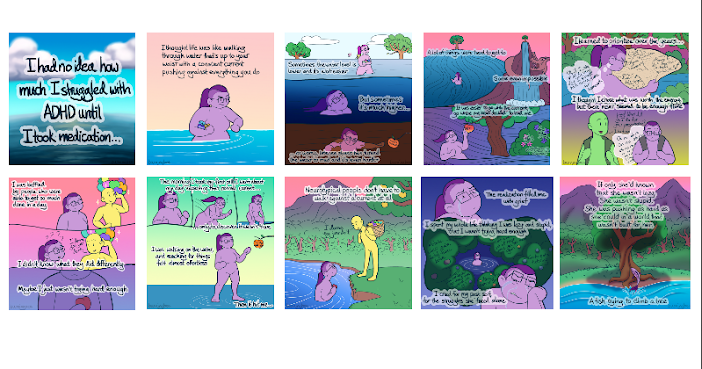
Dr. Biradar closed her presentation with the comic below, which captures some of the challenges of neurodivergent learners -- and the potential benefit of medication treatment for some conditions (in this case ADHD). 
References:

AoME Insights Embracing Neurodiversity in our Healthcare Educators 29 March 2023. (2023). Academy of Medical Educators.
https://www.youtube.com/watch?v=Ugx2WjkKvSI

Duong D, Vogel L. Untapped potential: embracing neurodiversity in medicine. CMAJ. 2022 Jul 18;194(27):E951-E952. doi:
10.1503/cmaj.1096006. PMID: 35851534; PMCID: PMC9299741.

Fung, L.K. & Doyle, N. (2021). Neurodiversity. The new diversity. In: Neurodiversity. From Phenomenology to Neurobiology and
Enhancing Technologies.

Goldberg H. Unraveling Neurodiversity: Insights from Neuroscientific Perspectives. Encyclopedia. 2023; 3(3):972-980.
https://doi.org/10.3390/encyclopedia3030070

Hamilton LG, Petty S. Compassionate pedagogy for neurodiversity in higher education: A conceptual analysis. Front Psychol. 2023 Feb
16;14:1093290. doi: 10.3389/fpsyg.2023.1093290. Erratum in: Front Psychol. 2024 Feb 20;14:1345256. doi:
10.3389/fpsyg.2023.1345256. PMID: 36874864; PMCID: PMC9978378.

Robinson D. Neurodiversity in medical education: How can we improve postgraduate learning for neurodiverse doctors? Med Teach.
2022 May;44(5):564-566. doi: 10.1080/0142159X.2022.2039383. Epub 2022 Mar 2. PMID: 35236237.

Shaw SCK, Fossi A, Carravallah LA, Rabenstein K, Ross W, Doherty M. The experiences of autistic doctors: a cross-sectional study.
Front Psychiatry. 2023 Jul 18;14:1160994. doi: 10.3389/fpsyt.2023.1160994. PMID: 37533891; PMCID: PMC10393275.

Syharat CM, Hain A, Zaghi AE, Gabriel R, Berdanier CGP. Experiences of neurodivergent students in graduate STEM programs. Front
Psychol. 2023 Jun 15;14:1149068. doi: 10.3389/fpsyg.2023.1149068. PMID: 37397290; PMCID: PMC10311419.

Taylor G. Editorial: Embracing neurodiversity in medicine. Aust J Gen Pract. 2021 Mar;50(3):101. doi: 10.31128/AJGP-03-21-1234e.
PMID: 33634273.


Diagnosis and Management of Osteoporosis (Hamann 7/23/2026)

 A recording of this presentation is available HERE .  *** Thanks so much to Dr. Kendal Hamann, SMGR Endocrinologist, for an outstanding Gra...