Showing posts with label inequality. Show all posts

Thriving or Surviving: The Connection Between Chronic Stress, Chronic Disease, and Social Determinants of Health (Deol - 9/6/23)

 A recording of this presentation can be viewed HERE

***

Thank you to Dr. Navi Deol, PGY3, who gave an excellent presentation this week titled Thriving or Surviving: the intersection between chronic stress, chronic disease, and the social determinants of health. Each of the items in the subtitle is a HUGE topic, and Dr. Deol was able to weave them together beautifully and powerfully. I encourage you to watch yourself.

Image from https://www.glasbergen.com/stress-management-cartoons/cartoons/page/3

If you prefer the written word, see my notes:

  • stress: how certain stimuli (stressors) affect a person's mind, body and spirit
  • stress response: how our body reacts normal, a normal physiologic and psychologic response to stressors
  • some stressors evoke positive emotions and can be beneficial (eustress); some evoke negative emotions and cause problems (distress)
A certain amount of stress is important and necessary to generate optimum productivity and performance, but too much stress can lead to anxiety, overload, and burnout (see image below of the Yerke's-Dodson Law).
Yerke's-Dodson Law, image fromhttps://stock.adobe.com/

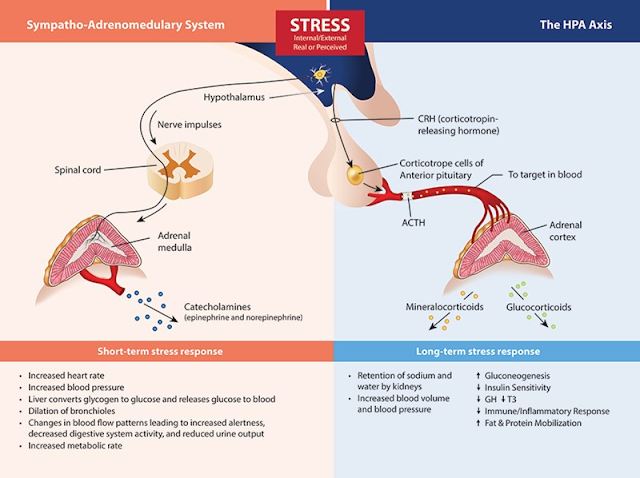
Stress causes physiologic changes in our bodies. We are all familiar with the autonomic nervous system, which responds to acute stress with the sympathetic "fight or flight" and the balancing parasympathetic "rest and digest", but what happens when the stress response is constantly being activated? 

Image from: https://www.backtothebooknutrition.com/adrenal-fatigue-hpa-axis-dysregulation/


The answer is that our long-term stress response leads to a cascade of responses that make us more vulnerable to chronic diseases.

A 2019 study published in the Journal of ACC looked at the link between SES factors such as low income and higher crime on MACEs (cardiac death, myocardial infarction, unstable angina, cerebrovascular accident, peripheral artery disease with revascularization, or heart failure). This study suggests that a biological pathway contributes to this link, involving, in series, higher amygdala activation, increased activation of the bone marrow (with release of inflammatory cells), which in turn leads to increased atherosclerotic inflammation and its atherothrombotic manifestations


Patients were categorized according to quartiles of their neighborhood median income and neighborhood crime rates.  Amygdalar activity (A) and arterial inflammation (B) were lower as neighborhood median income increased. Amygdalar activity was higher (C) and arterial inflammation trended toward an increase (D) as neighborhood crime rate increased. One image from that study is seen below. For more information, click the link above or see the study link below the image.

https://www.jacc.org/doi/10.1016/j.jacc.2019.04.042


Chronic diseases are non-communicable illnesses that persist for long periods of time and result from a combination of genetic, environmental, and psychological factors. These include cardiovascular disease (e.g. hypertension, coronary artery disease, and strokes), metabolic disorders (e.g. type 2 diabetes and obesity), mental health issues (e.g. depression, generalized anxiety disorder), and substance use disorders.

We know that inflammatory cascades play an important (and damaging role) in the onset and progression of chronic disease. While acute inflammation is technically "good" for us because it cleans up disease states in our body, chronic inflammation is bad bad bad.

Financial stress

Are you aware that money (finances and inflation) is a tremendous source of chronic stress for a shocking number of US adults. A 2022 survey found that 57% of US adults reported not having enough money to pay for essential items; 43% reported that they are not saving enough, and 56% had to make different choices due to their lack of money. 

Violent stress

Mass shootings, gun violence, and crime are also sources of tremendous chronic stress, particularly for people living in poverty and disproportionately for BIPOC people. 

Social Determinants

This leads us directly into a discussion of the importance of the Social determinants of health (SDOH), the conditions into which individuals are born, grow, live, work and age. There is an unsurprising link between chronic stress and the SDOH. These include your neighborhood and built environment, healthcare, education, economic stability, and social and community context. 

image from Healthy People 2030

If this is news to you, check out this video about how zip codes influences an individual's health: A Tale of Two Zip codes.

And for something even closer to home, check our our local Sonoma County data on how the SDOH vary based on zip code in the report titled A Portrait of Sonoma County 2021 Update, available here:  https://upstreaminvestments.org/impact-make-a-change/portrait-of-sonoma-county

https://upstreaminvestments.org/impact-make-a-change/portrait-of-sonoma-county


What can we do about all this stress?
Dr. Deol encouraged us to take a deep breath and realize that we cannot tackle these complex issues alone. First, we must acknowledge the deep-rooted history of structural and systemic racism, oppression, and discrimination that have led to health inequities that require interventions at multiple levels to reduce disparities. 

When caring for individuals, we should be careful about using the term "non-compliance" and better recognize the daily barriers our patients face due to their own SDOH. In our communities, we should be screening for SDOH and get to know and refer to appropriate community services. And at the state level, she encouraged us to support CAFP Bill AB85, which requires SDOH screening and provides resources and education for providers in referring to community health workers. 

More information for AB85 can be found HERE


What Language do you Prefer: Care of Patients with Limited English Proficiency (Jordan, 11/2020)

Limited English Proficiency (LEP) refers to anyone above the age of 5 who reported speaking English less than “very well,” as classified by the U.S. Census Bureau. Though most LEP individuals are immigrants, nearly 19 percent (4.7 million) were born in the United States, most to immigrant parents

            The US Department of HHS  defines LEP as “individuals who do not speak English as their primary language and who have a limited ability to read, write, speak, or understand English.”


  • Overall, the LEP population represents about 8% of the total US population ages 5 and older.

  • Between 1990 and 2013, the LEP population grew 80% from 14 million to 25.1 million.

  • California has a high proportion of people with LEP, almost 20%

  • Sonoma County is higher than the national average, at 10.5-11.5%. The overwhelming majority of people with LEP in SoCo speak Spanish.

Medical interpreters are trained to interpret the spoken word, whereas translators work with written words. Although the two professions are often confused, they require different skill sets, with interpreters working in live situations.


Professional Medical Interpreter: An individual who has been assessed for professional skills, demonstrates a high level of proficiency in at least two languages and has the appropriate training and experience to interpret with skill and accuracy (certification varies).

A bilingual individual is a person who has some degree of proficiency in two languages. A high level of bilingualism is the most basic of the qualifications of a competent interpreter, but by itself does not ensure the ability to interpret. A bilingual employee may provide direct services in both languages but, without additional training, is not qualified to serve as an interpreter.

LEP impacts health.

  • Lower likelihood of having a regular source of care
  • Lower rates of preventive services (mammogram, colonoscopy, paps)
  • Less likely to receive standard care for chronic medical illnesses
  • Increased rates of medication complications
  • Higher acuity of illness at presentation to the hospital
  • Longer length of hospital stay
Medical Interpretation impacts health. 
  • Access to medical interpretation improves patient experience
  • Patients who need but do not get interpreters have a poor self-reported understanding of their diagnosis and treatment plan and frequently wish their provider had explained things better
  • Ad hoc interpreters
    •     misinterpret or omit up to half of all physicians’ questions
    •     are more likely to commit errors with potential clinical consequences
    •     have a higher risk of not mentioning medication side effects
    •     ignore embarrassing issues (esp when children are interpreting)

Who are our patients at SSRRH?
  • 13.8% of ALL patients prefer a language other than English
  • 12.6% of ALL patients prefer Spanish
  • In addition to Spanish, languages include Vietnamese, Khmer (Cambodian), Tigrinya, Laotian and Mandarin
How are we doing on interpreter use?
  • In 2020, 88% of minutes used were Spanish
  • 5.7% American Sign Language (ASL), 2% Cambodian, 2% Lao
  • Some departments in the hospital use interpreters more than others. Specifically L&D has increased their use of interpreters over the last year due to intensive interdepartmental work and the placement of an interpreter device in every room.
  • ED and Women's Services also have high number of minutes
That being said, our documented of use of interpreters is pretty depressing.
See graphic below which shows which percentage of patients with LEP have documented use of interpreter at least ONE time on their chart.
Some questions to ponder with regards to interpreters:
  • Identification of language preference: How should we ask? How do we document that we asked? How do we not miss this? 

  • Ad hoc Interpreter: When is it appropriate to use a family member as interpreter? Who decides? How can we best use family?

  • Medical error and/or adverse outcome: Who is responsible for communicating medical error or bad outcomes? How should that be done for LEP patients?

  • Family Meetings, Family with mixed language status: How should complex conversations with interdisciplinary teams  and multiple family members be conducted? When should bilingual staff be used vs. VRI vs. both?

We need to cultivate the expectation that we use the interpreter just like we use hand sanitizer. Every. Single. Time.


Single Payer Health Care (Duncan, 9/9/2020)

Great thanks to Dr. Parker Duncan who gave a passionate presentation on Single Payer Health Care on his very own birthday! Dr. Duncan started with three foundational premises (which he called his disclosures). The beliefs that:

1) Health care is a human right.

2) The barriers to achieving single payer health care in the US are rooted in struggles with racism and inequality (not simply the money).

3) Thus, before health care for all, first make sure Black Lives Matter.

Dr. Duncan also introduced us to the three phases of A Road Map to Golden State Care,  a comprehensive plan written by the California Physician's Alliance (CaPA), which lays out strategic steps to get California to universal coverage and an equitable health care system. 

Phase 1 involves a focus on cost control measures (making the state the sole prescription drug/DME purchaser as well as creating an all payer claims database), establishing something called the Golden State Care and Trust Fund (GSCTF), and improving Medi-Cal, which is already California's largest insurer.

Phase II creates a Medi-Cal buy-in via Covered California (a public option) as well as all-payer rate setting via Golden State Care.

and

Phase III involves transitioning to a true GSCTF which includes a 95/5% mandate (that is 5% cap on administrative spending) vs. non-profit insurance managers

An info-graphic of the strategic plan is seen below. The road map, published in 2019, can be found here in its entirety. 

Road Map To Golden State Care - CA Physicans Alliance

Dr. Duncan shared some of the current bills that have passed and/or are moving through CA legislature-- essentially incrementally changing our system. These include SB-104 (signed into law 7/2019), which expanded Medi-Cal to undocumented adults ages 19-25 "who are otherwise eligible for these benefits but for their immigration status", expanded pregnancy Medi-Cal for maternal mental health conditions, and established the founding of a Health CA for all Coalition.

There are other bills making their way through the CA Legislature including cost containment bills and additional bills to expand Medi-Cal to undocumented seniors. For more information on legislative issues. Dr Duncan recommends you go to this resource: Health Access, California's Health Consumer Advocacy Coalition

Also, consider signing up for daily emails with health policy updates here: PNHP Qote of the Day, written by Dr. Don McCanne. 

Another excellent health policy resource that is politically neutral and very well researched and reported is the Kaiser Family Foundation

COVID-19 and Medicare for All - PNHP

Mental Health Disparities in Latinx (Flores, 7/29/2020)

A big thanks to CEDAWG and Dr. Yvette Flores, clinical psychologist and professor of Chicano/a studies at UC Davis, who gave a powerful and heartfelt Grand Rounds presentation this week on how to consider and approach the mental health of marginalized groups, particularly Latinx , in this time of COVID. Again, it is hard for me to give her words justice in summary, but the following is my attempt.

Dr. Flores started with "stating the obvious": 1) That racism, sexism, homophobia and other forms of discrimination affect the mental health of those who experience them, 2) That stress affects well-being and 3) That yes, in fact, we are all in this together.

If I don't wear a mask, I affect you.
If my grandchildren don't wear a mask, it affects me.
We are all a little anxious, depressed, and experiencing past traumas as we live this pandemic.
We all need to be in this together, including in mental health.

Dr. Flores spent some time reviewing the important effects of stress on mental health.

Social stress: stress is produced not only by personal events but also by the social conditions that surround us-- and for all our patients, their intersectional identities (gender, class, nativity, immigration status, length of residence in the US). 

Minority stress: high levels of stress faced by members of stigmatized minority groups (race, gender, sexuality, linguistic ability, physical/mental abilities), including:
  • lacking proper social supports
  • socioeconomic status (SES)
  • interpersonal discrimination
Marginalized status affects physical and mental health.

Good stress vs. bad stress: a little stress has been found to improve performance, but a lot of stress can become problematic. In what ways is minority stress a risk factor? And how may minority stress also be a protective factor?

I love considering the possibility that the very minority stress our patients are experiencing may make them simultaneously vulnerable and resilient. 

What has COVID-19 Revealed?
1) Health disparities have been made more visible
2) Xenophobia and hate crimes against Asian Americans
3) Disregard for these disparities from politicians at the highest levels
4) People of color disproportionately work in front line jobs
5) Disproportionate unemployment rates for Latinx and African Americans
6) Ageism (are old people important enough?)

How can we translate scientific data in a way that people can understand?
How do we frame the message?

"There is no one to blame here, but we all have responsibility."

Role of Gender: For the working class, life and work are often synonymous. How does unemployment affect men? How does unemployment impact women who are single parents and have to work? People of  color will often go to work despite the risk because of their gender or cultural mandate that it is their obligation to provide. But this is also a class issue (always need to think intersectionally).

What are the protective factors in communities of color that might mitigate the crisis?
  1. Resilience: Immigrants are tremendously resilient. It takes incredible courage to make the journey that many immigrants (particularly undocumented immigrants) make.
  2. Stoicism:  coping, "it's alright, I am fine", challenging for healthcare professionals to care for someone who says they are fine (when they clearly aren't). Dr. Flores' rec: Bring in partner if there is one/
  3. Religious faith: "Si Dios quiere" God willing. Can be frustrating because seems fatalistic but is also protective. How can we leverage this?
  4. Networks of support:  Overcrowded and/or Multi-generational households, which make them more vulnerable are also the very support structures that allow people to survive. How do we mobilize the 
  5. Positive ethnic, racial and gender identity: reaffirm their identification (whatever they may be). Call them what they want us to call them. 

Remember that mediational factors may ADD to minority stress
  • Internalized racism
  • Controlling images (often propagated in the media-- more serious and perverse than stereotypes), many are gender specific (angry black woman, loud Latino, Latino male as criminal or rapist). How does this affect internalized perception of people of color?  How are people in power speaking about these controlling images?
  • We must uphold the identities of the people with whom we work: we need to counter these controlling images (mental health workers)

And finally, on coping: how to potentiate coping, so we can be better healthcare providers and caretakers. 

Dr. Flores called this digging into our ancestral well: we have all learned lessons from our family that can help us to serve our patients. In times of crises, we can draw from the stories/legacies that the elders and ancestors have shared with us (and with each of our patients), which can help transform our fears into opportunities

Where do you draw your strength to continue to care for your patients?

Self care is essential during COVID-19:
It is important for us to promote self-care and resilience as we do this work.
Gendered expectations (nurture ourselves in order to refill the well)
Remember to check out and disconnect in order to connect to ourselves 
Cultural traditions can offer balancing and healing: including prayers, smudging, meditation, mindfulness, exercise, baking, cooking

Preparing for Passover during a Plague:

Health Equity (Muodeme, 7/23/2020)

Special thanks to Dr. Ada Muodeme for her thoughtful and thought-provoking Grand Rounds this week on Health Equity. 

A friend and healthcare provider asked me this week, "Why are you hosting  so many Grand Rounds on race, racism, equity, and inequity?" My response is the following: "We bring you these topics because we-- the Sonoma County medical community-- need formal education on these topics. We need race discussions in our academic centers, in our hospitals, in our clinics, in our classrooms, break rooms and beyond. Grand Rounds is a natural place to start these conversations."  

And I am so grateful to our brave residents for being the leaders of this education!

While social justice was definitely integrated into my own medical training, race and racism in medicine were definitely not a part of any training. I did not get taught about how race and racism are structurally a part of medicine. I was not trained on allyship, anti-racism or white privilege. These are topics most white people (myself included) need to hear, read about, grapple with, and consider both personally and professionally. While many of our current residents come to us now with formal training in race and medicine, their teachers have little to none. 

And so we do this work.

This is another GR presentation by a BIPOC better listened-to than summarized by a white gal like me, but here are a few key points:
  • Dr. Muodeme reminded us that healthcare comprises only 10% of an individual's health and well-being-- the remaining 90% includes behaviors, environment, societal factors, etc. She grounded her talk in the historical perspective of the African American citizenship status and health experience from 1616 to 2020-- slavery, Jim Crow, and Civil Rights. 
  • Dr. Muodeme also shared with us a definition of health equity: "The attainment of the highest level of health for all people". Health equity-- she continued-- requires valuing everyone equally, societal efforts to address avoidable inequities and injustices, and the elimination of health and healthcare disparities.
  • But what I appreciated most about Dr. Muodeme's presentation was her focus on the concept of unconscious bias, and the process of self-reflection and self work we all need to do to help mitigate those biases. "I don't know a doctor who comes to work thinking I don't want to right by my patients today," she said. "I don't know a doctor who thinks I am going to treat my black patients differently". And yet, we know we do. The system does. And we do. 

And so, pay attention, watch your thoughts, all. And see you next week!

Watch your thoughts; for they become words. Watch your words; for ...


Allies and Accomplices: How Health Care Providers Can Cultivate Equity (Washington 7/15/2020)

Well, Dr. Sharon Washington did it again. And this time on Zoom (which is no easy task). She pushed us. And moved us. To think differently. To act. To do better. To question the insidiousness of race and racism embedded in our society and in medicine. To not be not racist, but rather to be ANTI-racist. She is such a tremendous speaker and incredible teacher, and we at the Santa Rosa Family Medicine Residency are so lucky to have had her with us this last year and a half. 

A summary cannot really do Dr. Washington's work and words justice. I highly recommend you watch the Grand Rounds if you did not attend live, but nevertheless, here are some highlights. . .

Racism is not merely one individual's negative thoughts about another person of a different race. Racism is more layered and complex. It includes:
  • internalized: the devaluing of one's own identity and culture according to societal norms
  • interpersonal: the way in which we perpetuate racism on an individual basis
  • institutionalized: the way in which institutions perpetuate racism
  • structural: system of public policies, institutional practices, cultural representations, and other norms work in various, often reinforcing ways, to perpetuate racial group inequity
Dr. Washington highlighted the legacy of inequity for African Americans in the US dating back 401 years (see image)

Dr. Washington reminded us that:
  • There is racial bias built into almost every aspect of healthcare.
  • Significant health disparities exist for people of color in chronic disease (diabetes, cancer, heart and kidney disease), infant and maternal mortality, stroke, addiction and mental illness.
  • People of color receive fewer/less breast cancer screenings, kidney transplants, vaccinations, eye exams cardiac care, cancer pain meds, revascularization procedures, and mental health treatment.
In order to not be part of the problem, health care providers have a responsibility to be ANTI-racist: the active process of identifying and eliminating racism by changing systems, organizational structures, policies and practices, and attitudes so that power is redistributed and shared equitably.


What is allyship? 
Allyship is a person of one identity group standing in support of another identity group 
  • allyship is not a noun, it's an action
  • allyship is about listening
  • allyship is not a proclaimed identity--> trust is earned
  • allies don't take breaks
  • allies educate themselves (and don't expect marginalized people should teach you)
  • allies don't need the spotlight
  • allies focus on those who share their identity
  • when criticized or called out, allies listen, apologize, act accountable, and act differently going forward
What is an accomplice? 
"While an ally will mostly engage in activism by standing with an individual in a marginalized community. An accomplice will focus on dismantling the structures that oppress that individual or group-- and such work will be directed by the stakeholders in the marginalized group" (Teaching Tolerance)
  • accomplices assess an organization for inequities in hiring, promotion, pay, evaluation, termination, etc
  • accomplices encourage major institutions benefiting from inequities to invest in marginalized communities
  • accomplices engage in anti-racist assessment of laws, policies, institutions, and systems
  • accomplices divest institutions from (private) prisons, detention centers, and institutions engaged in systems harmful to BIPOC
  • accomplices promote self care for BIPOC
  • accomplices create systems of accountability for supporting hate speech and behavior

Examples of what allies and accomplices can do in medicine:
  • Petition the laboratory you use to stop reporting GFR differentiated by race
  • Hold a fellow physician accountable if they send a racist email or make a racist comment
  • Interrupt micro-aggressions when they are happening
  • Don't vote to appoint someone to the board unless they divest from investments that perpetuate racist structures
  • Pass the microphone to the marginalized person next to you whose voice is not often heard
Questions to ask yourself:
  • In what ways can you be an ally?
  • In what ways can you be an accomplice?
  • In which institutions do you have agency to create structural change?
  • What is holding you back from taking action?
  • What commitment can you make to move you toward meaningful action?

Diagnosis and Management of Osteoporosis (Hamann 7/23/2026)

 A recording of this presentation is available HERE .  *** Thanks so much to Dr. Kendal Hamann, SMGR Endocrinologist, for an outstanding Gra...