Showing posts with label genetic screening. Show all posts

Prenatal Genetic Screening (Mullin, 4/10/2024)

 A recording of this presentation is available HERE

***

Many thanks to Dr. Briga Mullin for an excellent presentation this week on Prenatal Genetic Testing. Dr. Mullin reminded us from the get go -- that all patients have the right to accept or decline testing after counseling. Then she proceeded to update us on current prenatal genetic screening recommendations available to prenatal care providers and to pregnant patients. 

This topic is ever-changing, as genetic screening tools become increasingly sophisticated. If you want to watch the entire presentation, please see the link above. Here are my notes.

It is important to make the distinction for patients and ourselves between SCREENING and DIAGNOSTIC tests. As we know, screening tests are those designed to "pick up" disease in patients who are otherwise well-appearing; in the case of prenatal genetic screening, they are designed to assess a pregnancy for the risk of certain congenital conditions. Diagnostic tests are designed to confirm a specific diagnosis. 

In the world of prenatal genetic testing, current screening tests available to pregnant patients include: carriers testing, cell free DNA (cfDNA), AFP, early 1st tri and 2nd trimester ultrasound. The two currently available prenatal diagnostic tests are chorionic villous sampling -- CVS-- (10-13 weeks) and amniocentesis (>15 weeks).

Carrier Screening

Carrier screening looks for autosomal recessive and x-linked conditions in maternal DNA.  There is a huge range of options for carrier testing -- patients can be tested for up to 400 conditions, depending on the assay. ACOG currently recommends universal carrier screening for three conditions: 1) spinal muscular atrophy (SMA), 2) cystic fibrosis (CF), and 3) hemoglobinopathies. ACOG additionally recommends carrier screening for specific populations: Fragile X if a family history of intellectual disabilities and Tay Sachs disease for people who identify as Ashkenazi Jews, French Canadians and people of Cajun descent.

Sutter/CPMC currently offers a 112 gene expanded carrier screening panel (called "Horizon" by Natera). In contrast, SRCH -- via Quest labs -- offers a 3-condition carrier panel, which includes CF, Fragile X and SMA. 

Of note, it is only necessary to screen maternal serum once in a lifetime, ideally before pregnancy. If a patient screens positive for any of these conditions, the partner should be offered carrier testing as a follow-up. If BOTH parents screen positive, diagnostic testing via CVS, amniocentesis or even IVF with embryo testing are options.

Cell Free DNA (cfDNA)

cfDNA tests look for placental DNA in maternal serum. Typically, cfDNA screens for three trisomies - Trisomy 18 (Edwards Syndrome), 21 (Down Syndrome) and 13 (Patau Syndrome).  cfDNA is 98% sensitive in detecting these three trisomies. The gender of the fetus can also be identified with cfDNA. Testing is ideally done after 9-10 weeks gestational age because enough placental DNA is present at this time in the maternal serum to reliably detect and test. Of note, placental mosaicism does exist and can lead to a false positive screening test with cfDNA.

The California Genetic Disease Screening Program (GDSP) currently offers statewide cfDNA through their prenatal screen program to all patients with Medi-Cal. Their test detects Trisomy 18, 21, and 13 and gives gender  as well. As of 4/1/2024, the GDSP program will also test for chromosomal aneuploidies.   

Natera's Panorama screen, available to some privately insured patients, screens for for additional conditions. These tests cost between $170 and $300 out of pocket if not covered by insurance.

Early Anatomy Ultrasound (previously called nuchal translucency or NT ultrasound)

This ultrasound is generally performed at 10-13 weeks and is offered to detect severe structural anomalies (e.g. anencephaly). Given that it is only 70% sensitive for Down Syndrome, NT should no longer be used for screening over cfDNA. Arguments for doing an early anatomy ultrasound is to allow women to be able to terminate a pregnancy with severe structural anomalies as early as possible. 

Maternal Serum Alpha Feto Protein (MSAFP)

For many of us in practice, this OG of prenatal genetic screening tests. It is a maternal serum test done between 15-20 weeks EGA and still has utility in the detection of neural tube defects (e.g. spina bifida) and abdominal wall defects (e.g. omphalocele and gastroschisis). Recommendations are evolving but it does screen for defects that are not otherwise picked up on cfDNA and can be done prior to a second trimester ultrasound, and so some guidelines encourage using it in addition to cfDNA for this reason, particularly for higher risk patients (e.g. family history, maternal age, etc).

Second Trimester Ultrasound (Anatomy survey)

This is another screening tool that has a decently long history -- usually an ultrasound performed between 17-21 weeks EGA to look at the fetal anatomy. In actuality, there are two versions of this ultrasound: the original Level 1 ultrasound, performed by a radiology tech with static images interpreted by a radiologist and Level 2 ultrasound, performed by a maternal-fetal-medicine (MFM) physician. Level 1 ultrasounds have historically been considered adequate for "low risk" pregnancies, but local practice has evolved such that most pregnant women in Santa Rosa are offered a Level 2 ultrasound as the screening test of choice. This is, of note, not a current ACOG recommendation. Some argue that Level 2 ultrasounds have less false positive findings because of the skill of the technician performing the study. 

***

Regardless of which modality of prenatal genetic screening you are discussing with patients, the concept of shared decision-making is absolutely central to the practice of prenatal care. Shared decision making with pregnant patients should be 1) clear 2) objective and 3) non-directive. This can be challenging at times and take time to elicit a patient's values and goals as part of this discussion. 

There are patients for whom knowledge will absolutely change the way they experience their pregnancy. Some who might terminate or choose to deliver in a different setting based on the findings. There are others for whom the anxiety of choosing a screening modality that could return a false positive result is not worth it. See the slide image below to consider ways in which shared decision making can be considered for different types of patients. 


Remember that a positive screening test is not the same as a positive diagnostic test. The follow-up for most positive prenatal screens is either a CVS or amniocentesis. 

Positive Predictive Value

Also remember that positive predictive value of any test depends on the prevalence of that disease in the population, and in pregnancy, this is extremely dependent on maternal age. So, a positive cfDNA in a 40 year pregnant patient has very different implications than a positive cfDNA in a 20 year old patient. Dr. Mullin recommends the use of the prenatal screen calculator to help you help your patients understand their positive screening test.
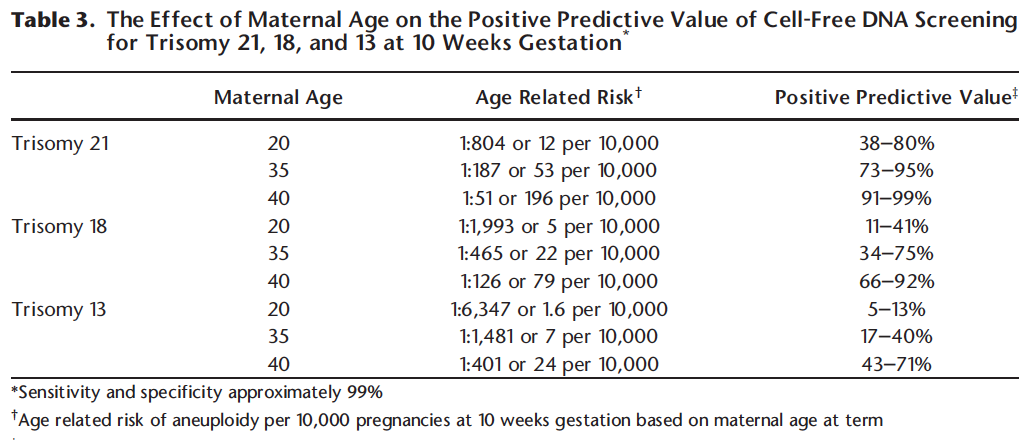


That calculator is available here: NIPT Predictive Value Calculator      (https://ppv.geneticsupportfoundation.org/). See the images below to understand how a very highly sensitive screening test still gives very different PPV based on baseline risk. For example, note that a positive screen for Trisomy 21 in a 20 year old woman is still only going to turn out to be a true Trisomy 21 50% of the time. In contrast, a positive screen in a 39 year old woman will be true 91% of the time.
There is local help!
If you have a patient with a positive prenatal genetic screening test, our local MFM consultants are available to help you. Here's how to contact them: CPMC Sonoma Ave number: 707-569-7366 to reach on call Genetic Counselor and or MFM 

Prenatal Genetic Screening and Diagnosis (Shaffer, 1/20/2021)

Many thanks to Dr. Brian Shaffer, Sutter West Bay Medical Group Perinatologist, who gave an informative Grand Rounds this week on Prenatal Genetic Screening and Diagnosis. Prenatal Screening is a BIG topic that is ever evolving with improving gene sequencing technology and innovation, necessitating important (and potentially challenging) decision-making conversations with women early in their prenatal care.

Just a reminder that there are important differences between genetic screening tests (e.g. first and second trimester blood screens, nuchal translucency ultrasound, and even our standard fetal survey) and prenatal diagnostic tests (e.g. chorionic villous sampling, amniocentesis and cord blood in terms of their positive predictive values as well as their risks. The new-ish kid on the block is non-invasive prenatal testing/screening (aka NIPT, NIPS), which is a screening test and NOT diagnostic. 

Of note, ACOG and other guiding bodies  recommend that a discussion of the risks, benefits, and alternatives of ALL prenatal screening and diagnostic testing should occur with ALL patients, ideally at first visit, regardless of maternal age, including non-invasive prenatal screening (NIPS) and diagnostic testing "even in low risk pregnancy" (e.g. CVS, amniocentesis)

Dr. Shaffer gifted us with a set of probing questions to conduct these conversations about prenatal screening with patients. This can be a really challenging conversation, and it is helpful to consider the language we use to frame the conversation. Consider starting with:

If your pregnancy was affected with a genetic disorder or chromosome abnormality, would you want to know?

  • What would the information mean to you?
  • Would an abnormal result or prenatal diagnosis ruin the experience of the pregnancy or provide valuable guidance?
  • Some people want more information to help them (and healthcare providers) prepare for the birth of a child with special needs
    • Some might choose to terminate a pregnancy with a diagnosed condition
    • Some couples do not want this information during pregnancy

There is a spectrum of congenital disease that can affect a pregnancy (as depicted in image below), and no ONE screening test can provide results about the entirety of this spectrum. Really, in fact, a combination of screening tests aims to cover this range (e.g. ultrasound is best to evaluate structural malformation vs. a quad screen designed to detect some autosomal disease, NIPT is excellent for down syndrome but gives no information regarding spina bifida). 

The menu of screening tests we currently offer includes: 

  1. Nuchal translucency ultrasound (NT),
  2. First Trimester screening (serum),
  3. Integrated/sequential screening (first and second trimester), 
  4. Quad screen, and 
  5. Cell free DNA (often referred to as NIPS or NIPT).  
Each of these tests has benefits and limitations as well as variable sensitivities for different conditions. See table below for some of these stats. For example, for Down Syndrome (DS), the NT alone has a 70% sensitivity as compared to the NT plus serum markers which brings that to 90-95%. 

However, also note that because these conditions are quite rare, the positive predictive value (PPV) is only 5-10%. That is only 5-10% of positive screens will actually correlate with a abnormality in the fetus. And the impact of false positives is real.


What are the implications of this 5% PPV?

Well, let's take an example: with the prevalence of DS in the US, 1/16 women with a positive screen will have a child with DS. 15/16 will have a normal fetus. And if the abnormal screen leads to more invasive diagnostic testing (CVS, amnio)--> that equates to 570 losses of normal fetuses. Is this an acceptable tradeoff? Up to each woman to decide. And up to us to counsel those women.

What should we know about NIPS?

NIPS is a pretty awesome technology that is able to identify cell-free DNA segments (from the placenta) in maternal serum. It can be done from 10-30 weeks EGA and has a a very high positive predictive value in "high risk pregnancies" (defined as women with advanced maternal age/AMA). In younger women-- lower risk women-- while the sensitivity and specificity remain the same, the PPV is decreased because the prevalence of these chromosomal abnormalities are just so much rarer. 

NIPS screens for Trisomy 21 (Downs), Trisomy 18, and Trisomy 13, as well as sex chromosome abnormalities (XXX, XXY, XY) and some other microdeletion and microduplication disorders.

Results return as:
LOW risk
INCREASED risk (including borderline)
Other (including no call, maternal chromosomal conditions, and inconclusive/atypical)

A "No call" (aka test failure) occurs in 1-8% of patients, often due to low fetal fraction. Low fetal fraction may be due to too young gestational age, as well as maternal conditions (e.g. SLE) and women on lovenox. Can also be low in obese women (<1% in women <60kg, >50% in women >160mg). Can also be low in placentas with certain aneuploidies (particularly Trisomy 18 and triploidy). NIPS cannot be used for paternity or single gene deletions.

This table from Society Maternal and Fetal Medicine summarizes NIPS key points nicely

Dr. Shaffer cautioned us that there is no "best test"-- up to 2% of of pregnancies with a conventional positive screen had a detectable chromosomal abnormality not detectable on NIPS.

What about ultrasound (including NT and 2nd trimester screening ultrasound)?

  • Between 11 through 13+6 EGA
  • NT<3.5mm is considered normal
  • If  an abnormal NT is detected, recommendation include 1) formal genetic counseling 2) invasive testing (CVS) as well as 3) fetal echocardiogram
What about advanced paternal age (APA)?
  • in men >40, associated with small increased risk for de novo autosomal dominant disorders
  • possible increase in behavioral issues including schizophrenia and autism
  • structural malformation
  • fetal growth restriction and preterm birth
Expanded carrier screening vs. Ethnicity Based Screening
Over the last decade, we have been offering women "ethnicity based screening'-- e.g. offering CF, Tay Sachs, hemoglobinopathies based on a maternal report of heritage. There is evolving argument in the literature that we are very unaware of our genetic heritage AND that there may be benefit to offering all women expanded carrier screening for conditions that might impact pregnancies and pregnancy outcomes. As expanded carrier screening cost come down, and as our capacity to test for a large number of conditions simultaneously, the argument is that more information in the hands of the mother can be helpfu. However, the risk is that we currently have no uniform or standard best practices on these ECS panel, and such testing may give us information on late onset genotypes (e.g. BRCA1) that parents don't really want to be thinking about.

In summary,
All screening and diagnostic testing are optional in pregnancy and women should ALWAYS have the right to decline.
Remember that a screening/anatomy ultrasound is still a screening test (and women should know this)
If a patient wants screening, they should have the most accurate screening tests available
Providers should be able to explain what conditions we are screening for, explain false positives and detection rates, and have a plan for results if they are anything other than "normal"
Any questions: contact Dr. Shaffer at shaffebl@sutterhealth.org

Diagnosis and Management of Osteoporosis (Hamann 7/23/2026)

 A recording of this presentation is available HERE .  *** Thanks so much to Dr. Kendal Hamann, SMGR Endocrinologist, for an outstanding Gra...