Showing posts with label in vitro fertilization. Show all posts

Barriers to Fertility Care (Orozco-Llamas, 9/18/2024)

Many thanks to Dr. Orozco-Llamas for an excellent, thought-provoking presentation this week on Barriers to Fertility Care. A recording of her presentation is available HERE.

My notes:

2020 American Society for Reproductive Medicine definition for infertility:

  • Inability to achieve a successful pregnancy based on a patient’s medical, sexual, and reproductive history, age, physical findings, diagnostic testing or any combination of those factors.

  • Need for medical intervention to achieve a successful pregnancy either as an individual or with a partner

In patients having regular, unprotected vaginal-penile intercourse, evaluation should be initiated at 

  • 12 months when the female is under 35 years of age
  • 6 months when female is 35 - 40 years
  • Immediate evaluation may be warranted in female >40 years
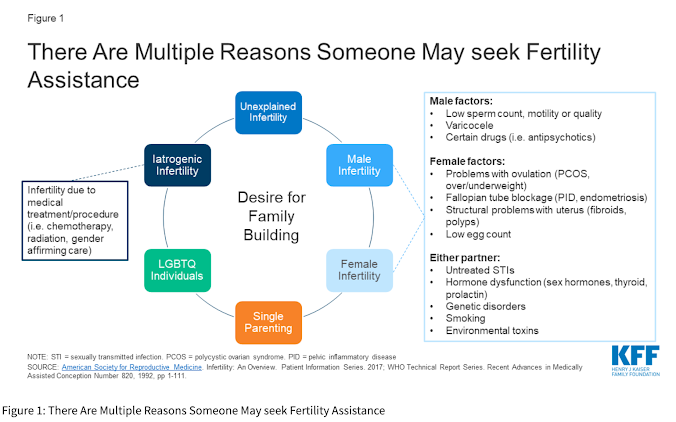
Infertility affects 15% of heterosexual couples in the US
Male factor accounts for 40-50%
Female factor accounts for 35-50%
Unexplained fertility accounts for ~30%
This talk did not cover the usual fertility evaluation, but a typical plan for infertility includes diagnostic services (serum lab tests, semen analysis, imaging and diagnostic procedures, e.g. laparoscopy or hysteroscopy) and treatment services, including medications (clomiphene/letrozole), surgery (laparoscopy or hysteroscopy), intrauterine inseminations (IUI) and in vitro fertilization (IVF)

Each of these components has an associated cost:
For patients who need fertility specialty care, costs are generally self pay. At our local fertility clinic-- Advanced Fertility Associates, Inc, here are some current out of pocket costs:
  • Consult $280 

  • US done in-house $275  (even if done already at outside facility)

  • Blood work $350 (often needs repeating)

  • IUI $400 per cycle

  • IVF $10,000-$15,000 per cycle

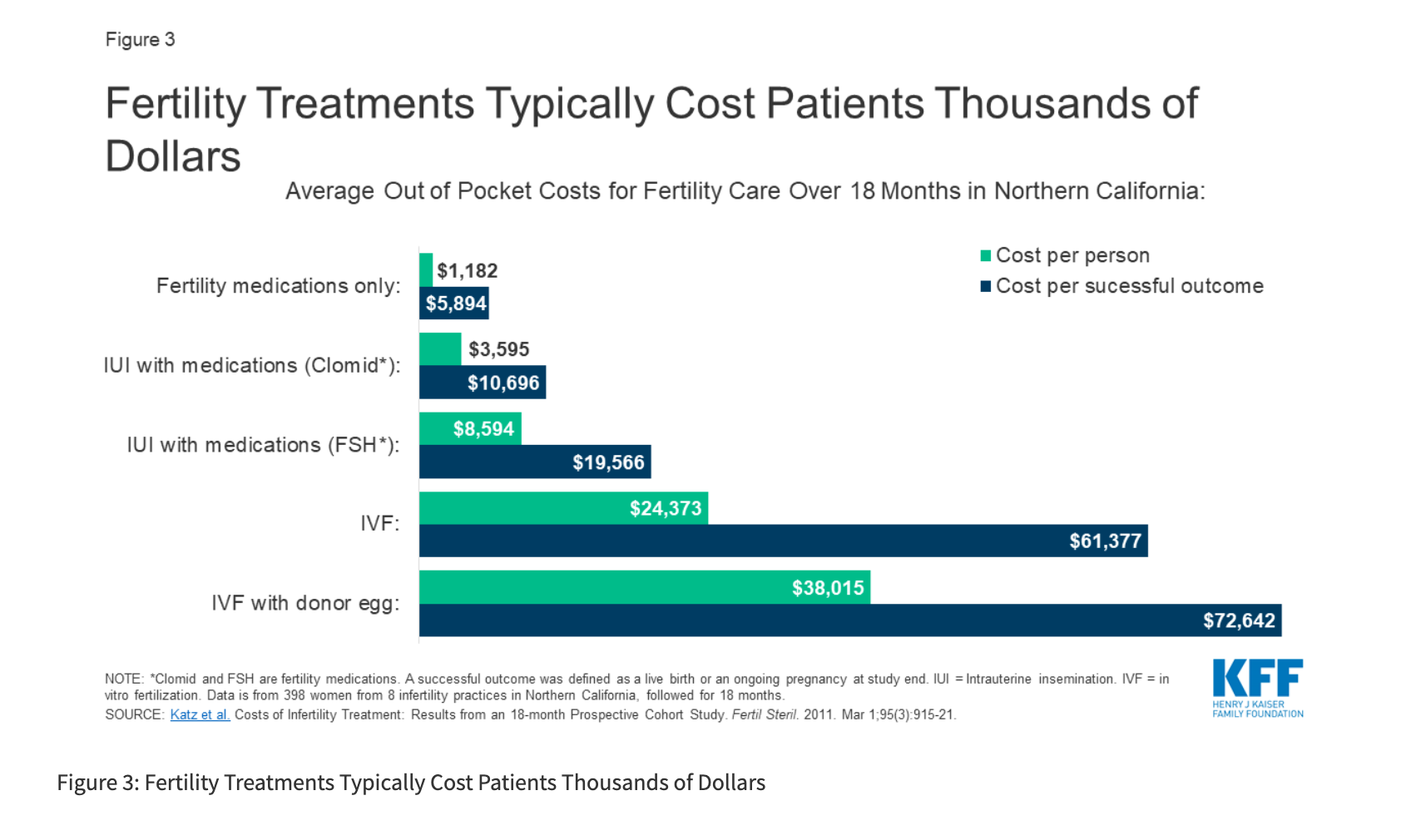
It is important to note that fertility treatments do not every guarantee a successful pregnancy and many of these costs need to be multiplied to achieve success. If you look at the graph below from KFF, you can see that whereas a single cycle of IUI may cost about $3500 dollars, the average cost per successful pregnancy is over $10,000 dollars. 

Ovulation stimulating medication is relatively low-cost for our Medi-Cal and uninsured patients (~$18 for a course of clomiphene and/or letrozole), but there is currently no in clinic IUI offered at our community health centers. Patients can be counseled on doing home insemination, which has a lower success rate.

We know that IVF has been in the national political conversations lately. It is important to note that there is wide variability in states regarding private insurance mandates around fertility care. 

As of June 2024, 23 states have mandates requiring insurance companies to include some coverage for infertility diagnosis and treatment. Of these, 15 states specifically require coverage for IVF. Most require a clinical diagnosis of infertility, often requiring all people seeking coverage, including single people and people in same sex partnerships, to demonstrate clinical infertility (sometimes requiring a rounds of IUI before covering IVF).

Where policies cover IVF, coverage is limited by either a dollar limit or a maximum number of IVF cycles.  Several of the states that mandate insurance coverage of infertility treatment do not require religious organizations, small businesses, or employers who self-insure to offer coverage. Several states require that the patient be married. Many states place an age limit on infertility treatment.

No state Medicaid (in California, MediCal) currently covers IUI or IVF.
***
All this being said, patients of color and patients with low SES have higher rates of infertility! In fact
  • All non-white racial and ethnic groups (black, other race, and Hispanic) are significantly more likely to experience infertility than whites.

  • Both high school dropouts and high school graduates are significantly more likely to experience infertility than four-year college graduates. 

  • Women who are not white and women who are of lower SES are significantly less likely to report ever having received infertility treatment.
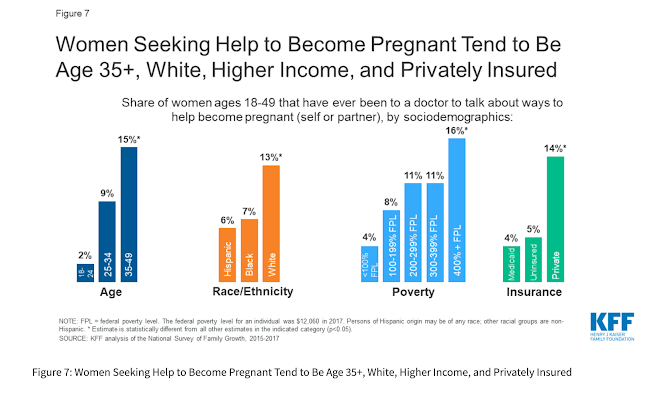
This is an equity issue. It shouldn't be surprising that women seeking fertility treatments tend to be older, white, of higher income and privately insured. 

Also of note, there is evidence that women who work with pesticides have higher rates of infertility. See image below for details on two studies that are highlighted. This is particularly relevant to many of our local SoCo patients who work in vineyards and local farming industry. 


What can primary care docs working in the safety net do with patients who need fertility services?
  • Talk to your  patients about fertility!

  • Refer to WHPC or GYN clinic at Vista SRCH

  • Education on infertility and ovulation cycle

  • Mental health resources

  • Diet and lifestyle modifications

  • Guidance on when to refer and providing financial information


References:
  • Bill Status - SB-729 Health Care Coverage: Treatment for Infertility and Fertility Services. leginfo.legislature.ca.gov/faces/billStatusClient.xhtml?bill_id=202320240SB729.
  • FigĂ -Talamanca, Irene. “Occupational risk factors and reproductive health of women.” Occupational medicine (Oxford, England) vol. 56,8 (2006): 521-31. doi:10.1093/occmed/kql114
  • Fuortes, L et al. “Association between female infertility and agricultural work history.” American journal of industrial medicine vol. 31,4 (1997): 445-51.
  • Gaskins, Audrey J, and Jorge E Chavarro. “Diet and fertility: a review.” American journal of obstetrics and gynecology vol. 218,4 (2018): 379-389. doi:10.1016/j.ajog.2017.08.010
  • “Infertility: An Overview Patient Education Booklet.” Infertility: An Overview Patient Education Booklet | ReproductiveFacts.Org, American Society for Reproductive Medicine, www.reproductivefacts.org/news-and-publications/fact-sheets-and-infographics/infertility-an-overview-booklet/.
  • Infertility Workup for the Women’s Health Specialist: ACOG Committee Opinion, Number 781. Obstetrics & Gynecology 133(6):p e377-e384, June 2019. | DOI: 10.1097/AOG.0000000000003271
  • Katz, Patricia et al. “Costs of infertility treatment: results from an 18-month prospective cohort study.” Fertility and sterility vol. 95,3 (2011): 915-21.
  • Mays, Mackenzie. “A Bay Area Cancer Patient Froze Her Eggs in Hopes of Having Children. She Can’t Afford to Finish IVF - Los Angeles Times.” Los Angeles Times, 9 Apr. 2024, www.latimes.com/california/story/2024-03-31/ivf-isnt-covered-by-insurance-in-california-hopeful-parents-are-struggling-to-afford-fertility-care.
  • Phillips, Kiwita, et al. “Infertility: Evaluation and Management.” AAFP, 15 June 2023, www.aafp.org/pubs/afp/issues/2023/0600/infertility.html.
  • Practice Committee of the American Society for Reproductive Medicine. Electronic address: asrm@asrm.org. “Definitions of infertility and recurrent pregnancy loss: a committee opinion.” Fertility and sterility vol. 113,3 (2020): 533-535. doi:10.1016/j.fertnstert.2019.11.025
  • Weigel, Gabriela, et al. “Coverage and Use of Fertility Services in the U.S. | KFF.” KFF, 15 Sept. 2020, www.kff.org/womens-health-policy/issue-brief/coverage-and-use-of-fertility-services-in-the-u-s.

Practical Reproductive Medicine for the Primary Care Provider (Uzelac, 5/12/2021)

Many thanks to Dr. Peter Uzelac, medical director of the Marin Fertility Center, who gave a really great presentation this week on reproductive medicine  for primary care providers. He covered a lot of important topics that are not bread and butter for us, but that are definitely important to understand and consider in caring for patients of reproductive age. Dr. Uzelac also gave us some great insight as to what patients can/are doing themselves and what we can/might recommend.

For those of you who want to see the presentation, a video recording is available HERE.

For my notes, keep reading. . . 

Optimizing Natural Conception: 

  • the "fertile window" is a 6 day interval when conception is possible, ending on the day of ovulation
  • frequency of intercourse recommended for optimal fertility success: q1-2 days in the fertile window (though 2-3 times/week nearly equivalent)
  • there is no substantial evidence that monitoring increases success
    • it turns out that changes in cervical mucus performs as well or better than basal body temperature (BBT) or urinary LH
  • no timing, position, resting around sexual intercourse have any impact on fertility
  • moderate alcohol (1/day) or moderate caffeine (1 cup coffee/day) is probably okay
  • smoking, recreational drugs (including marijuana) are not good

Causes of infertility: 
  • male factor 30% 
  • diminished ovarian reserve 30%
  • ovulatory dysfunction 10%
  • tubal/peritoneal 20%
  • unexplained 10%

When should someone be evaluated for infertility?

In the absence of a remarkable history or physical findings, treatment should be started if no pregnancy results after active attempt for pregnancy within:
    • 12 months for women <35 (85% of couples trying to get pregnant will be successful after 12 months)
    • 6 months for women >35
    • Immediate evaluation and tx for women >40

3 "Tiers" of Diagnosis and Treatment of Infertility
  • Tier 1: for all couples; focus on the basics: eggs, uterus/tubs, sperm
  • Tier 2: ~15% of people; more focused, newer diagnostics, less validates (endometriosis, chronic endometritis, molecular sperm assessment, things only seen during ovarian stimulation or embryo culture)
  • Tier 3: difficult/rare cases, after multiple treatment failures (immunomodulation, uterine microbiome) 

What historical clues can help?  
  • Menstrual history:
    • Intervals: 28 days +/- 7 is considered normal
    • abnormal uterine bleeding (structural, hormonal, endometriosis)
    • pain/dysmenorrhea (endometriosis)
  • Duration of infertility: unsurprisingly, the longer the problem, the harder to solve
  • Gs and Ps
  • How many children desired? (start planning with first child--> embryo banking)
What physical clues can help?
  • ultrasound (cysts, polyps, fibroids, adenomyosis)
  • BMI (extremes, upper and lower)
  • androgen excess (especially in oligomenorrhea)
  • Thyroid
How do you know a woman is ovulating? There are many ways to detect, none are perfect
  • Of note, 1-12% of normal women's cycles are anovulatory (more likely in extremes of reproductive age)
  • You can detect ovulation through a variety of methods:
    • mid cycle symptoms: discharge, mittelschmerz
    • moliminal symptoms (fluid, breast tenderness, craving, mood)
    • hormones: LH surge, mid-luteal progesterone (normal is >3ng/ml, drawn one week prior to expected menses rather than on a specific cycle day; levels may vary 7-fold even within hours)
    • Ultrasound: dominant follicle, corpus luteum cysts
What patients may be doing to detect ovulation? Tracking w/apps, diary good start but women get too focused on these, urine ovulation kits (detect both LH surge and estrogen surge as well), wearables, post-ovulatory progesterone kit. All can be used to demonstrate ovulation and time intercourse. 

Pearl: Eumenorrheic patients with sporadic anovulation doesn't impact fertility. They will eventually get pregnant over the 12 month interval! Many women get very focused on this step. Try to have patient focus less on ovulation if they are generally ovulating.

What about ovarian reserve? This is often the most important factor in fertility; age is so impactful on chances for successful pregnancy. Plus, fertility doctors can fix almost anything EXCEPT ovarian reserve
  • all eggs a woman will ever have are present at birth
  • apoptosis occurs through a woman's lifetime
    • egg survival falls more around age 35/37, fertility ends early 40s, but menopause doesn't happen until closer to 50
  • for a woman's last 10 years, she often has  regular periods but not able to get pregnant
    • last child statistically  is age 42, pregnancy is possible but not probable after 43


Ovarian reserve testing: REI no longer use FSH/E2 (not sensitive enough), or provocative tests, really test of choice is anti Mullerian hormone (AMH)
  • AMH is more sensitive than FSH (can be done on OCPs, needs to be adjusted by 30%). 
  • A follow-up test: antral follicle count (on ultrasound)
Of note, these markers are poor predictors of fecundability , they mostlyt help to characterize where a patient is on their fertility timeline, not really a great test to predict pregnancy. REI uses them to predict response to stimulation in IVF

What patients are doing? At home "hormone testing" not well validated, often include hormones not assessed at the same time as other hormones, so not great. Would NOT recommend.

Fertility ultrasound (Antral follicle):

What you are looking for on ultrasound:
  • early resting follicles 2-10mm
  • dominant follicle 20-28mm prior to ovulation
  • corpus luteum cyst left behind right after ovulation

Uterus/tubes:
  • For tubes: hysterosalpingogram (HSG): proximal and distal tube occlusion, adhesions, etc
    • not great for uterine cavity visualization, cannot differentiate septate from bicornuate uterus
    • bilateral FILL and SPILL, delays in fill/spill, obstruction (proximal vs. distal), hydrosalpinx
  • For uterus: saline sonogram (hysterosonography) defines size and shape of uterine cavity (91% sensitivity, 84% spec for intrauterine pathology: polyps, myomas, synechiae)
  • hysteroscopy is not typically done unless plan for intervention (e.g. ablate septum, polypectomy)
Male factor:
  • history: prior fertility, erectile or ejaculatory dysfunction, anabolic steroid use (testosterone, previous abdominal or scrotal surgery, STD
  • semen analysis: concentration, motility, morphology
  • see WHO guidelines below for normal values
  • results are a SPECTRUM: more abnormal parameters, the higher increase in fertility problems
  • only a spot check, lots of fluctuations (should be repeated if abnormal)
What are patients doing? Home semen analysis is available: 
  • Yo test ($50)
  • Fellow: send in kit, conventional semen analysis  ($170)

Tier 2 conditions to consider:
  • Endometriosis, underdiagnosed, classically a surgical diagnosis, now fertility doctors using specialty markers
  • Chronic endometritis
  • Microbiome

Reproductive Therapeutics 
"Simple fixes"
  •  Polypectomy, ovulation induction in PCOS, IUI for mild male factor, etc
Superovulation and Intrauterine insemination (IUI) for women <37
  • Clomid or letrozole x 5 days
  • IUI (with sperm washing)
*NEW guidelines 2020: Immediate IVF should be offered in women >38 years of age

Diagnosis and Management of Osteoporosis (Hamann 7/23/2026)

 A recording of this presentation is available HERE .  *** Thanks so much to Dr. Kendal Hamann, SMGR Endocrinologist, for an outstanding Gra...