Showing posts with label medical history. Show all posts

Healing through Strengths, Movement, and Culture (Fleg, 1/10/2024)

 A recording of this presentation is available HERE.

***

Deep gratitude for today's Grand Rounds, an impactful presentation by Dr. Anthony Fleg from  University of New Mexico in Albuquerque, about changing the way we assess and treat patients by assessing for their strengths, rather than their deficits. 

I would say this is a presentation better watched and absorbed than summarized, but here are my notes for those of you who prefer them.

Dr. Fleg encouraged us from the beginning of his presentation to consider how we are trained in medicine to assess and manage patients by understanding their "problems" or "deficits" rather than to understand their strengths. 

To begin, he asked us to consider one of the patients we may have struggled to serve effectively in recent weeks and to list out their problems. After about a minute, he then asked us to list out this same patient's strengths. Once we were done with the exercise, he made us do a self-assessment.

  • What was our ratio of problems to strengths for our patient? (on average, he said, physicians are able to list 6 problems to 1 strength)
  • Did we have trouble thinking of strengths? It wouldn't be surprising, we aren't trained to look for them.
  • How might we care for our patients differently if we ask "what is right with you?" instead of always "what is wrong with you"?          
  • How can we possibly ask patients to use those strengths if we do not know what they are? 
  • How can we change even very complex medical situations into achievable goals for patients -- particularly for historically marginalized patients, e.g. BIPOC patients, but really for everyone?    

Dr. Fleg spoke about how social workers are trained to do something called "asset mapping" with their clients, which is exactly what it sounds like -- looking for people's strengths, even under challenging conditions. The idea is that, by understanding assets, we  empower people in communities to build on what they do well in order to improve their health. 

Take, for example, Dr. Fleg's wife's 95 year old Navajo grandfather, a traditional medicine man, who died of COVID early in the pandemic. This person, Grandad Bahe Manybeads, looked at from a traditional medical model -- a deficit perspective -- had many things stacked against him: low English proficiency, low educational attainment, minimal eye contact, hard to communicate with, doesn't share, geriatric. But what happens if we flip his deficits into strengths: he is Navajo speaking, culturally competent and highly educated in Navajo culture, a recognized community healer, humble and modest, stoic and strong, wise elder, a physical strong healer who still performs all night healing ceremonies well-into his nineties. How does that lens change how we treat his medical illness?


By not focusing on strengths, Dr. Fleg argues, we perpetuate racism, lose key chances to empower patients to heal from within, dehumanize patients and ourselves, and feed into our own burnout. Deep breath. Take that for consideration. Consider how focusing on patient strengths may actually feed you and sustain your practice.

***


Dr. Fleg ended his thought-provoking presentation on leading with strength on a reminder of  the decimation of the Indigenous people in California (from the state of CA court's website):

  • From 1840-1870, the California indigenous population decreased from 200,000 people>> 12,000 due to disease, removal and death. This was not accidental.
  • Even still, CA has the largest Native American population in the country (12% of all Native Americans in the US live in California)
    • Over 1/2 of California's indigenous people are descendants of those displaced due to mass relocation to urban centers (SF and LA)
  • Systematic oppression, codified by law:
    • Any Indian declared vagrant could be thrown in jail 
    • Indian children were allowed to be sold as slaves
    • Laws explicitly prohibited Indians from testifying in court against a white person
  • While there are currently >100 tribes recognized in CA, there are also tribes that were erased by federal policy. Be careful with each individual's identity and passing value judgements without understanding
In summary, while we may be medically proficient, we may also be culturally and historically deficient in understanding people's contexts. Be sure to consider be peoples contexts and make an effort each day to care for people, rather than treat patients.

I'll end on a state from Dr. Fleg that was particularly poignant for me: "We decolonize ourselves when we are strength-based and that is good for ourselves and for every single person we care for."

Let's Talk about Sex (MacArthur 5/4/2022)

 Big thanks to Dr. Sophie MacArthur for her excellent presentation on a topic that we could  ALL use a little education on-- Sex. And specifically how we talk about it with patients.

The recorded presentation is available HERE

Link to her slides is HERE

My notes:

  • The Sex Ed most of us had in school wasn't any good 
    • a meta-analysis of 48 different studies in 10 countries (including US) in BMJ found high school students believed their sex ed to be impractical, out of touch, sexist, heteronormative, and embarrassing
  • And. .. let's face it. Physicians aren't very good at talking about sex with patients. 
    • While 88% of primary care physicians say they take a sexual history, only 25% of charts have said history recorded
    • A study from the 1990s-- height of the AIDS epidemic-- found providers didn't take sexual history because they didn't feel it was relevant, didn't feel well-trained, and felt embarassed
    • We are inadequately trained
    • We tend to discuss sex only when patients ask
  • But. . .patients want to talk about sex! 
    • In one large study from Europe, 91% of patients want their physicians to ask about their sexual history and sexual health
    • Even of the 15% who would feel embarrassed talking about sex, 75% still wanted their doctor to ask
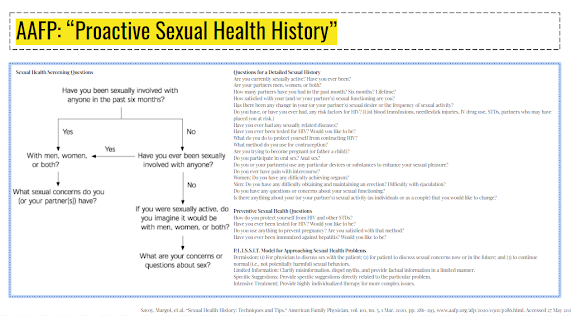
As part of sexual history and STI screening, many of us were trained to ask the following question: "Do you have sex with me, women or both?"

Dr. MacArthur asked us to consider a better question: "When you have sex, what parts of your body come in contact with what parts of someone else? And how?"


Two reasons this question is a better question than the men, women or both question:
  • it is not heteronormative
  • it allows us to screen people for STIs at appropriate sites (e.g. for rectal,  oral GC/CT)
There are several different ways we can approach the topic of discussing sex with our patients. All of them promote using open ended questions. 

3 options:
  • Permission ("May ask you a few questions about your sexual health and sexual practices?")
  • Partners ("Do you have any new partners in the last 12 months? How many? Do your partners have any risk factors?"
  • Practices ("When you have sex, what parts of your body come in contact with what parts of someone else? And how?")
  • Protection from STIs ("Do you and your partners discuss protection from STIs? "What methods do you use? How often do you use them?")
  • Past history STIs ("Have you ever been tested for STIs? Have you ever had an STI?")
  • Pregnancy intention ("Do you think you would like to have (more) children some day?")


3) Fenway Institute/Harvard: 6Ps + Guidance: Taking an Affirming Sexual History
  • Ask routinely, confidentially and free of assumptions
  • Do it often (you will get better at it)
  • Explain why it's important to know what you are asking
  • Ask about function and satisfaction (not just about STI risk)
  • Use open ended questions (e.g. "what types of sex do you have?"), at least initially
  • Normalize less desired responses (e.g. many people don't consistently use condoms; how often do you find yourself not using a condom?")
  • Mirror patient's language if possible 
  • Make the interaction as natural as possible (not robotic) 
  • Give patients the option to answer questions indirectly (e.g. I recommend screening for GC/CT in all the sites that may have been exposed; for example, the throat, the anus, the penis, the vagina. Which of these sites should you have tested today?)
  • Tone and rapport matter, at least as much as the questions 

Risk reduction is an important part of sexual history, but risk extends beyond our traditional view of STIs and unwanted pregnancy. 
Risk=anything that is not sexual health and/or sexual well-being

This can include non-consensual sex, painful sex, bad sex, legal repercussions of sexual behavior (e.g. consent is not sufficient to protect someone), nerve damage (S&M practices)


Risk reduction Resources

Radiology Potpourri (Kujala, 3/17/2021)

Many thanks to Dr. Nick Kujala, Sutter Radiologist and mid-West Scrubs and hockey fan, who gave an entertaining and informative presentation this week, covering a range of topics in radiology: from the history of the first radiograph to the risk of radiation exposure to the invention of the CT scanner. The video recording is available HERE.

Here are a few summary points from his presentation:

1) Radiation Exposure: Many patients (and clinicians) have concerns about the risks of radiation exposure with imaging studies. It may be helpful to note that living on earth gives us daily background radiation exposure, and certain jobs/situations (e.g. working as flight attendant or pilot) increase the amount of that exposure over time. Of note,  exposure from one chest x-ray is the equivalent of  ~10 days of background radiation, whereas at CT of the chest is equivalent to ~2 years. 

Information on radiation exposure for patients is available at this website:  https://www.radiologyinfo.org/en/info.cfm?pg=safety-xray

Also, remember that MRI and ultrasound are alternative imaging modalities that offer ZERO radiation exposure.


2) Breastfeeding and contrast: Women who are breastfeeding can safely receive contrast (iodinated and gadolinium-based) for imaging studies without concern. The dose absorbed by an infant is exceedingly low. There is no need to pump and dump, but ultimately the decision should be left to the lactating mother.

3) ACR Appropriateness Criteria: The American College of Radiology (ACR) has an excellent, information-packed website to help clinicians make the correct choice about imaging studies. Everything you want to know about radiology imaging (indications, risks/benefits, radiation exposure, alternatives) can be found here: https://www.acr.org/Clinical-Resources/ACR-Appropriateness-Criteria

An excerpted example of these ACR criteria for abnormal uterine bleeding is pictured below.


4) MRI and Gadolinium: Gadolinium has been used as contrast in MRI for over 30 years. There is a known phenomenon of gadolinium deposition in some tissues (bone, kidney, brain); however, there has been no consistent evidence to suggest that these deposits are associated with neurotoxicity. However, as recent as 2016, some scientists have suggested a condition called Gadolinium Deposition Disease, linking these deposits with a constellation of neurological symptoms and signs.  While Dr. Kujala and the ACR  support the safety profile of gadolinium, it is not recommended during pregnancy

5) More IS Better! Give your radiologist as MUCH clinical information as possible when ordering an imaging study-- you will get more clear results back. And if you have a question, call your local radiologist sitting in his dark reading room (or at home) at x-44551.

Extras:

Roentgen's first ever radiograph of his wife's hand (1895) 


Hounsfield's invention: the CT Scanner (he shared the 1979 Nobel Prize in Medicine)


And finally, what is an Aunt Minnie? The origins of the term "Aunt Minnie" are a bit hazy, but it's believed to have been coined in the 1940s by Dr. Ben Felson, a radiologist at the University of Cincinnati. He used it to describe "a case with radiologic findings so specific and compelling that no realistic differential diagnosis exists."


Can you name the Aunt Minnie below?


Answer: Tension Pneumothorax


Methamphetamine Use Disorder (Nicholson, 1/8/2020)

Thank you so much to Dr. Lisa Nicholson for her excellent presentation this week during Grand Rounds on Methamphetamine Use Disorder.

Most of you are well aware that methamphetamine has some health effects and societal implications, but did you know that our very own health care system and pharmaceutical companies are responsible for introducing methamphetamine to our military pilots in WW2 (to keep them awake), to the general market OTC in 1939 (brand nameBenzedrine) and is still available even today with a prescription?
Meth has been marketed for the treatment of depression, obesity, fatigue, low libido, inattentiveness, menopause, nasal congestion, asthma, and even the common cold. (Check out the ads to the Right) 

Methamphetamine is typically smoked, inhaled, or ingested. In California, the majority of people who use meth smoke it, but in Texas, the majority inject it.
·        1.2% of Californians have used meth in the last year
·        6% of Sonoma County 11th graders have tried meth (yikes!)
·        Meth is the most common illicit substance used worldwide (after MJ)
·        In Sonoma County, meth is by far the most commonly used substance in families involved with the Sonoma County court system implicated in the abuse or neglect of children (second to alcohol)

This is MIND-BLOWING! Meth is the most addictive substance that exists: 47% of people will become addicted after first use, 60% after second use

Medical implications of meth use:
·        Acute intoxication: malignant hypertension, stroke, cardiac arrest, meth psychosis
·        Post-meth: altered mental status, irritability, violence
·        Long term: meth cardiomyopathy, dental problems, cerebral atrophy, mood disorders

A bit on Meth psychosis. . .
·        Up to 40% of users get meth psychosis, it is dose dependent, on average 1 week duration, but users with >5 years of use can have prolonged psychosis (>1 month).
o  If a patient has experience meth psychosis in the past, they are “sensitized” and more likely to experience it again in the future
·        Meth psychosis can mimic other mental illness: mania, schizophrenia, mood disorders.
o  At Zuckerberg SFGH inpatient psych facility estimates 47% of patients admitted to the inpatient ward are not mentally ill—they are high/coming down from meth (2019 study)
·        To distinguish primary psychosis from meth induced: you must have meth use BEFORE psychosis, and abstaining from meth likely will improve/make recede the psychosis
·        There is limited evidence on the use of atypical antipsychotics for thetx of meth psychosis: generally olanzapine, quetiapine. There is also evidence for the use of benzodiazepines for the treatment of meth withdrawal

A bit on hypertension. . .
Severe hypertension of meth should be treated with BETA BLOCKERS: labetolol. Tachycardia can be treated with  metoprolol (correct the catecholamine flood)
Patients with severe hypertension and chest pain are at risk for acute MI, dissection, and/or aortic aneurysm. Get a head CT if you cannot examine them thoroughly.

Meth cardiomyopathy very common (usually dilated non-ischemic, VERY low EF ~10%).
A 2017 German study found that with meth abstinence average EF increased from 20% to 43%, so STOPPING METH can improve cardiac function markedly!!!

There are no FDA approved treatments for meth use disorder. Mixed evidence for:
·        Bupropion (Wellbutrin): blocks dopamine reuptake, can help in early abstinence, modest evidence, not recommended after 4 weeks abstinence (can be triggering)
·        Mirtazapine: helps with sleep, appetite, modest reduction in meth use
·        Naltrexone: appears to decrease meth high and cravings, mixed results
·        Modafinil (Provigil): some evidence in cocaine use disorder, 2010 RCT said no better than placebo for meth
·        Adderall/Ritalin: jury still out

      
Psychosocial approaches:
Best evidence in non-pharm management of patient is for contingency management (=monetary or other tangible short term rewards for abstinence)PLUS Community reinforcement (healthy restructuring of social environment)
Not great evidence for 12-step, CPT or supportive therapy. Hmmm. No one in Sonoma County appears to currently be using contingency management—MediCal does Not cover it

Don’t forget harm reduction in patients with meth use disorder:
1)     Condoms 2) PrEP 3) Needle exchange (when appropriate) 4) Dental Care 5) Clinic structures that don’t punish people for no-shows, tending more to drop-in

Diagnosis and Management of Osteoporosis (Hamann 7/23/2026)

 A recording of this presentation is available HERE .  *** Thanks so much to Dr. Kendal Hamann, SMGR Endocrinologist, for an outstanding Gra...