Showing posts with label bupenorphine. Show all posts

Methadone in Hospitalized Patients (Bowen & Aguilar 11/6/2025)

 A recording of this presentation is available HERE

Deep gratitude for our two Addiction Medicine Fellows, Drs. Bianka Aguilar and Anna Bowen, for an important and concrete presentation this week on Methadone in Hospitalized patients. They will be back in the spring with another Addiction Medicine presentation!

Here are my favorite pearls:

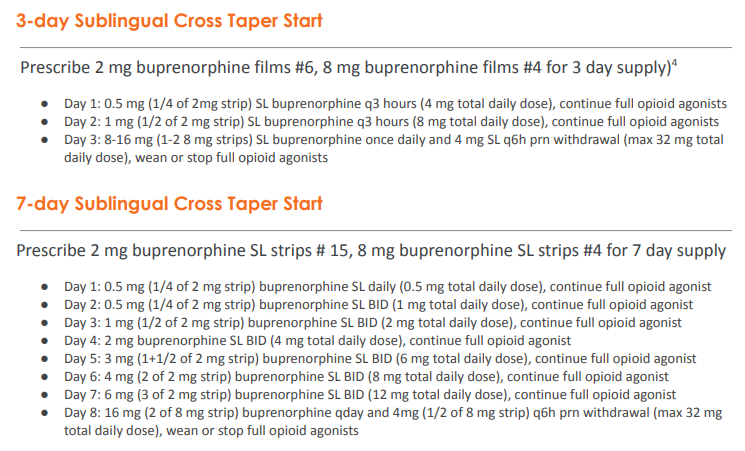
1) Starting methadone in the hospital decreases self-directed (AMA) discharges (30% vs. 59.6%), reduces all-cause readmission rates (27% vs. 41%), and decreases risk of endocarditis, osteomyelitis, and septic arthritis. I was taught that we should be "cautious" in the hospital about starting methadone if there wasn't a long-term plan for follow-up, but this is no longer true. If a patient is motivated to start methadone and it is indicated, we should do it. There are many new algorithms that can cross taper people easily from methadone to buprenorphine IF they are unable to get methadone through an outpatient treatment center.

2) Fentanyl in our drug supply has changed the treatment of opioid use disorder (OUD).  Recent studies are showing the methadone may be superior to buprenorphine in terms of treating OUD in fentanyl users. Methadone for OUD also appears to have higher retention rates. 


3) Traditional methadone induction involved weeks of up titrating doses until methadone was at therapeutic levels; newer studies, particularly in the fentanyl era, have found that quick starts--  higher starting doses, 30-40mg on D#1, and quicker up-titrating, increasing by 10-15mg, per day is safe and effective.

4) While methadone is known to lengthen the QT interval, not everyone on methadone needs serial or even baseline EKG monitoring. Most guidelines recommend an EKG at initiation of methadone only for patients with other cardiac risk factors (e.g. known prolonged QT, CAD, CHF, etc.)  AND once methadone doses near 100mg daily. This is a dose response side effect. We should remember to look at other medications that can also prolong QTc to see if those can be altered/discontinued. A QTc of >500 is not an absolute contraindication to treating with methadone, but the clinical scenario merits review (e.g. medication review)

4) Some people are "rapid metabolizers", meaning that single daily dose of methadone may be insufficient to help with cravings and treat their opiate use disorder. This is known to be true in pregnancy, but can also occur in some patients. Rapid metabolizing most often manifest as someone who appears appropriately treated by a certain methadone dose by 2-4 hours after their dose (maybe even a little sedated), but then 12 hours later is experiencing s/sx of withdrawal or cravings. We can potentially help their case to receive methadone BID by checking "peak" (2-4 hours after the dose) and "trough" (right BEFORE their dose) serum level of methadone.


Practical tips for methadone in hospitalized patients:

  • Consult the addiction medicine fellows (on call schedule on Epic)
  • Document a 1 year history of OUD
  • Use the COWS score to monitor s/sx of withdrawal
  • We have 2 Methadone clinics in Santa Rosa: DAAC and SRTP. When initiating methadone, contact one of these clinics ASAP to arrange intake.
  • There is a federal 3 day exception for patients being discharged from the hospital, to whom we can prescribe methadone. Current local help is available via Creekside Pharmacy vs. SSRRH ER.
  • Offer all patients naloxone on discharge. 
  • Use the California Bridge website for help, including guidelines and algorithms.


  • Keep your eye out for newer studies showing quick start algorithms
  • Toronto Perinatal Addiction Medicine Team


Treating Opioid Use Disorder in the Hospital: A Trauma Informed Approach (Strickland, 11/17/2021)

Many thanks to Dr. Tiffani Strickland, who gave an action packed Grand Rounds this week on Treating Opioid Use Disorder in the Hospital. She covered a ton of ground on this important topic-- from opioid use trends to adverse child experiences to trauma informed care to  micro-dosing of buprenorphine in the hospital.

To see a full recording of Dr. Strickland's excellent presentation click HERE.

My notes:

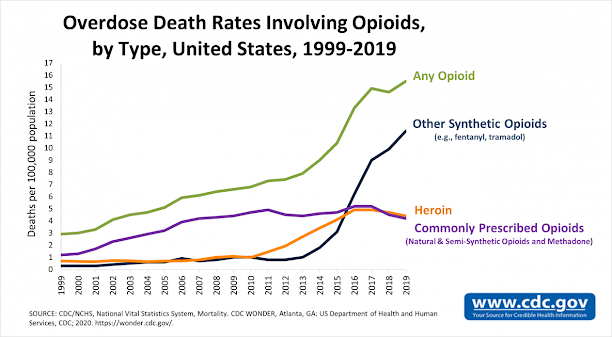
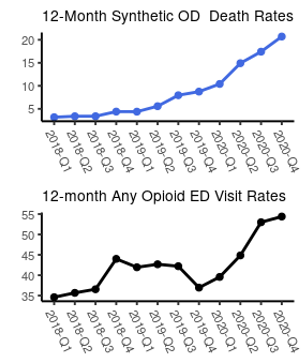
  • Overdose deaths from opioids are off the charts and continue to increase in the US and in our own Sonoma County (see graphs below, including local data)
  • If you only have 5 minutes, watch this video about our current understanding of addiction and social isolation: "Everything you know about addiction is wrong". It challenges our traditional framework for addiction and substance use disorder.
  • Also consider reading this book: Chasing the Scream (by Johann Hari)
SoCo DPH opioid overdose rates (Death and ED visits)

Racism and the opioid epidemic
  • Despite similar rates of drug use, Black Americans (who make up 13% of the population) make up 27% of drug arrests (2018)
  • Disparities in incarceration have affected generations of communities of color
  • African American and Hispanic Americans are 7.5 and 2.3 times more likely to have an incarcerated parent (than white children)
    • having an incarcerated parent puts children at increased risk for future substance use
Adverse Childhood Events (ACES)
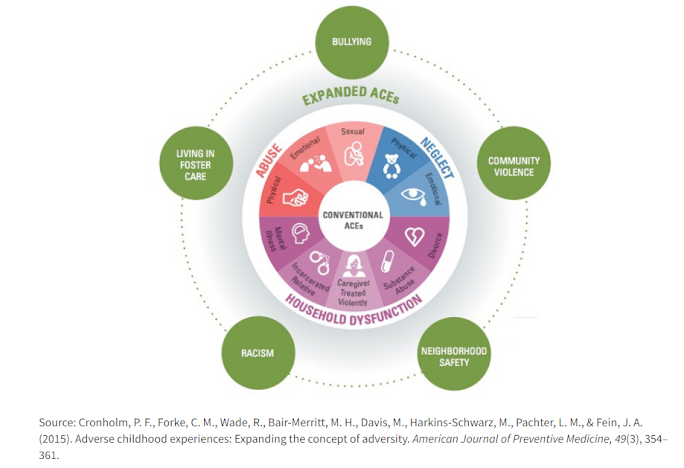
We know that ACES (childhood abuse, neglect and household dysfunction)are associated with risk for substance use disorder. I.e. the more ACES you have, the higher risk you have to have issues with substances, including IVDU.

Trauma Informed Care
  • It is our job to care for patients with a hx of trauma by influencing healthy coping mechanisms and helping patients build resiliency
  • The Substance Abuse and Mental Health Service Administration (SAMSHA) decribes 6 principles of a trauma-informed approach. These are SO important to consider in how to engage with all patients, but particularly those with high ACE scores
    1. Safety
    2. Trustworthiness and transparency
    3. Peer support
    4. Collaboration and mutuality
    5. Empowerment, voice and control
    6. Cultural, historical and gender issues
  • Again, providers should consider how to help patients focus on RESILIENCE and COPING
  • Examples of how to do this include
    • Openly discussing harm reduction methods (prevent dying and suffering)
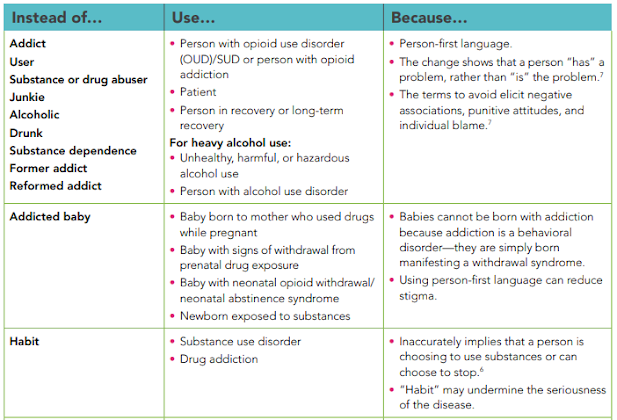
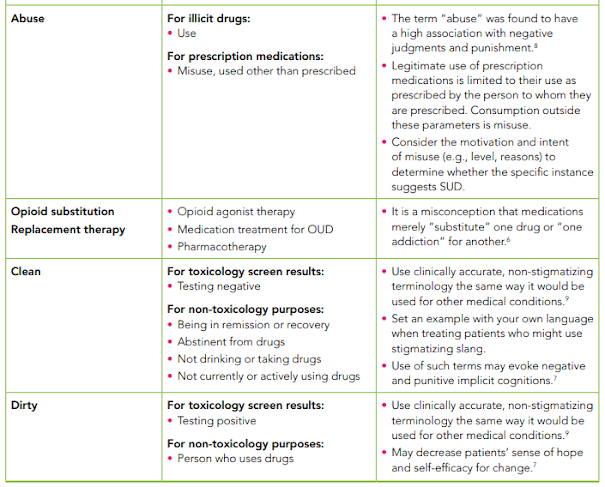
    • Person first language, welcoming, non-discriminatory, non stigmatizing language
      • i.e. person with substance use disorder, person in recovery
      • i.e. avoid "clean" and "dirty" when talking about drug screen results
    • Put up signage offering treatment for opioid use disorder in hospitals and clinics
Words Matter! Check out these tables to make sure that you are using language that is non-stigmatizing.

https://www.drugabuse.gov/sites/default/files/nidamed_wordsmatter3_508.pdf 


Treatment of acute pain and management of withdrawal 
  • If a patient is on BUP, don't STOP it when treating acute pain
    • patients can safely get acute pain meds on top of their BUP
    • you will only precipitate withdrawal at initiation of BUP
    • split dosing to BID for pain management in the acute setting
    • provide sense of calm and comfort (help patient feel safe and connected)
  • Also, schedule tylenol and/or ibuprofen (or toradol) in setting of acute pain
  • consider gabapentinoids, SSRI, TCA, regional block
  • can increase up to 32 mg/day for acute pain
    • add opioids with higher Mu affinity: morphine, hydromorphone, fentanyl
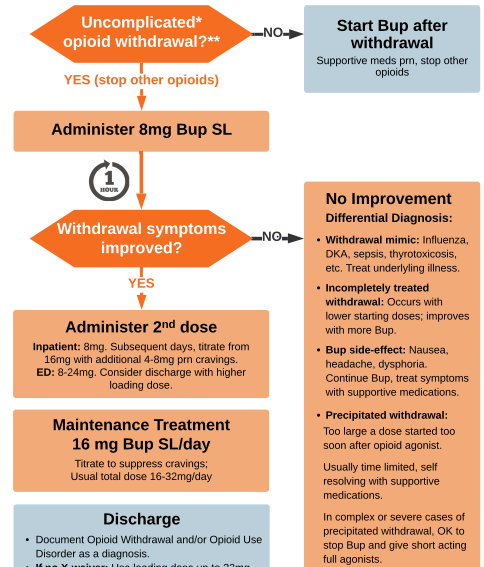
Buprenorphine (BUP) inductions in the hospital (simplified from CA Bridge: https://cabridge.org/tools/resources).
  • Very simple! For uncomplicated withdrawal (COWS>8), start with 8mg BUP SL, recheck in 1 hour, give second dose of 8mg
  • Subsequent days, titrate from 16mg with additional 4-8mg prn cravings
  • Labs to consider (but don't need results to start): UDOA, CBC, HIV, HCV, RPR, HCG, HAV and HBV immunity
  • Adjunctive medications: acetaminophen (pain, headache), clonidine (w/d symptoms), diphenhydramine (anxiety), loperamide (diarrhea), ondansetron (n/v), trazodone, melatonin (sleep)


Microdose inductions of BUP
  • Very slow start of BUP to decrease or even eliminate withdrawal symptoms 
  • Consider: if patient taking methadone, history difficulty BUP start, transitioning from prescription opioids, intentionally taking fentanyl daily
  • Avoid: if already significant withdrawal (it's too slow), don't want to continue full opiate agonist, risk for respiratory depression/sedation, prefer rapid start
Harm reduction refers to a set of policies, programs and practices that aim to reduce health, social and economic consequences of drug and alcohol use. 
  • Reduce stigma by being a safe place, regardless of ongoing substance use
  • Offer clean needles (available at Face to Face, DAAC, but also on PHP formulary (see image below)
  • Always give Narcan Rx
  • Give Fentanyl test strips (available at Face to Face)
  • Resource support
  • If patient leaving AMA, give direct phone # to outpatient MAT care:
    • Marla Pfohl MAT program manager SRCH 707-890-0375
    • Erick Hill, Matt Clinic supervisor SRCH 707-867-8690
    • Never Use Alone phone # 800-484-3731
  • Connect to outpatient MAT, give bridge Rx to outpatient MAT (x-license no longer required)


Diagnosis and Management of Osteoporosis (Hamann 7/23/2026)

 A recording of this presentation is available HERE .  *** Thanks so much to Dr. Kendal Hamann, SMGR Endocrinologist, for an outstanding Gra...