Showing posts with label race. Show all posts

Race-Based Affinity Caucusing as a Tool for Promoting Equity and Inclusion (Washington, 1/19/2022)

Many thanks to Dr. Sharon Washington for an important presentation on Race-Based Affinity Caucusing as a Tool for Promoting Equity and Inclusion

It is always worth your time to listen to Dr. Washington. She has been a tremendous resource and teacher for our anti-racism work at Santa Rosa Family Medicine Residency. A recording of her presentation is available HERE

Dr. Washington opened with two recent articles from the medical literature exploring racial harms in the healthcare setting and recommended that leadership teams could explore caucusing as a tool to support community, connection, and racial healing and equity in the health care setting

Paper #1: Racism as Experienced by Physicians of Color in the Health Care Setting, Serafina et al, Family Medicine 2020, exploring racism as experienced by physicians of color

  • 71 physician participants, 88% family medicine physicians
  • 72% female, 1.4% gender non-binary
  • 34% black, 34% Asian, 24.7% Hispanic/Latinx, 1.4% Native American/Alaskan Native
  • 33% English as a second language (ESL)
  • Dr. Washington notes two caveats
    • we know that physicians are higher in medical hierarchy, and this study doesn't take into account experiences of nurses, support staff, that are also BIPOC
    • the study also doesn't include color/lightness of skin (which we know plays a role in the experience of racism), and which we know from previous studies is likely to be lighter than those of staff lower in medical hierarchy
Findings from this study
Experiences offered by Physicians of color (POC):
  • more likely to experience racism from colleagues than from patients
  • 23% POC reported a patient refused their care because of their race/ethnicity
  • ESL POC report more incidents of racism than those with English as first language
  • Experiences of micro-aggressions are associated with secondary trauma/stress with ongoing implications in the mental and physical health of these POC
    • surprisingly, not statistically significantly associated with compassion fatigue or burnout
Qualitative themes from this same study:
How has institutional racism affected you?
  • exclusion from leadership advancement (treated differently than non-black counterparts)
  • assumptions discounting abilities or expressing stereotypes
  • being held to higher standards than white counterpart
  • numerous microaggressions in the workplace without response from the institution
Incidences of racism from a colleague. . .
  • many did not have an example of experience of racism from colleague 
  • microaggressions from colleagues: assumption they are not a doctor because of race, general lack of respect, homogeneity bias
  • assumptions: e.g.  about medical knowledge in context of accented English
  • invalidation: lack of trust
Instances of racism from a patient. . .
  • microaggressions
  • assumptions
  • patient refusal of care
  • adaptation: comments on "where were you born and how how well I speak English"
  • psychological burden of patient questions "where are you from", "Are you Korean"
  • patients reacting differently to the same advice when offered by a colleague
  • differential treatment: non-verbal, body language
Dr. Washington remarks: above are the experiences that POC revisit (and hyper-revisit), struggle to let go of, not for lack of conscious effort, experiences that can cause physical and chemical reactions when these types of instances happen with patients, colleagues, staff, etc. have weathering/long term effects on physical and mental well-being, ability to stay in the work place

Recommendation for promoting inclusion includes listening to POC, offer diverse representation in leadership, staff and recruitment, empowering BIPOC leadership

  • learners (students, residents) and lower level health care staff are more vulnerable to racial trauma, particularly during pandemic
    • seeing selves in the disparities, seeing structural and interpersonal practices
  • creating a safe and trusting environment where staff can share their racial trauma
  • training managers and supervisors (skills, time)
  • engage in deep listening to the trauma stories
  • provide concrete support, if needed (e.g. escort at night to the car, restorative time off)
Note from Dr. Washington: while the title includes "health care staff" this is actually another paper about physicians. Researchers need to be reflecting on the power hierarchy and be sure to extend beyond physician experience when reporting on this topic

Racial Affinity Group Caucusing is approach to bring people together, based on shared mindset, identities, orientation (e.g. physicians come together, nurses have meetings)
  • allow group to focus on manifestations of how we internalize racial oppression in a system that is hierarchical, promotes dominance, and is inherently racism
    • identify where behaviors originate
    • collectively find new behaviors that stop self-perpetuation of cycles of these concepts
  • allows groups that identify as white to come together, people who identify as black (or African descent), groups who identify as Latinx (or Hispanic)
    • the bigger the group, the more specific these groups can be
    • allows people to be in "safer space", grounded in "shared experiences" to explore structural racism, how we contribute to perpetuation
    • seek to explore ways in which we contribute in unintentional ways
  • build communication skills to stay present and effectively navigate cross-racial dynamics
    • our bodily reactions can make it hard to stay present if we don't have the racial literacy to stay present in our bodies
  • allow for creation of community of dialogue, accountability, support institutional growth of equity and racial inclusion
  • challenges white folks to do their own work (and not rely on BIPOC to do the work)
    • allow white people to develop a racial identity, own one's racial identity (just like BIPOC do every day)
    • leverage the sense of self to be committed to growing together in anti-racism
  • within BIPOC spaces caucusing allows be understood, collaborate, not have to explain or be believed
    • have more nuanced, deeper more complex conversations about intersection and deeper identities, how BIPOC perpetuate other forms of bias and dominance in other identities
What does caucusing look like?
Priming content: e.g. podcast, readings, video content
Groups (as defined by the institution) but self-selected by the participant
Planned curriculum discussion, agenda with a trained facilitator/moderator
Engage in dialogue and discussion during the session
Have some sort of report out: sharing, transparency, accountability to the other caucus groups

What is caucusing is NOT?
not place to whine/complain, not hate fest, hot pot for racism
people are not assigned for multi-racial or mixed race person (they can be fluid), people self-identify and choose the group 


A final note: Caucusing is NOT "the only answer" to solving racism in the health care setting.
Caucusing must be combined with a comprehensive PROGRAM of equity and inclusion, including DEI leadership, committees, curriculum and trainings, policy, metrics of accountability, dashboards, and a concrete commitment of the organization to anti-racism work. 


Is it Vaccine Hesitancy? (Thompson 9/22/2021)

Many thanks to Dr. Cherriese Thompson for a thought-provoking Grand Rounds this week titled "Is it Vaccine Hesitancy?" in which she explored the historical and present day impediments that make it challenging for BIPOC to accept and receive the COVID-19 vaccine and discussed ways to mitigate barriers to vaccine admin and acceptance. 

Dr. Thompson defined vaccine hesitancy as: "a delay in acceptance of refusal of vaccines despite availability of vaccine services". This definition, Dr. Thompson, told us, assumes a level of complacency, convenience and confidence. We may want to question these assumptions. 

A recording of her presentation is available HERE.

Here are my notes:

We all know that COVID-19 disproportionately affected BIPOC in the US with increased rates of hospitalizations and death over population levels (see image below)


Racial breakdown of vaccine trials: while these vaccine trials have been praised for inclusion and diversity, there is still much work to be done to be sure they are reflective of the population


Rates of vaccination by race/ethnicity (updated 9/21/2021):


Concerns about COVID-19 vaccination in communities of color include medical and structural racism, as well as historical and present day trauma

For Black/African American people
  • Centuries-long history of experience of discrimination in health care, being ignored or dismissed: "if you haven't cared about me in the past, why should I believe you care about me now?
    • slave ships in Middle passage: sick slaves thrown overboard or forced treatment
    • medical experimentation on black women's bodies
    • withholding medical treatment for slaves
    • 1973: yellow fever outbreak, one physician believed black people were immune and didn't give treatment
    • 1932-1972 Tuskegee study, knowingly withheld treatment to 400 black men for syphilis to watch the progression (100+ died) 
  • Concerns about vaccine incentives: lack of trust in governmental organizations 
  • "Medical racism: The New Apartheid" antivax organization, film specifically targets black communities, weaponized history of experience of black people, "should you really get this vaccine?", false claims regarding potential vaccine harm
  • Social media: misinformation on Twitter and FB, e.g. Nicki Minaj (famous rapper) on Twitter:

For Hispanic/Latinx people
  • concerns about female fertility
  • concerns that the vaccine contains stem cells, ethical to take vaccine if prolife?
  • worries that the vaccine itself may give you COVID
  • Spanish language information (on Whatsapp and Telegram channels) discuss ineffectiveness of masks, vaccine ineffective
  • Vaccine being used to track down immigrants and deport them
For Native American/Indigenous
  • historical trauma leading to skepticism
    • 1970: Family Planning Act: sterilization of more than 25% Native American women without consent
    • 1989 Havasupai Tribe asked for assistance from John Martin, anthropologist to understand diabetes in their community; blood samples provided were used without their consent to study schizophrenia, alcoholism, inbreeding and origins and migrations of their people
  • concern people might be injected with COVID from the vaccines
  • huge concern about speed of manufacture
  • historical distrust: "Am I willing to gamble that they care this time?"
  • lack of involvement of their own populations in clinical trials
And, unfortunately, this is not just about historical trauma, but ongoing/current lived experiences for BIPOC
Reframe. This is NOT hesitancy. There are real impediments, many impediments. 
  • Among the impediments: skepticism, lack of accurate information, actual vaccination access, including online only signups, issues with appointment scheduling transportation
  • Having the time to be vaccinated: working multiple jobs
  • Valid concerns about being unable to get vaccinated due to vaccine side effects and not be able to take time off work, or because you are caring for others
  • Pharmacy Deserts (residents living >1/2 mile from a pharmacy), many exist in communities of color. A lot of these communities lack reliable transportation to get/to from pharmacies to get vaccines. CVS, Rite Aid, Walgreens, local pharmacies may not have capacity to carry and administer these vaccines 
Okay, what can we do?

1) Get more BIPOC included in clinical trials
  • recruitment of diverse populations, particularly Native American communities-- working with sovereign government and respecting data sovereignty
  • FDA: Enhancing the Diversity of Clinical Trials, ideas include reducing visit frequency, provide flexibility, using electronic communication if possible
  • PhRMA's Equity Initiative
    • building trust and acknowledging mistrust
    • reducing barriers to clinical trials access
    • utilizing real world data
    • boost info of diversity and inclusion in clinical trial participation

2) Increase access to trusted information
  • There is so much misinformation/disinformation out there, more accessible
  • meet people where they are: go into the community, being present to answer questions
  • being a resource to isolated populations
  • Empower individuals to question info they see on social media, question the source, question the validity
  • Provide trusted information: Voto Latino partnered with another organization to provider accurate info to Latinx (they also partnered with Uber/Lyft to transport Latinx to vaccination)
  • CDC: information on vaccine equity, increasing uptake in racial/ethnic communities, communication toolkits, printed resources and posters in multiple languages

3) Improve access to vaccination sites
  •     mobile vaccination units
  •     reach places where access to healthcare is already a problem (rural and urban)
  •     targeting opening vaccination sites within vulnerable communities (i.e. Roseland Library)
  •     pop up vaccination sites
  •     home vaccination (to the most vulnerable)
  •     clinics and pharmacies providing access

4) Foster trust and utilize empathy
  • creating a space for patients in the room
  • take the power away, ask the patient "Can I talk to you about the COVID vaccine? What are your concerns? What have you heard about it? How has it affected you?"
  • Create open dialogue to explore skepticism
  • foster continued discussion
  • provide accurate information
  • show empathy: patients often will trust their doctor over time, if they felt heard/held

5) Shift the blame
  • there will be skepticism; don't blame the individual patient for their skepticism
  • relieve the blame to foster an environment of trust and open dialogue

6) Increase BIPOC pipelines in healthcare
  • more funding and access for BIPOC in healthcare
  • "Because I am black, and I have been vaccinated. . .and I hear your concerns. . .Here is what I experienced." That means so much to a lot of my black patients
7) Dismantle structures of racism inherent in medicine

Birth Equity (Jimenez, Lund, Bacon 9/8/2021)

Many thanks to Drs. Jimenez, Lund and Bacon for an important presentation on Addressing maternal health disparities and birth equity this week. A full recording of their excellent presentation is available HERE.

https://youtu.be/Y2uJEZyT1ZE

My notes:

What is birth equityBirth equity is the assurance of the conditions of optimal births for all people with a willingness to address racial and social inequities in a sustained effort  

https://www.cmqcc.org

Dr. Jimenez led off with a review the concept of race

  • The notion of race is a social construct designed to divide people into groups ranked as superior and inferior. Societies use race to establish and justify systems of power, privilege, disenfranchisement and oppression
  • Scientific consensus: race has no biological basis (we are all one race)
  • In a racialized society like the US, we are all assigned a racial identity, whether we are aware of it or not
  • Geographic ancestry (which does have genetic importance) is not the same thing as race (which does not)
  • 1700s, Carl Linnaeus, father of modern taxonomy, classified our own species into races based on reports from explorers and conquerors 
    • Americanus, Africanus, Europaeus, Asiaticus, Monstrosus
    • Western concept of race is based on a classification system that emerged from, and in support of, European colonialism
He followed with a review of racism and bias
  • Racism is an organized system premised on the categorization and ranking of social groups into races, and devalues, disempowers, and differentially allocates desireable societal opportunities to racial groups regarded as inferior (Bonilla-Silva 1996)
  • Racism often leads to the development of negative attitudes (prejudice) and beliefs (stereotypes) toward non-dominant stigmatized racial groups and differential treatment (discrimination) of these groups by both individuals and social institutions 
  • Bias is a decision we make so quickly that it simply occurs to us as data; we don't even rela
Dr. Jimenez finished his section with real life examples of racism in maternity care (past and present) and an encouragement that we must begin to come to terms with our own past
  • The 2018 story of tennis star Serena William's emergency c-section, complicated by PEs and failure of her physicians to listen to her and diagnose her quickly
  • Slave-holding surgeon (Francois Marie Prevost) pioneered c-section surgeries on American enslaved women's bodies through repeated experimentation
  • In the 1840s, J Marion Sims, father of modern gynecology, was a plantation physician and then gynecological surgeon in Alabama--> experimental surgeries on enslaved women for vesico-vaginal fistulas. Did not use anesthesia, despite it being readily available. Got rich and famous from his work.
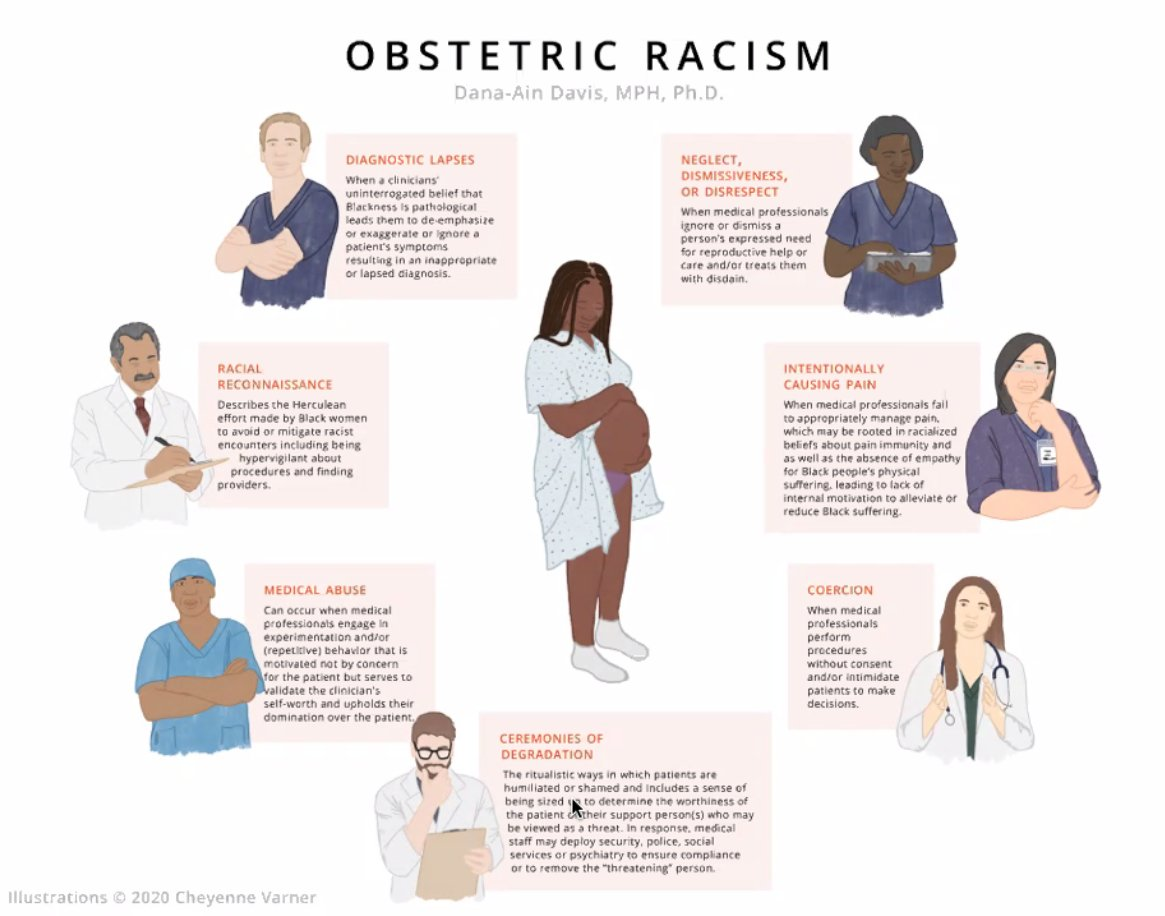
  • Consider reviewing the image below to understand how racism impacts obstetric care
Dr. Lund took part 2 of the presentation to review disparities in maternity care in the US
  • Black women experience far worse outcomes than any other racial or ethnic group. Black women:
    • are 3-4x more likely to die than their white counterparts
    • comprise 13.5% of live births, but 35.5% of pregnancy-related deaths
    • have higher preterm delivery (13.4% vs. 9%)
    • have higher c-section rate (RR 1.23)
    • have higher PPH rates (3% vs. 1.6%)
    • have higher peripartum infection (4.9% vs. 4.1%)
  • Pre-E, diabetes, and and unintended pregnancy are also higher for black women
  • American Indian/Alaskan Natives (AI/AN) are also at risk for adverse outcomes
  • Black and AI/AN infants are more likely to die in their first year of life
    • black infants diet at greater than 2x rate of white infants (11.4 vs. 5.2 per 1000 live births)
California has been working hard since 2006 to reduce our maternal mortality rates, and it's working!
(this graph below shows a decline by 55% 2006 to 2013)
However, despite tons of successful work to reduce maternal mortality, the disparity ratio (black women vs. white women) remains unchanged (see image below):
Dr. Lund also shared some of our local stats at SSRRH
  • ~50% of our deliveries are to Hispanic patients (~ 20% US-born and 30% foreign born)

  • Another 37.5% of our deliveries are to non-Hispanic White identified Patients
  • 4.5% of births to Asian or Pacific Islander patients
  • <2% of our deliveries to non-Hispanic Black identified Patients
  • About 2% “other” which primarily represent American Indian/Alaskan Native patients
  • A full 6% were race/ethnicity “unknown”
Dr. Lund shared important outcomes for our maternity patients, including NTSV c-section rates, maternal morbidity, preterm birth rates, unexpected newborn complications, and exclusive breastfeeding at discharge:
  • Hispanic born US rates of pLTCS are the lowers of all, much lower than state average
  • Non-Hispanic black patient cesarean rates are about 4% higher than almost all others but lower than state average. 
  • Our “other” category (largely AI/AN) exceptionally high NTSV c-section rate. Total # of patients in the “other” category higher than for non-hispanic black but still only about 145 patients over 5 years. 


And for preterm birth:

  • Non-Hispanic Black preterm birth rate is similar to others at our facility and lower than state average, however note that #’s are quite small so should continue to trend over time 11 patients out of 124 patients total in 5 years. 
  • Rate of PTB among white patients higher than the rest of CA
  • “Other” preterm birth rate is quite high, mostly represented by AI/AN individuals, numbers still low 28 patients out of 144 over 5 years. 


What can be done?

Dr. Bacon capped off this week's Grand Rounds presentation with a series of recommendations of how you might engage in local advocacy and beyond to work on birth equity:

  • Individual work: if you are unsure where to begin and/or unsure about what you think about this information, individual work is the place for you
    • consider reading and/or listening to podcasts, listening to the experiences of others (particularly BIPOC), assessing your own personal unconscious bias, and work on retraining your brain on these biases
    • Listen to Dr. Camara Jones
    • Visit Project Implicit
    • I personally recommend Seeing White on Scene On Radio as a good place to start (we have been listening to this as a faculty for our anti-racism work)
  • Institutional work
    • there are lots of robust toolkits and trainings to help guide institutions
    • these might help you help guide YOUR institution
    • try: CMQQ, ACOG/SMFM, https://blackmamasmatter.org/, CDC's Hear Her campaign
    • Locally, attend CEDAWG grand rounds, September 22 Foundations for Health Equity Workshop, UCSF Differences Matter, Trauma informed care trainings
    • Check out the SSRRH Labor Culture Committee (LCC) at SSRRH (inquire with Julie Barajas or 
  • Community Work
    • Workforce development, pipelines
    • Community health workers
    • Doulas
    • Black midwifery
    • Centering pregnancy
  • Statewide and National work
    • Pay attention to what is happening in politics and policy:
      • SB65: a bill that creates a committee to investigate maternal deaths, examines adding a doula benefit to medi-cal funding, and helps low income communities have access to midwifery care
      • California AB4: removing documentation status for Medi-cal benefits
      • Governor Newsom's 2022 budget, which includes California extension of OB Medi-cal to 1 year postpartum
    • Also take a look at commonwealthfund.org Maternal mortality and maternity care project

And more resources:

Jenee Desmond-Harris: Implicit bias means we're all probably at least a little bit racist. https://www.vox.com/2014/12/26/7443979/racism-implicit-racial-bias

Eric Deggans: 'Not Racist' Is Not Enough: Putting In The Work To Be Anti-Racist. https://www.npr.org/2020/08/24/905515398/not-racist-is-not-enough-putting-in-the-work-to-be-anti-racist

Camara Phyllis Jones, MD, MPH, PhD: 


https://www.projectimplicit.net/

CDC Hear Her campaign: https://www.cdc.gov/hearher/resources/download-share/warning-signs-poster.html

ACOG Health Equity Curriculum: https://www.acog.org/education-and-events/creog/curriculum-resources/additional-curricular-resources/health-equity

ACOG CO 649 (2015): Racial and Ethnic Disparities in Obstetrics and Gynecology https://www.acog.org/-/media/project/acog/acogorg/clinical/files/committee-opinion/articles/2015/12/racial-and-ethnic-disparities-in-obstetrics-and-gynecology.pdf

Black Mamas Matter Alliance Toolkit: https://blackmamasmatter.org/resources/toolkits/


Interrupting Racial Trauma: Strategies & Tools to Assist Health Care Professionals to Do No Harm (Washington, 2/17/2021)

A HUGE thanks to Dr. Sharon Washington for her wisdom on interrupting bias in the health care setting. Engaging in anti-racism is hard work. We know that every institution in this nation is struggling now to confront the recognition that race and racism are a fundamental part of who we are as a nation, as a society, and as a community. Healthcare is no different. I will add a summary of this Grand Rounds in the near future. Better yet: watch it yourself here: https://youtu.be/YpjNkCTNpxY

Health Equity (Muodeme, 7/23/2020)

Special thanks to Dr. Ada Muodeme for her thoughtful and thought-provoking Grand Rounds this week on Health Equity. 

A friend and healthcare provider asked me this week, "Why are you hosting  so many Grand Rounds on race, racism, equity, and inequity?" My response is the following: "We bring you these topics because we-- the Sonoma County medical community-- need formal education on these topics. We need race discussions in our academic centers, in our hospitals, in our clinics, in our classrooms, break rooms and beyond. Grand Rounds is a natural place to start these conversations."  

And I am so grateful to our brave residents for being the leaders of this education!

While social justice was definitely integrated into my own medical training, race and racism in medicine were definitely not a part of any training. I did not get taught about how race and racism are structurally a part of medicine. I was not trained on allyship, anti-racism or white privilege. These are topics most white people (myself included) need to hear, read about, grapple with, and consider both personally and professionally. While many of our current residents come to us now with formal training in race and medicine, their teachers have little to none. 

And so we do this work.

This is another GR presentation by a BIPOC better listened-to than summarized by a white gal like me, but here are a few key points:
  • Dr. Muodeme reminded us that healthcare comprises only 10% of an individual's health and well-being-- the remaining 90% includes behaviors, environment, societal factors, etc. She grounded her talk in the historical perspective of the African American citizenship status and health experience from 1616 to 2020-- slavery, Jim Crow, and Civil Rights. 
  • Dr. Muodeme also shared with us a definition of health equity: "The attainment of the highest level of health for all people". Health equity-- she continued-- requires valuing everyone equally, societal efforts to address avoidable inequities and injustices, and the elimination of health and healthcare disparities.
  • But what I appreciated most about Dr. Muodeme's presentation was her focus on the concept of unconscious bias, and the process of self-reflection and self work we all need to do to help mitigate those biases. "I don't know a doctor who comes to work thinking I don't want to right by my patients today," she said. "I don't know a doctor who thinks I am going to treat my black patients differently". And yet, we know we do. The system does. And we do. 

And so, pay attention, watch your thoughts, all. And see you next week!

Watch your thoughts; for they become words. Watch your words; for ...


Allies and Accomplices: How Health Care Providers Can Cultivate Equity (Washington 7/15/2020)

Well, Dr. Sharon Washington did it again. And this time on Zoom (which is no easy task). She pushed us. And moved us. To think differently. To act. To do better. To question the insidiousness of race and racism embedded in our society and in medicine. To not be not racist, but rather to be ANTI-racist. She is such a tremendous speaker and incredible teacher, and we at the Santa Rosa Family Medicine Residency are so lucky to have had her with us this last year and a half. 

A summary cannot really do Dr. Washington's work and words justice. I highly recommend you watch the Grand Rounds if you did not attend live, but nevertheless, here are some highlights. . .

Racism is not merely one individual's negative thoughts about another person of a different race. Racism is more layered and complex. It includes:
  • internalized: the devaluing of one's own identity and culture according to societal norms
  • interpersonal: the way in which we perpetuate racism on an individual basis
  • institutionalized: the way in which institutions perpetuate racism
  • structural: system of public policies, institutional practices, cultural representations, and other norms work in various, often reinforcing ways, to perpetuate racial group inequity
Dr. Washington highlighted the legacy of inequity for African Americans in the US dating back 401 years (see image)

Dr. Washington reminded us that:
  • There is racial bias built into almost every aspect of healthcare.
  • Significant health disparities exist for people of color in chronic disease (diabetes, cancer, heart and kidney disease), infant and maternal mortality, stroke, addiction and mental illness.
  • People of color receive fewer/less breast cancer screenings, kidney transplants, vaccinations, eye exams cardiac care, cancer pain meds, revascularization procedures, and mental health treatment.
In order to not be part of the problem, health care providers have a responsibility to be ANTI-racist: the active process of identifying and eliminating racism by changing systems, organizational structures, policies and practices, and attitudes so that power is redistributed and shared equitably.


What is allyship? 
Allyship is a person of one identity group standing in support of another identity group 
  • allyship is not a noun, it's an action
  • allyship is about listening
  • allyship is not a proclaimed identity--> trust is earned
  • allies don't take breaks
  • allies educate themselves (and don't expect marginalized people should teach you)
  • allies don't need the spotlight
  • allies focus on those who share their identity
  • when criticized or called out, allies listen, apologize, act accountable, and act differently going forward
What is an accomplice? 
"While an ally will mostly engage in activism by standing with an individual in a marginalized community. An accomplice will focus on dismantling the structures that oppress that individual or group-- and such work will be directed by the stakeholders in the marginalized group" (Teaching Tolerance)
  • accomplices assess an organization for inequities in hiring, promotion, pay, evaluation, termination, etc
  • accomplices encourage major institutions benefiting from inequities to invest in marginalized communities
  • accomplices engage in anti-racist assessment of laws, policies, institutions, and systems
  • accomplices divest institutions from (private) prisons, detention centers, and institutions engaged in systems harmful to BIPOC
  • accomplices promote self care for BIPOC
  • accomplices create systems of accountability for supporting hate speech and behavior

Examples of what allies and accomplices can do in medicine:
  • Petition the laboratory you use to stop reporting GFR differentiated by race
  • Hold a fellow physician accountable if they send a racist email or make a racist comment
  • Interrupt micro-aggressions when they are happening
  • Don't vote to appoint someone to the board unless they divest from investments that perpetuate racist structures
  • Pass the microphone to the marginalized person next to you whose voice is not often heard
Questions to ask yourself:
  • In what ways can you be an ally?
  • In what ways can you be an accomplice?
  • In which institutions do you have agency to create structural change?
  • What is holding you back from taking action?
  • What commitment can you make to move you toward meaningful action?

Diagnosis and Management of Osteoporosis (Hamann 7/23/2026)

 A recording of this presentation is available HERE .  *** Thanks so much to Dr. Kendal Hamann, SMGR Endocrinologist, for an outstanding Gra...