A recording of this presentation is available HERE.
***
This week's Grand Rounds on Long COVID was a practice-changing presentation! If you are caring for patients in a primary care setting or know someone who is suffering from Long COVID, I highly recommend you watch the entire presentation by Dr. Marcos Siqueiros, of KP Santa Clara. Dr. Siqueiros covered a TON of material, including what is known about Long COVID's epidemiology, risk factors, pathophysiology, and both medication and lifestyle/behavioral recommendations for management of Long COVID.
Here are my notes:
Unfortunately, there are a number of different definitions of Long COVID
- CDC: symptoms persist >4 weeks after COVID (live virus no longer detectable)
- WHO: symptoms present >3 months after acute COVID illness, lasting at least 2 months
- National Academies of Science: infection-associated chronic conditions after SARS-COV2 infection, present for at least 3 months as either continuous, relapsing/remitting or progressive, affecting one or more organ systems.
- PASC: Post-Acute Sequalae of COVID, lasting 4 weeks or longer


Epidemiology
17-18% of all US adults reported having long COVID at some point since 2020, ~7% having ongoing symptoms
20 million adults in US, 2 million adults in CA are experiencing Long COVID today
Long COVID numbers have declined, but rate has been consistent 6-7%
Characteristics of those who develop Long COVID
-higher rates of comorbid/preexisting health conditions, tend to have experienced more severe COVID illness or were hospitalized
-unvaccinated, greater # of infections PRIOR to vaccination increases risk of Long COVID
-adult population slightly lower (3x rate for people in 50s compared to 80s)
-higher rates in Females, Latinx/Hispanic
-increased rates in white Americans, rural regions, lower income households
-bisexual/transgender more likely to report Long COVID sx
Economic costs of Long COVID
-2-4 million people in US out of work due to disability to due Long COVID
-$168 billion/year, revised to $3.7 trillion/year
Clinical Manifestations
Long COVID symptoms can lingers weeks, months, longer. Severity and type can vary. Most patients will experience resolution of their symptoms by 1 year. Patience is key.
>200 symptoms under the Long-COVID umbrella, extremely non-specific, hard to categorize broadly
Symptoms tend to wax and wane, can be linked to any severity of acute infection (most people now only get mild COVID)
Symptoms vary according to variant
Pathophysiology
A complete understanding of pathophysiology is not established, but basic science is working to understand mechanism/pathways that can explain symptoms.
-Direct AND indirect mechanisms
-ACE2 receptors ubiquitous and expressed in various tissues in the body (heart, lungs, GI), involved in breaking down Angiotensin 2 to promote homeostasis, also downregulates inflammation. If left unchecked/unregulated, can get uncontrolled/chronic inflammation. When COVID infects the host, binds to ACE2 receptor sites, which makes it less available to break down Angiotensin 2>> release of cytokines and inflammatory mediators>> immune dysregulation and chronic inflammation

Clinical management 3 common conditions:
1) Chronic Fatigue is the MOST common symptom reported with Long COVID, can last weeks/months/years. Lingers the longest. This is profound and unusual persistent sense of exhaustion after simplest of activities, including ADLs. By definition, Chronic Fatigue must be present >6 months, otherwise it is called Long-COVID with prolonged post-viral fatigue.
Post-Exertional Malaise (PEM) commonly expressed by people with Long COVID. Can be induced by either physical or cognitive activities. Sudden drop of energy and profound fatigue that leads to struggle to complete activities for the day. Can be hours to days. Creates frustration, discouragement and fear.
A small observational 2023 study from Amsterdam found that abnormalities due to PEM are due to significant defects in skeletal muscle due to exercise-induced myopathy with infiltration of immune t cells and amyloid deposits. Also severe reduction of mitochondrial enzyme activity>> premature lactic acid buildup in skeletal muscles. This explains marked reduction in exercise capacity.

Treatment/Management for Long-COVID associated Chronic Fatigue
Medication
Low dose naltrexone (LDN), non selective opioid antagonist, seems to help with chronic fatigue. Well tolerated, reduced CNS inflammation, upregulates endorphins.
Dosed at bedtime 0.5mg-4.5mg (start low go slow, increase q2-3 weeks)
Side effects: vivid dreams, insomnia, GI upset (mild). If sleep disturbances, can give earlier in day
Anecdotally, about 1/2 of people that try LDN report some improvement in fatigue and brain fog
Lifestyle
Stress relief, sleep, nutrition
People able to reduce sugar and caffeine intake demonstrate less fatigue
Avoiding dehydration is key
Review meds and others substances that can worsen fatigue
Control comorbid chronic conditions that also exacerbate fatigue (DM, OSA)
Pacing is a mindset of learning to conserve energy balancing time spent on activity vs. time spent on rest with goal to increase participation in activities. Deliberate self-management strategy. Has evidence in Long COVID to improve energy and endurance

2) Brain fog is an umbrella term used to describe cognitive dysfunction associated with Long COVID. It is vague. No way to distinguish. Areas of cognition impacted: memory (working memory), attention (conversation details, following complex stories, multi-tasking), fluency (word finding), executive function (step by step actions, organizing or performing cognitive tasks).

Possible mechanisms of brain fog:
Direct: COVID enters CNS by retrograde transport along olfactory nerves, virus can cause direct toxic injury
Indirect: disrupted blood brain barrier, more permeable and porous. Disruption of BBB allows entry of inflammatory mediators to enter the CNS, disrupting cognitive function (2023 study in Nature Neuroscience found elevated biomarkers in people with long COVID and brain fog similar to TBI patients). Further study needed.

Off label Medications
- Guanfacine (old drug used for hypertension, selective alpha 2 receptor agonist, thought to improve working memory, improved attention. Used in TBI, ADD). Can drop BP. Protocol out of Yale combine guanfacine with NAC. (see below)
- Also SSRI/SNRI, stimulants (care w/habituation, tolerance, should be used rarely), amantadine (influenza anti-viral) increases dopamine release and prevents reuptake (used in TBI and CFS, 100mg BID)
- LDN (see above)

Stress reduction, screening for and management of anxiety/depression
Reduce neuroinflammation with healthier eating (low in carbs, simple sugar, low in caffeine)
Avoid neurotoxic substances: ETOH, cannabis, other drugs
Limit screen time (neuro-stressor), too much screen time can overtax brain and worsen brain fog
Quantity/quality of sleep: sleep hygiene rests nervous system, reduces neuroinflammation (turn off electronic devices)
3) Orthostatic Intolerance (OI) and Postural orthostatic tachycardia syndrome (POTS)
OI: uncomfortable symptoms that arise when moving to an upright position (faint, dizzy, palpitations, chest pain, SOB, blurry vision, coat-hanger headache). Often patients with OI need to lay down or sit to make symptoms to stop.
POTS: Same symptoms of OI, accompanied by HR increases >30 bpm within 10 minutes of standing
OI and POTS are both due to dysregulation of Sympathetic and Parasympathetic balance, probably involves Vagus nerve. Need to r/o underlying cardiac conditions!
NASA lean test can distinguish OI vs. POTS

- Hydration: ultra hydration, drink at least 2L of fluid/day, wake up and hydrate first thing int he AM, hydrate every 2-3 hours
- Salt Loading: increase sodium intake to at least 3000mg/day, can go as high as 10,000mg/day (very high), add salt or sodium tablets
- Compression: compression garments in lower limbs, torso
mid-thigh/waste-high compression stocking (20-30mmHg compression)
belly/abdominal binders
commercial body shapewear (e.g. Spanx)
Also, discourage people from laying around in bed for prolonged time, can worsen symptoms in the long run. If rest needed, avoid resting flat (HOB up by 6-10 inches) to minimize orthostasis. Get up slowly, give CNS chance to accommodate posture
Avoid anything that worsens dehydration: alcohol, caffeine, hot temperature (stream baths, hot day)
Medications (see image below)
Non-selective BB, e.g. propranolol
Flourinef (BP)
Midodrine
Ivabradine
IV saline boluses

-Paxlovid not shown to treat or prevent Long COVID
-Vaccines do prevent Long COVID, if shots tolerated, they are probably beneficial (large multi-national studies). The more boosters you get prior to getting COVID, less likely you are to get Long-COVID. For some people, vaccination improved Long COVID symptoms. However, vaccination (and reinfection) can also aggravate long COVID symptoms. Shared decision-making needed. Reasonable to pursue vaccination even in setting of long COVID.
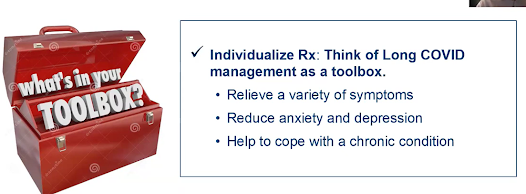
Be holistic, flexible, tailor to patient's individual needs.
Multidisciplinary approach is key, including PT/OT/SLT, nutrition, health education, mental health services
Advocate for patients. Validation and support are important. Bring patients in office for in person exam (no later than 3 months after symptoms started, rule out other chronic conditions)
There are no biomarkers to identify Long COVID, it's a clinical diagnosis
Look for red flag conditions (e.g. heart disease, metabolic/endocrine, etc) and optimize underlying chronic conditions.
Patience is key.