Showing posts with label autism. Show all posts

Care of Patients with Developmental Disabilities (French, 5/7/25)

 A recording of this presentation is available HERE.

***

Many, many thanks to Dr. Anne French, SRFMR Class of '99, who gave a pearl-filled presentation today about caring for patients with autism. Dr. French's many years of caring for patients with Intellectual and Developmental Disabilities (IDD) at Sonoma Developmental Center and now at Santa Rosa Community Health are literally priceless. We are so lucky to have her wisdom!

Please do watch her presentation. 

For those of you who prefer the Cliff's notes and pearls:

  • always presume confidence when speaking with an autistic patient (even if non-verbal), speak as if they understand (they often do!)
  • autism is often accompanied by other psych comorbidities, including anxiety disorders: GAD, OCD, and disordered sleep -- to name a few-- which impede function at school and work
  • other psychiatric comorbidities also exist, including bipolar disorder and ADHD. These may be challenging to tease out
    • look for anxiety
      • consider GABA, fish oil, probiotics (for parents who don't want to use meds)
    • r/o ADHD w/Vanderbilt
      • okay to do trial of meds like Strattera without psychiatrist consult
  • when you see self-injurious behavior (SIB), think physical discomfort (e.g. allergies, headaches)-- naltrexone can be a miraculous treatment for some with SIB (doesn't always work, but blocks the reward pathway for SIB)
  • Dr. French highly recommends the use of Gene Sight, which is covered by both Medicare and Medi-Cal. It is intended to help prescribers understand how individuals process psych meds differently
    • can help avoid medications that will have problematic effects
    • gives MTHFR status (folate), which can be supplemented. Of note,  patients with autism tend to have decreased folate
  • Physicians can only refer autism evaluation to the Northbay Regional Center before age 3, but parents can self refer after that. Give parents the phone number and email address of NBRC if they need to self-refer.
    • Dr. MacLeamy is a clinical psychologist in Petaluma. He and associates have the PHP contract to diagnose autism in SoCo
    • Applied behavioral analysis (ABA) Therapy, parents can self-refer, certified behavioralists can help treat at home/school (e.g. getting autistic kids to take shower, brush teeth, manage school day)>> many people with autism need extra support to reach their milestones
  • Always look for physical causes of agitation (e.g. allergies, dental pain, constipation)
  • Social stories is a simple way to teach people with autism, about social situations and expected behaviors (e.g. this is what happens when you go to the doctor, airport, pap smear, etc)
  • Use EMLA cream for lab draws
  • Medications that help with dysregulation include propranolol, clonidine, guanfacine, May be helpful.
  • Disordered sleep should be treated. Extra challenging in children (limited options). Consider melatonin, 5HTP, Consider Buspar (age >6).
  • Parents can get defensive and feel othered by the healthcare system. Building relationship and trust with them is key!
  • Polypharmacy is a HUGE problem, particularly notable is multiple antipsychotics in boys/men with autism during and after puberty.
    • Deprescribe antipsychotics when possible>> start with highest risk meds, if 2 of something, take one away
    • Oversedation may occur with age
    • Falls and/or ataxia can also be an issue with polypharmacy as patients with IDD age
Gene Sight report


Care of Patients with Intellectual and Developmental Disorders (French, 8/11/2020)

Many thanks to Dr. Anne French, who gave us a jam packed 45-minute mini-fellowship in the Care of Patients with Intellectual and Developmental Disorders (IDD) this week. I learned so much! But also am left feeling like I have so much more to learn. Her 11 years of experience as a family doctor at the Sonoma Developmental Center (SDC) and her sharing about her personal care of own brother with Down Syndrome make her an invaluable community resource. If you or someone you know is caring for someone with IDD and needs consultation, keep Dr. French in mind!

Risks: patients with IDD are at higher risk for neglect, abuse, poverty, substandard medical and dental care

  • ~46% of patients with IDD are on psychotropic medications 
    • 3/4 haven't seen a psychiatrist, 1/3 don't have a psychiatric diagnosis
  • Many folks with IDD have untreated hearing and/or vision deficits
  • High rates of obesity (sedentary lifestyle, poor diet)
  • Despite high rates of diabetes and hypertension, most are under-treated and under-screened
  • Very high rates of dental caries
  • (Dr. French recommends 3 sided toothbrush to prevent caries)
Cultural competency: caring for patients with IDD requires a special cultural competency
  • learn their language
  • "listen with the ears of your heart"
    • how do you get a patient to relax in the clinical environment?
    • how does illness present differently in this population?
    • see them as a fully aware human being
  • develop trust
  • be willing to abandon your own agenda
  • use "people first" language (eg. person with spastic quadriplegia, person with autism)
  • understand disability etiquette
Consent and Conservatorship: who speaks for the patient? (remember to document this in the chart)
  • Conservator: the legally appointed person to manage financial, legal, and medical affairs of an adults who is unable to do so (requires $$ and court)
  • Consenter:  typically family member but also can be a friend (without papers) who demonstrates consistent involvement, recognized in California as valid
  • North Bay Regional Center: if there is no conservator and no family involvement, NBRC signs and acts on behalf of their clients if they are clients of the NBRC
  • Some patients with mild IDD consent for themselves
Vital signs: interpretation of vital signs can be challenging
  • Temp: use infrared thermometer when possible
  • BP: consider wrist BP cuffs (more comfortable)
    • don't assume an elevated BP is correct in setting of agitation/anxiety
    • home BP checks may be more accurate
  • Weights: getting accurate weights (especially for wheelchair bound) can be challenging, use table weights if available (they have at Dutton)
***
Dr. French spent some time talking about the Fatal Four: SBO, Aspiration, Sepsis and Seizures. These are the Top 4 Preventable Causes of Death in patients with IDD. This section was particularly compelling to me because it brought forth many memories of previous patients I have cared for (in clinic and the hospital) presenting with one or more of the following challenges:

SBO
  • Pts with IDD tend to be on multiple meds with constipating side effects (antipsychotics, seizure meds). They also may have poor PO intake, low fiber diet, sedentary lifestyle
  • Underrecognized and undertreated chronic constipation 
  • Some people with IDD have neuromuscular dysfunction due to their underlying condition (e.g. CP)
  • What should you do about it?
    • Ask patients and caregivers about stooling at every visit
    • Insist upon daily bowel care (not PRN only)
    • If unclear, get KUB to assess stool burden
Aspiration
  • pts with IDD often have dysphagia secondary to neurological impairment (e.g. CP) or medications (depakote, antipsychotics)
  • neuromusclar disorders also include motility disorders, leading to more GERD/reflux
  • some people with IDD have postural issues
  • recurrent aspiration PNA causes scarring with reduce lung volumes, actually leading to a special type of COPD
  • feeding tubes do NOT prevent all aspiration
  • What should you do about it?
    • instruct patients and caregivers to keep people sitting up after eating
    • care with volume/quantity of feeding tube feeds
      • hold formula, use pedialyte instead when sick with URI Sx (x48 of hte worst symptoms)
    • use beta agonists nebs aggressively after aspiration sx
    • consider ABI vests (if can tolerate)
    • can use guaifenisin to thin secretions if aspiration event
Sepsis
  • early warning signs are key: know the patient (e.g. "quieter than usual", decreased appetite, "just not themselves", weakness may show up as exaggerated baseline neuro issues
  • understand patient hx and risk factors (e.g. recurrent aspiration, UTIs, gallstones, SBO)
Seizures
  • uncontrolled seizures can lead to sudden epilepsy death, aspiration PNA, other injury
  • epilepsy: there is in epilepsy specialist (for IDD and not) at Dutton
  • many new seizure meds that have less monitoring and less toxicity (e.g. keppra, pharmaceutical grade CBD=Epidolex)
  • Vagal Nerve Stimulators (VNS) can improve qol, especially after 2-3 unsuccessful seizure meds

Additional pearls:
  • Slow medicine: use serial exams, don't try to get it all done at once
  • Train caregivers to look out for signs of illness
  • Agitation may be a sign of communication or physical distress (e.g. pain)
    • don't forget neurogenic bladder, BPH in older men!
    • consider emotional sources: frustration, inability to communicate, abuse
  • Dual diagnosis is common (depression, anxiety, psychosis, ADHD)
  • Dementia (particularly in DS) very high incidence
  • Always send dislodged J tube to ER
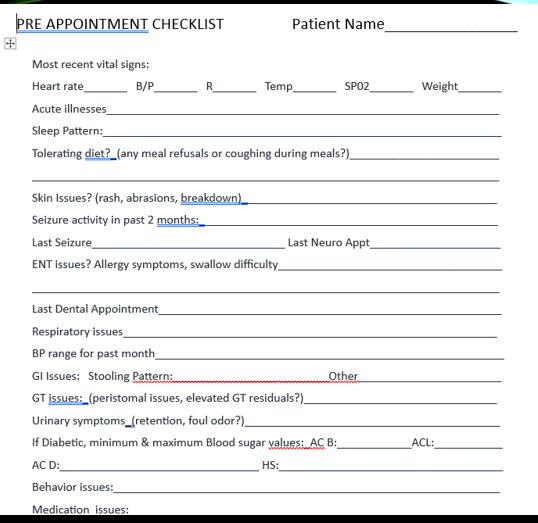
  • Health passport and pre-appointment checklist available on IDD orderset in ECW at SRCH (see images below)


Special Services available at Dutton Clinic (SRCH)
  • primary care IDD co-management (Dr. French, Dr. Camarata, Brittney English FNP)
  • dental care (including sedation)
  • podiatry
  • neurology/epilepsy (Dr. Rowena Korobkin)
  • general surgery (Dr. Michael Bozuk)
  • psych, behavioral health, including psych tech (Dr, Tract Jones, Mark Hecker PT)
Resources recommended by Dr. French:
American Academy of Developmental Medicine and Dentistry (https://www.aadmd.org/)
IDD order set (ECW)
IDD tab on SRCH intranet


2019 Practice Changing Papers: Ob, Peds & Medicine (2/19/2020)


Grand Rounds this week was a little bit like an average day in a primary care clinic: quite full, sometimes fun, and a little overwhelming. Definitely not boring! Three faculty members at the Santa Rosa Family Medicine Residency: Drs. Douglas Jimenez, Cherie Green, and myself presented a rapid medley of practice-changing papers from 2019 in obstetrics, pediatrics and adult medicine, respectively. Here are the the clinical questions, the papers, and a very abbreviated summary of each of our 2019 practice changers:


Obstetrics (Douglas Jimenez)


The question: Does ursodiol improve adverse perinatal outcomes in cholestasis?
The paper: Ursodeoxycholic Acid: versus placebo in intrahepatic cholestasis of pregnancy: A Randomized Controlled Trial (PITCHES), Chappell et al, Lancet 2019
Bottom line: In this study of ~600 women with cholestasis, ursodiol was safe (we knew this) but did NOT improve maternal itching symptoms or lead to a decrease in bile acids. Ursodiol also did not reduce the incidence of stillbirth, spontaneous preterm birth, or NICU admission. Ursodiol might reduce total preterm birth (iatrogenic plus spontaneous). The authors’ conclusions: the only intervention to affect adverse perinatal outcomes is delivery.


The question: What can bile acid levels tell us about adverse perinatal outcomes?
The paper: Association of adverse perinatal outcomes of intrahepatic cholestasis of pregnancy with biochemical markers: results of aggregate and individual patient data meta-analyses, Ovadia et al, Lancet 2019
Bottom line: The risk of stillbirth with cholestasis (usually quoted at 1-3%) increases markedly when bile acids are >100milimol/L. Most women with bile acids <100 can be reassured and should be rechecked weekly until delivery. For women with bile acids>100, delivery should occur between 35 and 36 weeks EGA.


The question: Does hydroxyprogesterone prevent recurrent preterm birth in singleton pregnancies?
The paper: 17-OHPC to Prevent Recurrent Preterm Birth in Singleton Gestations (PROLONG), Blackwell et al, American Journal of Perinatology, January 2020
Bottom line: In this study of 1700 women with a history of preterm labor, progesterone did NOT decrease recurrent preterm birth. There was also NO difference in any of the individual components that were part of the composite neonatal morbidity and mortality. Despite these findings, American College of Obstetricians and Gynecologists (ACOG) and Society for Maternal and Fetal Medicine (SMFM) have not changed their recommendations; they continue to recommend hydroxyprogesterone supplementation in all pregnant women with a singleton gestation and a history of a prior spontaneous preterm delivery.


Pediatrics (Cherie Green)


The question: Is high dose oral dexamethasone our only option for croup?
The paper: Prednisolone versus Dexamethasone for Croup: A Randomized Control Trial, Parker et al, Pediatrics, September 2019
Bottom line: Oral steroids are an effective treatment of croup, and the type of steroid  (high dose dex (0.6mg/kg), low dose dex (0.15mg/kd), prednisolone (1mg/kg)) seems to have NO significant impact on efficacy either acutely or in the week after treatment. 


The question: How accurate is the M-CHAT/F as a screening tool for autism?
The paper: Accuracy of Autism Screening in a Large Pediatric Network, Guthrie et al, Pediatrics, October 2019
Bottom Line: In this “real world” use of the MCHAT in 26,000 children, sensitivity was quite low at 39% with a positive predictive value of 15%; this is much lower than previous studies. However children who screened positive and were ultimately diagnosed with autism, were caught 7 months earlier than those who screened negative. Children of color and those from low income homes were found to have lower rates of screening, screen positive more often, and have more false positives. Be aware of the low sensitivity, and be SURE to follow-up positive MCHAT screens in a sensitive manner.


The question: Which leads to speedier recovery in sport-related concussion: rest or a bit of exercise? 
The paper: Early Subthreshold Aerobic Exercise for Sport-related Concussion: a Randomized Clinical Trial, Leddy et al, JAMA Pediatrics February 2019
Bottom Line: Though the standard of care for sport-related concussion has been sustained rest until resolution of symptoms, this study of 100 teenage athletes shows that sub-symptom threshold aerobic exercise during the first week after injury safely speeds recovery in adolescents with concussion symptoms. 


Adult Medicine (Veronica Jordan)


The question: Should we prescribe intermittent inhaled corticosteroids for mild asthma?
The paper: Budesonide-formoterol in adults with mild to moderate asthma, Hardy et al, Lancet September 2019 
Bottom line: Yes, probably. In this study of ~900 patients with mild asthma, the combination of inhaled corticosteroids (ICS) and beta agonist (SABA) (Symbicort Turbohaler) used PRN led to reduced incidence of both moderate and severe asthma exacerbations. Europe changed their guidelines in 2019 and now recommend ICS-SABA prn as first line in mild asthma. In the US, we don’t have access to the Turbohaler, and the ICS-SABA is much more expensive than albuterol MDI. For very low risk patients, you can probably continue albuterol only, but for anyone with any more risk, consider Symbicort MDI (budesonide-formoterol). 


The question: When should we stop and resume DOACs for patients with atrial fibrillation who are going for surgery?
The paper: Perioperative Management of Patients with Atrial Fibrillation Receiving a Direct Oral Anticoagulant, Douketis et al, JAMA Internal Medicine, August 2019
Bottom line: For patients who are on dabigatran, rivaroxaban, or apixaban for atrial fibrillation undergoing LOW bleeding risk surgeries/procedures (e.g. colonoscopy, dental extraction, pacemaker), stop DOAC 1 day before surgery, restart POD#1. For HIGH bleeding risk surgeries (most surgeries), stop DOAC 2 days before, restart 2-3 days after. Using this standardized perioperative management strategy, there are acceptable rates of bleeding and of arterial thromboembolism, but that number is not 0.


The question: What is new in the 2019 IDSA Pneumonia Guidelines?
The paper: Diagnosis and Treatment of Adults with Community-acquired Pneumonia. An Official Clinical Practice Guideline of the American Thoracic Society and Infectious Diseases Society of America, American Journal of Respiratory and Critical Care Medicine,, October 2019
Bottom line: These guidelines, available here: (https://www.atsjournals.org/doi/full/10.1164/rccm.201908-1581ST) are 23 pages long. Please feel free to read the entire thing. Here are my personal favorite practice changers: 1) Health care associated pneumonia (HCAP) is gone! RIP. 2) You only need blood and respiratory cultures in patients with pneumonia for whom you are treating empirically for either MRSA or pseudomonas 3) No steroids for non-severe CAP 4) Only cover anaerobes in presumed aspiration pneumonia if confirmed empyema or lung abscess (no more flagyl!) 4) Amoxicillin is now FIRST line treatment for uncomplicated outpatient CAP. 5) No routine CXR after pneumonia.

Diagnosis and Management of Osteoporosis (Hamann 7/23/2026)

 A recording of this presentation is available HERE .  *** Thanks so much to Dr. Kendal Hamann, SMGR Endocrinologist, for an outstanding Gra...