Showing posts with label coronavirus. Show all posts

Pandemic Pearls and Pivots: A Public Health Perspective (Drs. Mase & Shende, 5/25/2022)

Many thanks to our SoCo Public Health Officer, Dr. Sundari Mase and our SoCo Vaccine Chief, Dr. Urmila Shende for an excellent Grand Rounds this week on Pandemic Pearls and Pivots: A Public Health Perspective.

A recording of their presentation is available HERE

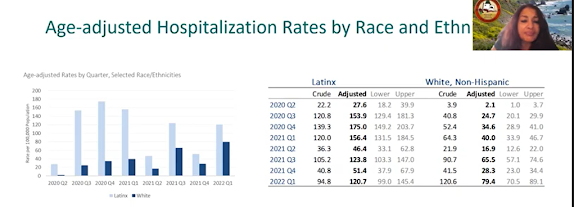
As we all know, COVID-19 has taken a great toll on our world, our nation, and our county. As of this week,  there have been 6.28 million deaths worldwide (probably an underestimate), >1 million US deaths (more have died from COVID-19 than HIV/AIDS, the 1918 influenza pandemic), 90,000 deaths in California, and 491 deaths in Sonoma County. This has led to the largest drop in life expectancy since WWII. And we know that there have been disproportionate numbers of cases, hospitalizations, and death among people of color.

Key SoCo public health interventions during the COVID-19 Pandemic
  • Building Public Health testing capacity
    • SoCo regional lab has done 206,000 (of 1.6 million PCRs total) to date in SoCo
  • State of California and FQHC partnerships
  • Focus on equity
    • bilingual messaging
    • pop up testing sites (using local data to determine neighborhoods for sites)
    • bilingual/bicultural testing/contact tracing
  • With increase in Ag testing (no longer have a denominator), we are beginning to pivot toward wastewater surveillance
Public Health Mitigation Measures
  • Communication campaigns, outreach, press conferences
    • re. masking, hygiene, social distancing, gathering size limitations
    • reaching so many different sectors, subgroups was VERY challenging (e.g. reaching the elderly: age, transportation, low tech)
    • local radio, social media: FB, instagram, etc, flyers
    • work with community based organizations, promotoras essential
  • Shelter in place (averted huge surge/disaster early on)
  • Alternate care site/non-congregate site (for people with unstable housing, served thousands of people, SSU>>hotels)
  • State, local and Bay Area health orders to protect vulnerable populations 
  • Vaccines
Disproportionate impacts of COVID
  • Magnification of underlying/pre-existing disparities
  • Latinx  residents: largely essential workers, hardest hit
    • 27% of our population is Latinx, accounted 45% of all cases
    • at one point, case rate was 9X higher for Latinx
    • In 2020, life expectancy decreased by 2.1 years in Latinx population (compared to 0.7 years in White SoCo population)
  • Addressing these inequities, THE PUBLIC HEALTH CHALLENGE of this pandemic
  • Health Equity Working Group helped get services to vulnerable population
    • trusted messengers (community health workers, promotoras)
    • vaccines, masks/PPE, rental assistance
    • CURA: important partner to reach community, ensuring financial assistance provided to people who needed it ($8 million)
  • FQHC network for collaboration--> 13 different vaccine sites to prioritized populations
  • Special shoutout to Dr. Jenny Fish and Dr. Panna Lossy for uplifting the voices of vulnerable communities
COVID-19 Deaths
  • 75% of SoCo deaths were in people >65
  • residents of skilled nursing facilities were particularly vulnerable prior to the introduction of vaccines
Vaccine Rollout
  • SoCo PH chose to prioritize the most vulnerable residents for vaccine roll out
    • older adults (65+, 75+)
    • SNF and residential care facility patients (RCF)
    • Essential workers and marginalized communities (health workers, farm workers, food service workers, homeless)
  • We have very high degree of vaccination in our elders: 93% of those >65 are fully vaccinated
  • Vaccination of vulnerable elders reduced deaths at SNFs and RCFsVaccines work!  The reduce infection, hospitalization, and deaths.
  • from https://socoemergency.org/
SoCo has the 9th highest vaccination rate (of 58 counties in CA), which is amazing! 78.7% of the total population fully vaccinated (this includes under 5 year olds); 82% of eligible population are fully vaccinated. We have a lower than expected unvaccinated rate (11% compared to 15% in all of CA). Boosters are catching up (66% of those eligible). Vaccination rates for our BIPOC population are high, particularly for our Black population (lots of education, outreach, webinars, presentations, etc). Latinx population while lagging is close. BUT, disparities still exist (see image below) and SoCo Public Health continues to work on this to encourage everyone to get boosted
  

In summary, Drs. Mase and Shende highlighted this list of pearls in public health management of this pandemic: data-driven decision making, constant pivoting, expanded communication, collaboration with all the health care entities in SoCo, importance of community outreach and trusted messengers, and ultimately active listening.

COVID-19 Update (Green, 9/23/2020)

Great thanks to our local expert for an excellent, power packed update this week on COVID-19. As I mentioned in my introduction to Grand Rounds on Wednesday, Dr. Green has been a tremendous resource to our hospital, our residency, and our community from the very start of this pandemic. Just six months ago, with our first two cases of COVID-19 having walked through our doors, he gave a great presentation. And how much we have learned in 6 months time!?!

Gary talks fast, changes slides even quicker than he talks, and packs his presentations from virology to epidemiology to pathophysiology, but here are my key takeaways for COVID-19, 6 months in.

Epidemiology:

As of this week, the US has recorded almost 7 million cases of COVID-19 and over 203,00 fatalities. California has 793,000 cases and 15,000 fatalities. Sonoma County has had 7225 cases and 120 deaths. 


Dr. Green said he believes that Sonoma County's peak of Phase 1 of this pandemic was mid to late August, putting us slightly behind the rest of the Bay Area (which is why we also are "behind" in reopening). He credits this later peak to the work Dr. Mase and our Public Health Department has done in public health prevention methods.


Whereas hospitalization rates in some cities have been much higher (25% in NYC) local data shows in Sonoma County that 5% of those testing positive have been hospitalized (49% male, 51% female).

Virology:

Dr. Green reminded us that the Coronavirus is a single-stranded RNA virus, which is important because RNA viruses (e.g. seasonal influenza) replicate with continuous random mutations. Whereas DNA viruses are more stable and tend to remain conserved, ssRNA viruses are frequently changing. COVID-19 is no exception.

There are currently 6 major clades of COVID-19 (D614G, L845, L3606F, D448del and G392D) and 14 subclades circulating. The virus that seems to be dominating worldwide is now the D614G clade (color blue in images below), which does seem to be slightly more infectious than the original virus but does not appear to be more severe. 

https://www.cell.com/cell/pdf/S0092-8674(20)30820-5.pdf

Is COVID-19 Droplet or Airborne?

There has been much discussion in the medical literature and lay press about whether or not COVID-19 is primarily spread through large respiratory droplets OR by smaller suspended particles that can travel farther. Dr. Green's answer is that COVID-19 is mostly droplet tranmission, but also probably a little bit airborne (e.g. more like influenza, which has features of both than measles or TB, which are primarily airborne). 

This week, after the CDC revoked a statement warning about airborne COVID-19 transmission, the California Department of Public Health (CDPH) released a statement saying that "long range (>6ft) aerosol transmission such as with airborne transmitted viruses such as measles, is the area of controversy. CDC did signal that the updated guidelines would acknowledge opportunistic airborne SARS-COV 2 transmission in settings with poor ventilation." Key in this statement is that airborne is likely the exception (not the rule) and requires poor ventilation to be spread in this manner.


What does airline travel have to do with this?

Dr. Green cited a study from a spring evacuation flight from Milan, Italy to South Korea (11 hour flight), in which flight was conducted with strict infection control procedures by the Korean CDC and WHO. There were 299 asymptomatic passengers on board; several others were refused passage due to symptoms. After arrival in Korea passengers were quarantined for 2 weeks at a government facility. Ultimately from that flight, there were 6 asymptomatic + Covid patients and 1 who developed symptoms and tested positive on D14. A study of the airplane location and transmission patterns surmised that there was unlikely to have been airborne transmission, more likely transmission occured through contaminated high touch areas (e.g. that dang bathroom). The CDC link for more information is here

https://wwwnc.cdc.gov/eid/article/26/11/20-3353-f1

When and how to test for COVID-19?

Dr. Green shared a virologic study testing for COVID-19 in different respiratory sites from July 2020 (link to that Lancet article here), which found viral load in oropharynx, nasopharynx and sputum at much higher levels in the first 0-7 days. Viral levels were detectable but decreasing markedly in the oropharynx by day 8, and decreasing in nasopharynx and sputum to a lesser extent, though lower load by over day 14. This study underscoring the need for earlier testing for better viral detection (no matter which site). Bottom line: earlier testing is likely more accurate.


What about blood type and COVID risk?

There were reports early in the pandemic about certain blood types being associated with increased risk of testing positive for COVID and/or possibly worse outcomes. That literature is still evolving (and is frankly a little messy). A very early study from Wuhan, China (available here) proposed a link between Blood type A and higher risk of acquiring COVID-19. A later study (available here) found no relationship to Blood type A but rather that Blood types B, AB and RH+ were all associated with higher odds of severe disease; in that study Blood type O seemed to have lower risk of testing positive for COVID. A more recently released genomic study from NEJM (found here) found a possible a genetic susceptibility locus in patients with COVID-19 with respiratory failure and a potential involvement of the ABO blood group system. Bottom line: for now, there is no clinical reason to risk stratify using ABO. 

What about vitamins and minerals?

Jury is still out. Per Gary Green, there is no good evidence on Zinc as protective. Vitamin A is currently being studied at UCLA in children in COVID, Vitamin C is being studied in Richmond, VA. Vitamin D seems to have a correlation in several studies, but very unlikely causation. Dr. Green reminded us that some vitamin and supplements can be dangerous in high doses, namely Vitamins A, E, D, and K (fat soluble one) and a recent statement from BMJ states that "there is no strong scientific evidence that very high intakes (mega supplement) of vitamin D will be beneficial in preventing or treating COVID-19". Bottom line: stay tuned for forthcoming studies on vitamins.

Unique COVID-19 manifestations include:

  • Late onset ARDS (~8 days) and multiorgan dysfunction (MODS)
  • Thrombotic events, including VTE (25-31%) and arterial thrombosis (CVA, acute limb ischemia)
  • Cardiac events (STEMI w/non occlusive coronaries, LV failure, myocarditis, kawasaki like illness)
  • Neurologic events (acute CVA in young patients), Guillain-Barre syndrome, encephalitis/opathy and seizures
  • Dermatologic events (pernio/Chilblains "covid toes")

What do we know about the cytokine storm? Should it be also called the bradykinin storm?

Here, Dr. Green expounded on a bunch of virology and biochemical mechanisms that are hard for me to capture in words (partly because I had a hard time keeping up!). The links to the papers are here and here, and the images from each of those studies are below. The top one discussing the immunologic response and the bottom the bradykinin storm. 


The gist of this part of the talk is that COVID-19 seems to elicit biphasic viral response that was also seen in virus causing the 2003 SARS virus outbreaks. In phase one (days 0-4), an acute infection stimulates an immune response. If that immune response is unsuccessful in clearing the virus, there is a second adaptive immunity response, which leads to a storm (see image below)


https://jvi.asm.org/content/jvi/84/3/1289.full.pdfAdd caption

This immunology and pathophysiology is actually very clinically important because it informs our current treatment approach for severe COVID-19 illness; that is, antivirals early, anti-inflammatories/immunologics (e.g. dexamethasone, tociluzimab) later when that inflammatory cascade is occuring. Here is my very favorite image from Dr. Green's talk:


I use this image ALL the time when talking with residents about this illness. It also helps me ground myself in where we are in an individual patient's course (e.g. symptom day 12 is very different than symptom day 4)

At SSRRH and around the country, we are tracking specific labs (procalcitonin, D Dimer, LDH, CRP, PMN/lymph, ferritin and sometimes baseline IL-6) to assess where a patient is in their disease course and how likely it is that they will develop severe illness. Several publications suggest that some or all of these values may have predictive value for severe disease.

This includes "Simple Rule of 6" (Ferritin>600, LDH>600, CRP>60) as well as other markers for severe disease: D Dimer >2-6, IL6 >163, and PMN/Lymph ratio >3.5

Why are we doing Convalescent Plasma?

Plasma is very safe and may improve outcomes in COVID-19. May is the key word here. Plasma was used in the influenza epidemic of 1918, also during outbreaks of polio, mumps and measles in the 1940s, in 2003 in the SARS Coronavirus in Hong Kong. Its use and study was largely abandoned after the discovery of penicillin and other antibiotics. It was tried (and failed) in 3003 (West Nile VIrus), 2012 (MERS) and 2014 (Ebola) outbreaks. 

SSRRH has been participating in a historic Extended Access Program via May Clinic, involving over 82,000 patients and 2700 sites. This is NOT an RCT. That program closed 8/31. Mayo is just beginning to study the potential benefit of convalescent plasma through this data set. It does appear in early papers that plasma given early that happened to contain high Antibody titers is associated with lower 30 day mortality. Preliminary results are available here

Figure below from that paper compares 30 day mortality in low, medium, and high titer plasma given early <3 days vs. late >4 administration of plasma. As we currently have no clinical way to measure antibody titers in plasma, Dr. Green is occasionally giving more than one unit in very sick people. This is experimental.


What about Remdesivir?

Here at SSRRH, thanks to Carolyn Dam (pharmacy) and Dr. Green, we were part of the earliest compassionate use of Remdesivir for our very first COVID-19 patients. Since then, data has begun to emerge on the utility of this antiviral designed originally for treatment of Ebola. Preliminary reports suggested benefit, particularly on duration of disease. 

The more recent ACTT-NIH study of 538 patients with severe disease found a reduce median recovery time (11 vs. 15 days for placebo, statistically significant) and a trend toward mortality benefit 7.1% vs. 11.9% (though not statistically significant). It appears that remdesivir is more effective the earlier it is administered (not unlike tamiflu) and most effective in patients who require oxygen but who are not ventilated. 

Where are we today, September 2020, 6 months into our own pandemic experience? 

In addition to working from home, wearing our masks, and helping our kids fumble through distance learning, our current standard of care at SSRRH for COVID-19 includes the following:

  • Full PPE for clinical staff caring for suspected or confirmed cases of COVID-19 
  • Swab testing for COVID-19 for all admitted patients and preoperative patients
  • Daily labs for patients including IL-6 (baseline), CRP, didmer, ferritin, procalcitonin, CBC (leukopenia) and thrombocytopenia
  • Treatment:
    • Early convalescent plasma for all hospitalized pts (even asymptomatic ones)
    • Proning (for anyone needing O2)
    • High flow oxygen before mechanical ventilation
    • Early IV Remdesivir for severe illness
    • Anticoagulation for everyone, double for our sickest
    • Steroids/dexamethasone (later-- if/when cytokine storm)
    • Other immunosuppressants only with care (taciluzimab), watch for secondary bacterial infections
    • Blood sugar control (diabetics)

COVID-19 in Pregnancy (Mason, 8/18/2020)

Many thanks to Dr. Antoinette Mason for her excellent review of the emerging literature on COVID-19 in Pregnancy. As Dr. Mason explained at the start of her presentation, much of the information regarding COVID in pregnancy is based on observational data with recommendations that are expert opinion at best. But as we continue to increase our understanding of this disease, we are gaining a better understanding of its impact on pregnant women and infants. I consider Dr. Mason one of our local experts-- herself having cared for several of our first OB patients with COVID locally this past month. With that, I will do my best to summarize Dr. Mason's key learning points.

Epidemiology

  • In the US to date, there have been 16,798 documented cases of COVID-19 in pregnancy, 4,262 hospitalizations, and 37 deaths
  • Here at SSRRH, we have had 9 total OB patients with COVID ( some only triaged, others admitted). In these patients:
    • Gestational age ranged from 22-39 weeks
    • 5 have delivered (2 returned later with PROM)
    • 2 were picked up by admission screening (asymptomatic)

Is pregnancy a risk factor for COVID-19? Answer: We don't really know. 

The incidence of COVID-19 in pregnancy is similar to that of the general population. Several studies suggest that pregnancy and childbirth do not increase the risk of acquiring COVID-19. There is mixed data on whether or not pregnancy worsens the course of the disease. An MMWR from the CDC June 2020 showed the following: pregnant women were 5.4 times more likely to be hospitalized, 1.5 times more likely to be admitted to the ICU, 1.7 times more likely to receive mechanical ventilation, but no increased risk of death. (Reference: https://www.cdc.gov/mmwr/volumes/69/wr/mm6925a1.htm). Some of these stats are likely impacted by providers being more likely to admit and act more conservatively with sick pregnant women, but it is hard to see that in this data.

What is the clinical presentation of COVID-19 in pregnancy? Answer: The same as the general population

1/3-1/2 of OB patients with COVID-19 are asymptomatic

How to assess severity of disease in pregnant women? Answer: Oxygen saturation, consideration of comorbidities and close follow-up are key

  • Oxygen saturation should be >95% on RA for pregnant women. This is a different standard than for non pregnant COVID patients (>92%). Also consider tachypnea (RR>30bpm).  
  • Outpatient management is appropriate for pregnant women with COVID-19 with mild symptoms, but women should be monitored  (at least once within 1-2 weeks of diagnosis)
    • should have home pulse oximeter if possible
    • should have easy access to care if needed
    • antenatal testing should be done as per standard recommendations
  • Inpatient management: pregnant patients with moderate or severe disease (O2 sat <95% on room air, refractory T>39 despite antipyretics) and/or significant comorbidity (e.g. DM, CKD, immunosuppresion) should be managed in the hospital
  • See diagrams below from ACOG and SMFM. Top diagram is indications for testing, bottom diagram is for triage in known COVID disease.

What are the maternal and fetal outcomes in COVID-19?    Answer: we don't really know.

From case reports, observational studies, and some reviews, there is concern that COVID may be associated with an increase in preterm birth, PPROM, cesarean delivery, and stillbirths. We do know that severe viral illnesses (e.g. influenza) have been associated with these outcomes.

One systematic review found aere possible increase in preterm delivery, including spontaneously and medically indicated preterm birth and c-section in pregnant women with confirmed COVID-19 infections. (Reference: https://www.thelancet.com/journals/eclinm/article/PIIS2589-5370(20)30190-5/fulltext). A UK study looking at outcomes pre and post pandemic preterm found a higher rates of still births-- the authors speculated that outcomes had more to do with access to care and comorbidities directly related to the virus rather than the virus itself.

Is there vertical transmission of COVID-19? Answer: Probably not.

While there is a theoretical risk of vertical transmission, most studies with significant number of cases have demonstrated no evidence of vertical transmission: looking at placenta, cord blood, amniotic fluid, and NP samples. There are a couple of case reports that call question to this, but the data is very limited. In addition, we have little to no data on the effect of COVID-19 infection on the first and second trimesters of pregnancy.

What is appropriate management of COVID-19 pregnant patients? Answer: Treatment for COVID-19 in pregnant women mirrors treatment of COVID-19 in non-pregnant women with slight modifications

  • Remdesivir is considered safe in pregnancy (no known fetal toxicity, recommended by SMFM when indicated)
  • Convalescent plasma is considered safe (currently under investigation for benefit)
  • Steroids if indicated (NIH recommends for "patients needing oxygen")
  • COVID-19 infection is NOT an indication for delivery;  mechanical ventilation is NOT an indication for delivery
    • For severe disease, risks/benefits should be weighed
  • Caution with magnesium sulfate because can increase risks of respiratory compromise (weigh risks/benefits depending on comorbidities)
  • Most standard obstetrical management is safe: internal monitors, amniotomy, forceps/vacuum
  • Might consider early epidural if symptomatic patient to mitigate risks of gen anesthesia for emergent c-section
  • Nitrous oxide: not recommended for PUI/COVID+ patients (because of risk of aerosolization) but nitrous is okay to use in women who test COVID negative.

Does COVID-19 in combination with pregnancy increase risk of VTE? Answer: Yes, probably.

While there are only a few case reports of VTE in COVID in pregnancy, both COVID and pregnancy are hypercoagulable states and separately increase risk of VTE. Thus current recommendations for VTE prophylaxis: 

  • All pregnant women admitted with COVID-19 should receive enoxaparin unless delivery is anticipated in <12 hours. 
  • Also all hospitalized pregnant women should be 10 days of VTE prophylaxis after hospital discharge.

How should COVID-19 couplets be managed postpartum? 

  • Moms with COVID-19 are prone to hypervolemia (keep strict Ins/Outs, watch respiratory status)
  • Infants of COVID moms should be bathed after birth
  • Breastfeeding should be encouraged!! 
  • Separation of mother and infant is NOT recommended (likelihood of testing positive is the same if separated or kept together, if precautions maintained)
    • infant should be tested once at 24 hours of life (no retest indicated)
    • mom should use mask/hand hygiene
    • baby should be in isolette when not breastfeeding

What about mental health in COVID in pregnancy? Answer: Ah, so much to say. . .

  • Social isolation is associated with increased risk of depression and anxiety. Screen and ask!
  • PTSD  has been recognized for those who are isolated/quarantined--> be sure to check in with new moms about the impact this may have on their postpartum period

Diagnosis and Management of Osteoporosis (Hamann 7/23/2026)

 A recording of this presentation is available HERE .  *** Thanks so much to Dr. Kendal Hamann, SMGR Endocrinologist, for an outstanding Gra...