Showing posts with label pregnancy. Show all posts

Thyroid Hormonal Disease (Magnotti, 4/17/2024)

 A recording of this presentation is available HERE.

***

Thanks to Dr. Mike Magnotti, SMGR Endocrinologist, for an excellent presentation on Hypo and Hyperthyroid. This was a jam-packed presentation. Check out the link above or my notes below.

Hypothyroidism

Hypothyroidism is characterized by non-specific and relatively common constellation of symptoms, including fatigue, weight gain, mental cloudiness, cold intolerance, etc. Plenty of people with these symptoms believe they have thyroid disease (and will even feel better on thyroid replacement), but this doesn't mean they actually have thyroid disease. 

Of note, weight gain is a known symptom of hypothyroidism, but obesity is not generally caused by hypothyroidism. Treating a patient's hypothyroidism can help mood, mental acuity, and focus but likely little (if any) weight loss.

Also of note, alopecia 2/2 hypothyroid takes a very LONG time to get better -- 6 months to 1 year, even with normalization thyroid hormone. Patients need to either be patient or use another med (e.g. Rogaine) in the meantime.

The only test you need to diagnose hypothyroidism is TSH. A normal TSH range is 0.5 to about 5 and excludes thyroid disease (except in very rare cases). Always want to check twice (there are lots of transient highs that can self-resolve), on repeat TSH, also check FT4, consider thyroid antibodies (not recommended in guidelines). Ft4 distinguishes between subclinical and clinical hypothyroidism. Antibody results do NOT change treatment, but can be helpful to patients to know WHY they have hypothyroid. No need to monitor antibodies -- levels change due to immune system activity and do not indicate illness state. 

High TSH, low FT4--> overt hypothyroidism, treat with levothyroxine

High TSH, normal FT4--> subclinical hypothyroidism, consider treatment**

If thyroid antibodies are elevated, dx is most likely Hashimoto's thyroiditis

TSH increases with age. A TSH of 6-8 may be normal in patients >70 years old; TSH can also be low in younger people (0.3-0.5 can be normal in young).

**Treat patients with subclinical hypothyroidism if they have symptoms, if TSH>10 (even no symptoms because of reduced risk CAD), TSH 7-10 if under 65. Only treat elderly patient <7 if you really believe they are symptomatic. 

Note: Biotin supplements alter the ability of the assay to detect thyroid hormones (it doesn't change actual thyroid hormone). Must be high dose biotin-- e.g. those in hair and nail formulations. Should avoid products with biotin 3 days before the assay. Biotin generally makes people look hyperthyroid (Low TSH, high FT4)

Treatment of hypothyroidism

Treatment of hypothyroidism is Levothyroxine (T4)

1.6 mcg/kg/day is the FULL replacement dose of thyroid hormone (patients with NO thyroid will need this full dose)

    • If older patient, start slow to avoid cardiac issues, arrhythmia
    • Younger person with a very HIGH TSH probably needs most of the high replacement dose right up front. If they have a lower TSH, can start with 1/2 the dose
  • take 30 minutes before food, 4 hours before calcium/iron/vitamin (absorption). 
  • brand does NOT matter unless someone has intolerance to fillers/dyes in a certain brand
    • Tirosint brand is a gel cap formulation with no filler, also liquid version, theoretically has least likelihood of having adverse reaction, but very expensive
    • For rare patients who are super sensitive to batch variations, use the same brand to maintain consistent
  • Only use TSH to monitor (goal is anywhere in the normal range), titrate to patient's feeling about how they feel
    • no need to monitor T3 levels, which vary more with stress and illness (helpful in hyperthyroidism)
  • Never use T3 alone! Our system has no way to regulate T3 levels in our body. T3 is the more active form. There is internal regulation of conversion T4>T3 (e.g. hospitalized patients have inhibition of conversion, normal stress response), but T3 is unregulated.
T3/T4 combination not generally recommended as first line treatment because most people feel fine on T4 alone. T3 is converted to T4 via deiiodinase. There are some (rare) patients with reduced ability to convert T4 to T3 (no ability is not compatible with life). Most people feel better on T3 because it gives them more energy. T3 makes people feel better like caffeine makes people feel better. 
  • Most trials adding T3 to T4 show no benefit, though a few studies show some benefit. Hard to quantify symptoms energy, focus, sleep. Some people feel a rush when they take T3. 
  • Consider adding T3 if patients are not better on T4 (but not an excessive amount)
  • T3 has a very short half-life (needs to be taken am/pm, e.g. 7am, 3pm)
  • Armour thyroid formulation (pig and cow thyroid) contains more T3 than normal human (4:1 ratio T4:T3 in Armour, humans generally have T4: T3, 13-16:1)
    • if you check T3 levels, you will see relatively high T3, low T4 and normal TSH
    • more variability from batch to batch (higher risk over-replacement)
    • Dr. Magnotti generally does not recommend Armour, unless a patient is stable on it and you are just continuing it
  • If you want to give T3, should dose separately
    • T4 is 4x potent as T3
    • Goal is maintain ratio T4/T3 13-16:1, e.g. 5mcg T3, 75mcg T4
    • T3 only comes as 5mcg and 25 mcg. Generally don't use 25mcg pills
  • Do NOT use T3 in pregnancy (doesn't cross placenta, so mom can be euthyroid and baby can be hypothyroid)
  • Only monitor via TSH, symptoms
Secondary hypothyroidism is VERY rare. Unlikely to be de novo or surprising diagnosis. Patients with known pituitary tumor, history of pituitary or sella radiation, other pituitary hormone deficits (prolactin, LH, FSH). In these rare patients, TSH is useless. You treat using FT4 to monitor, goal mid normal.

Hypothyroid in pregnancy
  • As soon as woman is pregnant, increase the dose up front 20-30% (right away) because risk of hypothyroidism on the fetus is WAY higher than hyperthyroidism 
  • Check TSH q4 weeks (up through the second trimester)
  • No T3 alone in pregnancy 
  • Current goal in pregnancy is TSH<2.5
  • Immediately after delivery, back to usual delivery
  • Recheck TSH 8-12 weeks post partum (not too soon) because lots of women have post partum thyroiditis, which can confuse things and make you worried they have levothyroxine too high
  • Let patient symptom guide 
If patient diagnosed with hypothyroidism during pregnancy. Guidelines vary about screening. 
BUT . . .
If TSH>4, treat
If TSH <2.5, no treatment
If between 2.5-4, check TPO, especially if recurrent miscarriage.
Starting dose based on level of TSH. If above 15-20, be more aggressive
Recheck 4 weeks even though not fully equilibrated.

***
Hyperthyroidism can definitely be more complex than hypothyroidism; there are more causes to consider, and the treatment is more nuanced.

Best first test for hyperthyroidism is TSH.
  • If TSH is LOW, check BOTH FT4 and FT3 (elevations in either can cause overt disease),
    • Also check TSI and/or TRAB (same test, different assay). 
    • If Ab positive, your patient almost certainly has Grave's disease.
  • If TSH is LOW, but BOTH FT4 and FT3 are normal>> this is by definition, subclinical hyperthyroid. 
    • Treat subclinical hyperthyroidism if TSH<0.1 (or <0.3 if older, atrial fibrillation).
    • CV risks of hyperthyroidism are definitely increased when TSH<0.1.
  • If TSH is NORMAL with elevations in FT4 or FT3, this either secondary hyperthyroidism (VERY very very rare) OR T4 resistance (genetic)
    • Refer to endocrine.
Additional lab findings: isolated elevation in alk phos is common with significant hyperthyroidism, will go down when treated. Transaminitis can be caused by methimazole but sometimes is also seen in hyperthyroidism.

Causes of hyperthyroidism
Grave's disease is by far the main cause of hyperthyroidism (75-80%, especially in younger patients), toxic multinodular goiter relatively more common in older population, also single functional nodule. Knowing the cause of hyperthyroidism doesn't impact who needs to be treated but can influence treatment decisions. 
  • +TSI and no palpable nodules on exam (usually sizeable on exam, 2-4 cm) >> patient almost certainly has Grave's disease (no scan needed)
  • -TSI and/or no nodules on exam >> need uptake scan (to r/o functional nodule)
  • If palpable nodule>> need both ultrasound and uptake scan
    • Toxic multinodular goiter usually is HUGE, nodular on exam

NOTE: If TSH is NOT close zero, the radioactive uptake scan is not reliable (even at 0.2 or 0.3, scan will generally be normal). If you cannot get uptake scan, ultrasound can be helpful (even without nodules). they evaluate blood flow. If blood flow is low, likely thyroiditis. High blood flow, likely Grave's. 

If no uptake>> likely dx thyroiditis (unless people taking iodine supplements, kelp, seaweed, or recent contrast in last 3 months. Amiodarone can also cause no uptake, even 3 months after taking it.
If normal or increased uptake>> dx Grave's
If uptake in single nodule>> dx toxic solitary nodule
Patchy uptake all around >> toxic multinodular goiter

Treatment of hyperthyroidism
3 options: methimazole, iodine (I-131), thyroidectomy. Beta blocker for symptom management

Methimazole is first line for most causes. 

Methimazole 10 mg/day, 20 mg/day, 40 mg/day for mild (<2x ULN), mod (2x ULN), severe (>2x ULN) disease, respectively. Taper down to 5-15mg (usual maintenance dose). Leave people on methimazole for 1-2 years before stopping. Want to be sure to have negative TSI (antibody) if they have positive to begin with. Don't stop methimazole in anyone who still has antibody at the receptor (+TSI is causing the hyperthyroidism).

There are some exceptions.
  • Iodine should be considered for young women who desire pregnancy and people without eye disease
    • Younger women who desire pregnancy may benefit from treatment with iodine treatment because methimazole can take years to get into remission. 
    • Can get pregnant 6-9 months, need normal TSH (with levothyroxine). 
    • Even after 3-4 years, with methimazole may not be in remission. Delays childbearing.
  • Iodine is also great for single toxic nodule because people will come out euthyroid. Likely curative. Normal gland not affected. 
  • Very severe hyperthyroidism in a younger person, especially with a large gland, they are very unlikely to have long-term remission at all with methimazole. Consider iodine vs. surgery.
  • Surgery may be best option if need to get thyroid hormone levels down quickly. It will still take weeks (body has to metabolize FT4 already floating around)
    • Consider surgery in case of: 1) very large goiter,  2) need for rapid correction, 3) concern for malignancy, 4) combo hyperthyroid+ hyperparathyroidism
Hyperthyroid eye disease: Send to neuro-ophtho if thyroid eye disease. Iodine can worsen thyroid eye disease. (if mild, can do Iodine with 3-4 months of prednisone to protect against progression). 

Hyperthyroid in pregnancy
Do NOT treat subclinical disease. 
Use PTU in first trimester, change to methimazole in 2nd and 3rd trimesters.
Target Total T4 and Total T3 in the high normal range, which is 1.5x ULN for pregnancy range due to higher estrogen, binding globulin. 

Abnormal Liver Function in Obstetrical Patients (Ludwig, 6/1/2022)

Many thanks to Dr. Alec Ludwig for an excellent presentation about liver and biliary abnormalities in pregnancy. It was jam-packed with good information. 

A recording of his presentation is available HERE

My notes:

Remember that what we typically call "liver function tests"  is actually a misnomer. In fact, there is no test that reliably demonstrates the liver's function. Elevation of AST and ALT -- the liver enzymes-- indicates liver injury, not liver dysfunction. Albumin and prothrombin time are factors that are produced by the liver and may be better markers of function. 

In normal pregnancy, you can see elevated alkaline phosphatase (up to 3x normal), as well as elevated cholesterol, triglycerides, and fasting gallbladder volume. Note that many measures we use to evaluate the liver (AST/ALT, T Bili, PTT, liver size, bile acids) don't change in pregnancy.

Hepatocellular injury as measured by elevation in AST/ALT:

  • acute viral/toxic hepatitis: AST/ALT 25x upper limit of normal
  • ischemic hepatitis: AST/ALT 50x upper limit of normal
  • chronic HCV/HBV: slight elevation of AST/ALT (2x normal), rarely greater than 10x normal

Gallstone disease in pregnancy

Gallstone disease is much more prevalent in pregnancy for several reasons. 1) Increased estrogen levels increase cholesterol, thereby supersaturating bile with cholesterol. 2) Progesterone slows contraction of gallbladder, disrupting the excretion of bile acids. AND 3) Increased fasting gallbladder volume.

  • acute cholecystitis: blockage of the cystic duct causing inflammation in the gallbladder
    • fever, WBC count, can have slightly elevated AST/ALT (if large stone)
  • choledocholithiasis: stone in CBD or hepatic duct, causing backup into liver, injury to liver
    • definite elevation AST/ALT
  • acute cholangitis: can be emergency due to severity of illness
    •  Charcot's triad (RUQ pain, jaundice, fever)

Generally treat GB disease in pregnancy with IV antibiotics, surgery if indicated. Laparoscopic cholecystectomy is safe in pregnancy, safest in the second trimester. Should occur within 24-48 hours conservative management. ERCP is also safe in pregnancy; minimize radiation by shielding, fetal monitoring.

Viral Hepatitis (A-E)

  • HAV: most common acute hepatitis in general population, but infrequent in pregnancy. 
    • Acute infection  (only care about IgM). 
    • Generally mild (malaise, HA, fever, jaundice, RUQ pain), supportive treatment. 
    • HAV vertical transmission rare but has been documented. Associated with preterm birth, neonatal cholestasis. 
    • Breastfeeding okay, HAV vaccine safe in breastfeeding
  • HBC: surface Ag used to screen everyone in pregnancy, core Ag, e Ag indicated infectivity/vertical transmission to 80-90% if occurring in the 3rd trimester. 
    • Major causes IVDU, sexual intercourse with people w/HBV, vertical transmission. 
    • can present with asymptomatic acute phase, can pick up infection even prior to symptoms
    • if mom has chronic HBV in pregnancy: need to check viral load, 1 million to 100 million is elevated, may need treatment during pregnancy w/Tenofovir after 28-32 weeks (to prevent vertical transmission)
    • Babies born to mothers with HBV needs HB IVIG and first dose of vaccine within 12 hours, don't determine delivery method
    • Breastfeeding is safe as long as infant got IVIG and HBV vaccine
  • HCV: can be acute and chronic 
    • HCV on the rise in the last few years (2009-2019 2x increase of patients with HCV), likely due to IVDU
    • vertical transmission 3-5%
    • 75% HCV infections are asymptomatic
    • ACOG does have some recommendations of Category B meds that could be used to treat HCV in pregnancy to decrease vertical transmission (Ribavirin is teratogenic)
    • Vertical transmission increases if co-infection w/HIV, invasive surgical procedure, ROM >6 hours, conflicting data but discourage fetal scalp electrode
    • Breastfeeding okay w/HCV
  • HDV: coexists with HBV only, anyone with chronic HBV should be tested for HDV. Supportive treatment, monitor symptoms. If treat HBV, clears HDV.
  • HEV: can be acute and chronic, based on genotype
    • some areas in Mexico, Asia, Africa and South America endemic (travel recommendations not to travel to endemic areas in 2nd and 3rd trimester)
    • believed to be water born
    • pregnancy women are particularly susceptible to severe liver damage and liver failure, 20-30% mortality
    • rare vertical transmission
    • breastfeeding okay
Other viral hepatitis: HSV hepatitis (rare but high mortality), CMV hepatitis (also rare, more common in organ transplant pts): most common hearing loss

Cirrhosis in Pregnancy: it is more difficult to get pregnant if cirrhotic (due to secondary amenorrhea), but can still get pregnant. High risk for bleeds, aneurysms and acute on chronic liver failure. Need variceal screening DURING pregnancy. Increased mortality with pregnancy (should calculate MELD, do HCC screening even during pregnancy). Can use beta blockers (e.g. propranolol) but can cause some side effects to baby. Octreotide okay. Mode of delivery unclear, should be individualized.

Autoimmune hepatitis in pregnancy generally improve during the 2nd trimester BUT can flare post partum.

Hyperemesis Gravidarum: 50-60% of patients hospitalized with hyperemesis demonstrate some abnormal liver tests: hyper bilirubin, elevated AST/ALT. Generally don't get fever, jaundice. 

Cholestasis of Pregnancy (ICP) is the most common liver disorder unique to pregnancy. Generally presents as pruritis without a rash. Even though palms and soles are most common places, can be in other places as well. May see abnormalities in AST/ALT. Increased serum bile acids confirm a diagnosis (>10=cholestasis dx, >100=severe, should be induced after 36 weeks, earlier other indications).
  • Elevated ALT 30x normal, elevated conjugated bilirubin
  • generally not jaundiced
  • start antenatal testing right away
  • treatments (all grade C): ursodiol improved labs and symptoms but no data that improves still birth. Other treatments: Hydroxyzine, cholestyramine
  • Some data on PO vitamin K (evolving evidence)
  • Can progress: 2-5x risk of progression to preE, if bile acids >40
Pre-Eclampsia is diagnosed by blood pressure criteria: SBP >140, DBP >90, 2 x, 20 minutes apart after 20 weeks AND either proteinuria (>0.3 microalbumin/creatinine ratio) OR lab abnormalities (platelets <100K, SCr>1.1 or double baseline, impaired liver tests (2x normal). Symptoms-based diagnosis is NOT recommended. Antenatal testing twice weekly. Deliver at 37 weeks

Pre-E with severe features: 
  • BP >160/110 (2x, 4 hours apart) OR
  •  thrombocytopenia, elevated SCr or liver test abnormalities (regardless of BP)
  • Antenatal testing daily, deliver at 34 weeks
HELLP syndrome is considered a complication of PreE even though 15% of patients don't have elevated BP or proteinuria. 10-20% of women with severe PreE progress to HELLP. Diagnosed with signs of hemolysis (LDH>600, platelets <100, AST/ALT 2x normal).  High mortality. Can lead to hepatic rupture/hematoma, placental abruption, acute renal failure, etc. Treatment is magnesium sulfate, treat BP and delivery. Hepatic hematoma and rupture (stretching of Gleason's capsule) -- pts often have severe RUQ pain. 

Acute Fatty Liver of Pregnancy has a lot of similarities with HELLP, Severe PreE and acute fatty liver. Originates from genetic defect in fetus and a susceptible mother. Presents with n/v, pain, jaundice, fever. Generally don't present with elevated BP. Swansea criteria to make diagnosis. Can add ammonia, uric acid to help classify. Imaging may demonstrate hypoechoic liver with lots of fatty deposits. 


Abortion in the US in 2022: What is at Stake? (Wallace 2/2/2022)

Many thanks to Dr. Robin Wallace for a really poignant and timely Grand Rounds this week on Abortion in the US: What is at stake in 2022. As we await the Supreme Court decision regarding Dobbs vs. Jackson in Mississippi-- decision expected in June 2022-- it is tremendously important for the medical community to know what is at stake if Roe is overturned.

Dr. Wallace graduated from the Santa Rosa Family Medicine Residency in 2007 and completed the to UCSF Family Planning Fellowship after residency. She worked for 8 years at a family planning clinic in Dallas, Texas and now lives and works in North Carolina. 

A link to a recording of her presentation is available HERE

With increased access to effective contraception, abortions have decreased steadily since the early 1980s

  • However, abortions are still common-- in 2017 in the US, 862,320 abortions were performed 
    • Most abortions occur at less than 8 weeks, 89% occur in the first 12 weeks
    • 10% happen in 2nd and 3rd trimesters: this is a critical and important health care service 
The US unintended pregnancy rates has also been going down, dropping below the intended pregnancy rate (since the ACA went into effect and required coverage of contraception)

There is evolving literature on "pregnancy ambivalence". It is not easy to classify intentions. There are plenty of nuances that exist on a spectrum

Abortion restriction disproportionately impacts low income women of color


While overall abortion numbers of declined, the proportion of medication abortions (MAB) have increased, generally up through 11 weeks. 

In some settings well over 50% are MAB.

2018 Comprehensive Review of Abortion Safety and Quality

  • There was a clear and dramatic drop in abortion related deaths after Roe vs. Wade (1973) 
  • This 2018 Comprehensive Review of Abortion Safety and Quality concluded withat abortion is a safe procedure.
  • It also refuted any association between abortion and breast cancer, future infertility, and depression/mental illness.
  • Abortions have a mortality rate of 0.7/100K-- this compared to a shot of penicillin which has a mortality rate of 2/100K, and giving birth a mortality rate of 8.8/100K.
  • increased mortality as gestational age increases, as the physiology gets more complex 
  • 20% of abortion related deaths are among those for whom pregnancy threatens their life 
  • abortion mortality rate higher in black women (1.1/100K)
  • "Legal abortions in the US are safe, but the likelihood that women will receive the type of abortion services that best meet their needs varies considerably depending on where they live."

  • Legal restrictions impact abortion care

    Many states have created barriers to safe, effective, patient centered, timely, efficient, and equitable abortion services.

    • Targeted restrictions of abortion providers (TRAP laws): specifically target the practice of medicine related to abortion care
    • "undue burden" standard established (Casey, 1994)
    • Example of TRAP laws (in North Carolina) include: mandatory ultrasound, mandatory waiting periods, telemedicine ban on abortion care, "physician only" procedure (no midwives, nurse practitioners), Medicaid restriction on coverage, State health plan restriction

    Texas Senate Bill 8 (went into effect 9/2021)
    • Restricts abortion after 6 weeks 
    • Enforcement intentionally crafted to circumvent the usual pathways of enforcement (the state) through private civil actions
      • Anyone can file lawsuit against someone who has violated the law (including those performing abortions, as well as those who aid and abet those procedures)
      • This has created enormous fear in counselors, medical assistants, uber drivers
      • If a person who sues is found in court to be in the right, they are awarded &10K for each abortion in violation
    • In a study from Texas in 2018, even though 58% of people <6 weeks, only 16% were <6 weeks when they had their actual abortion appointment
    • Texas SB8 has faced many challenges (abortion providers, ACLU, etc)
      • in the past federal district court has consistently blocked these laws from going into effect, but the 5th circuit court of appeals
      • Supreme Court denied emergency request to block the law
      • DOJ filed separate lawsuit (US vs. Texas), US Supreme Court heard these arguments 11/1, have not blocked enforcement despite having had several opportunities to do so (e.g. 1/20, denied plaintiff's request to return to be heard)
      • Sonia Sotomayor, "This case is a total disaster for the rule of law."
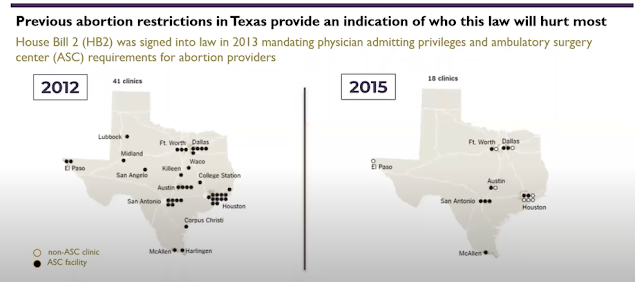
    We know from prior attempts by Texas legislators to restrict abortion what TRAP laws do to abortion access
    • HB2 (2013): Governor Rick Perry, admitting privileges law requiring any abortion provider have hospital admitting privileges within 30 miles of where they are providing abortions
    • Shut down >1/2 of abortion clinics, severely reducing access to Texans
    • Disproportionate effect on Latinx patients, rural patients, and those traveling for care
    • Increase in 2nd trimester abortions (therefore increasing complication rates)
      • especially black patients, low income, patients who had to travel far
    • Though the US Supreme Court nullified HB2 in 2016, having been enforced for 3 years had lasting impact
      • clinics, once closed, were not reopened


    The Turnaway Study is a really elegant longitudinal UCSF study examining the effects of unwanted pregnancy on women's lives in 1000 women who were denied abortions compared to women who were granted abortions. When patients are denied the abortions they want, families are significantly affected
    • financial instability, poverty
    • staying in violent relationships
    • resulting children not meeting developmental milestones
    Dobbs vs. Jackson (Mississippi), currently being considered at US Supreme Court
    • bans abortion in Mississippi after 15 weeks
    • decision expected June 2022
    • many experts are expecting the Supreme Court to uphold this law, which would essentially nullify Roe and permit states to limit abortion access based on gestational age
    • What would happen if Roe falls?
      • there are few states (blue, e/g/ CA, WA, OR, NY) with expanded access to abortion
      • other states (e.g. Florida) with protections that are currently in place but can be revoked easily by politicians
      • lots of states where abortion will not be protected in any way
    https://reproductiverights.org/maps/what-if-roe-fell/

    Dr. Wallace's Recommended Resources:
    https://liberalarts.utexas.edu/txpep/
    https://reproductiverights.org/
    https://txabortionaccessnetwork.org/
    https://www.guttmacher.org/
    https://prh.org/
    https://rhedi.org/
    https://www.reproductiveaccess.org/


    Diagnosis and Management of Osteoporosis (Hamann 7/23/2026)

     A recording of this presentation is available HERE .  *** Thanks so much to Dr. Kendal Hamann, SMGR Endocrinologist, for an outstanding Gra...