Showing posts with label social justice. Show all posts

Farmworkers’ experiences working during wildfires and impacts on health (Hyland and Gordon, 10/16/24)

This week, in commemoration of the 2017 Tubbs Fire, which destroyed over 5,000 homes in Santa Rosa, we had a really special presentation by two researchers from the Berkeley School of Public Health and Berkeley Law School on the impact of the Ag Pass program and wildfire smoke on Sonoma County farm worker health.  


If you can, please watch their presentation. A recording is available HERE.

It was both fascinating and disturbing to hear two researchers talk about the place we live and practice medicine-- and where thousands of vulnerable farm workers face dangers from our local policies during fire season.
  • AB1103: California law that established a "Livestock pass" in 2021, work authorization program, allowing workers back into evacuation zones during natural disasters
  • Counties have interpreted this law as permitting them to allow workers into evacuation zones
  • Unfortunately, no occupational health analysis (by Cal-OSHA) was done in the passing of this law
  • From 2017-2022, such passes were handed out in an Ad-Hoc manner by the Ag Commissioner, often based on personal contacts and phone calls
In 2022, the Sonoma County Board of Supervisors (BOS) passed their own version of the Ag Pass, which allows farmworkers back into an evacuation zones for "critical activities". The SoCo Sheriff decides when Ag Pass is activated.

In 2023, the local law was amended to include "grape harvest" as a "critical activity"

SoCo Ag Pass has three components:
1) Fire safety training (4 hours, no smoke or other exposure training required)
2) Apply through the SoCo Ag Commissioner
3) Go to the SoCo Sheriff's office to obtain the Ag Pass card
(this requires photo identification, address, phone number)

***
We have data from Sonoma County on the health impacts of wildfires on local health: 
  • 25% increase in ED visits for respiratory symptoms
  • 33% increase in hospitalizations for respiratory illnesses
  • 18.7% increase in asthma prescriptions
  • Disparities based on race and SES
This project was a collaboration between the Human Rights Center and Berkeley Public Health. Goal to examine health, physical safety, economic security, and data privacy

Law and policy analysis, health survey with overall goals to provide recommendations to Sonoma County and the State of California to improve health and safety of farm workers working in fire evacuation zones. 

Recruited local farm workers and trusted figures
Recruited farm workers: gain understanding of AgPass, their experience working previously in fire conditions (and symptoms), what information they need if they are working in wildfire conditions again, economic concerns related to wildfires.

1000+ workers from all over the county, 60% male, ~41 median age, 13 years on average experience working in agriculture
Experiences working during wildfires:
  • 75% reported having worked during wildfire
  • 64% received some protective equipment from employer
    • many had to reuse
    • many given surgical mask (rather than N95)
  • 70% reported short term health impacts
  • 36% who had health impacts indicated they lingered over time
  • Mental health impacts
Barriers to accessing health care
  • >50% reported no health insurance
  • 39% difficult to get appointment at clinic (hours, days open, etc)
Gaps seen in the Ag Pass program as it relates specifically to health: 1) No consideration of short or long-term health effects to workers when Sheriff activates Ag Pass 2) Lack of criteria when Ag Pass can be activated (e.g. AQI level) 3) No health monitoring during/after wildfire events

Very real tension in this population between health and economic security. At baseline 75% are spending 50-75% of monthly income on rent (recommendation is 33%). If there is fire/flood/extreme heat, and farm workers cannot work and do not get paid, they cannot make their basic needs. Even though people are worried about health impacts of wildfire, even more are worried about financial impacts. 58% continued to work despite feeling sick because they needed income and were worried to lose the job. 

Most farm workers are most worried about paying for rent, groceries, gas, medicine/healthcare

Physical Safety Results
  • There is no process to communicate with individuals who are reentering an evacuation zone.
    • Currently employers are responsible to ensure workers leave in time
  • The sheriff could request the information but no system at the county level to ensure this happens safely for workers. 
  • No method for county agencies to communicate directly with pass holders. All communication is via employers.
The research team is holding local forums and events to disseminate these results directly to farm workers, two forums open to the public.

Recommendations:
  • Recommending consolidating the AgPass application under one department (e.g. under Ag Commissioner) to make process more clear, streamlined, address concerns identified with signing up via the Sheriff's office (considering largely undocumented workforce)
  • Support additional research: survey H2A workers inside evacuation zones, specific needs of indigenous language speakers in the county (current offerings only available in Eng/Spanish), understanding air pollutant exposures (increased monitoring), financial literacy needs (long-term planning in changing climate and extreme weather, likelihood this will only get worse)
  • Health focused recommendations to SoCo BOS:
    • Public Health and Health officials should be included in decisions to activate the Ag Pass, specifically tracking air quality and heat levels inside evacuation zones
    • Increased air monitors across the county (hyper-local info needed in rural areas)
    • Increase collaboration and support with Sonoma County Community Organizations Active in Disaster (COAD), 80 organizations across the county who have infrastructure to provider training and information to farm workers
      • $$ support for health and safety training
      • PPE to COAD that could be distributed BEFORE fire season in places that are comfortable
    • Safety kids: N95, info about wildfire smoke, Cal-OSHA
    • Training for employers and how to protect self and 
    • Require sufficient stockpile of N95 for workers
    • Increase hours of FQHCs across the county, expanded mobile health services, expanded monitoring 
      • FQHC collecting farmworker employment
  • Health focus recommendations for State of CA
    • Update Cal-OSHA smoke standards (AQI >150, PPE needs to be available but not mandatory until AQI >500, no level which is considered unsafe to work)
    • Need more monitoring of AQI levels during fire event
    • Need requirements employers to communicate AQI levels
    • Decrease barriers to reporting concerns to Cal OSHA
  • Recommendation for Safety
    • Use current active SoCo Alert system, require Ag Pass holders to sign up for these alerts, sign up all farm workers for these alerts
    • Develop new alerts: e.g. Ag Pass activated, Deactivated, AQI levels
  • Recommendations for economic improvements
    • Interconnection of health/economic security
    • Comprehensive disaster pay program; create meaningful choice for workers (e.g. hazard pay, disaster insurance, unemployment, paid sick leave)
    • Enforcement of retaliation protection so workers don't lose job after choosing not to work for health and safety reasons
It is our duty as family physicians, particularly those of us working in the safety net, to pay attention to local policy and politic and to advocate for safer working conditions for our most vulnerable patients. Please help out where you can!

Abortion in the US in 2022: What is at Stake? (Wallace 2/2/2022)

Many thanks to Dr. Robin Wallace for a really poignant and timely Grand Rounds this week on Abortion in the US: What is at stake in 2022. As we await the Supreme Court decision regarding Dobbs vs. Jackson in Mississippi-- decision expected in June 2022-- it is tremendously important for the medical community to know what is at stake if Roe is overturned.

Dr. Wallace graduated from the Santa Rosa Family Medicine Residency in 2007 and completed the to UCSF Family Planning Fellowship after residency. She worked for 8 years at a family planning clinic in Dallas, Texas and now lives and works in North Carolina. 

A link to a recording of her presentation is available HERE

With increased access to effective contraception, abortions have decreased steadily since the early 1980s

  • However, abortions are still common-- in 2017 in the US, 862,320 abortions were performed 
    • Most abortions occur at less than 8 weeks, 89% occur in the first 12 weeks
    • 10% happen in 2nd and 3rd trimesters: this is a critical and important health care service 
The US unintended pregnancy rates has also been going down, dropping below the intended pregnancy rate (since the ACA went into effect and required coverage of contraception)

There is evolving literature on "pregnancy ambivalence". It is not easy to classify intentions. There are plenty of nuances that exist on a spectrum

Abortion restriction disproportionately impacts low income women of color


While overall abortion numbers of declined, the proportion of medication abortions (MAB) have increased, generally up through 11 weeks. 

In some settings well over 50% are MAB.

2018 Comprehensive Review of Abortion Safety and Quality

  • There was a clear and dramatic drop in abortion related deaths after Roe vs. Wade (1973) 
  • This 2018 Comprehensive Review of Abortion Safety and Quality concluded withat abortion is a safe procedure.
  • It also refuted any association between abortion and breast cancer, future infertility, and depression/mental illness.
  • Abortions have a mortality rate of 0.7/100K-- this compared to a shot of penicillin which has a mortality rate of 2/100K, and giving birth a mortality rate of 8.8/100K.
  • increased mortality as gestational age increases, as the physiology gets more complex 
  • 20% of abortion related deaths are among those for whom pregnancy threatens their life 
  • abortion mortality rate higher in black women (1.1/100K)
  • "Legal abortions in the US are safe, but the likelihood that women will receive the type of abortion services that best meet their needs varies considerably depending on where they live."

  • Legal restrictions impact abortion care

    Many states have created barriers to safe, effective, patient centered, timely, efficient, and equitable abortion services.

    • Targeted restrictions of abortion providers (TRAP laws): specifically target the practice of medicine related to abortion care
    • "undue burden" standard established (Casey, 1994)
    • Example of TRAP laws (in North Carolina) include: mandatory ultrasound, mandatory waiting periods, telemedicine ban on abortion care, "physician only" procedure (no midwives, nurse practitioners), Medicaid restriction on coverage, State health plan restriction

    Texas Senate Bill 8 (went into effect 9/2021)
    • Restricts abortion after 6 weeks 
    • Enforcement intentionally crafted to circumvent the usual pathways of enforcement (the state) through private civil actions
      • Anyone can file lawsuit against someone who has violated the law (including those performing abortions, as well as those who aid and abet those procedures)
      • This has created enormous fear in counselors, medical assistants, uber drivers
      • If a person who sues is found in court to be in the right, they are awarded &10K for each abortion in violation
    • In a study from Texas in 2018, even though 58% of people <6 weeks, only 16% were <6 weeks when they had their actual abortion appointment
    • Texas SB8 has faced many challenges (abortion providers, ACLU, etc)
      • in the past federal district court has consistently blocked these laws from going into effect, but the 5th circuit court of appeals
      • Supreme Court denied emergency request to block the law
      • DOJ filed separate lawsuit (US vs. Texas), US Supreme Court heard these arguments 11/1, have not blocked enforcement despite having had several opportunities to do so (e.g. 1/20, denied plaintiff's request to return to be heard)
      • Sonia Sotomayor, "This case is a total disaster for the rule of law."
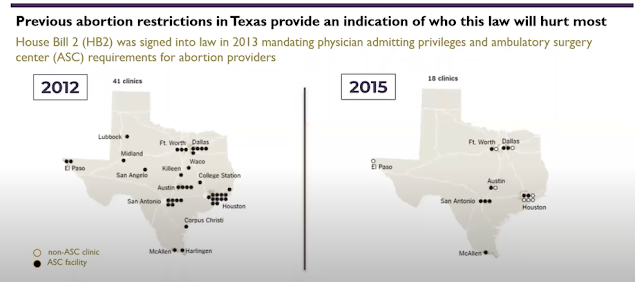
    We know from prior attempts by Texas legislators to restrict abortion what TRAP laws do to abortion access
    • HB2 (2013): Governor Rick Perry, admitting privileges law requiring any abortion provider have hospital admitting privileges within 30 miles of where they are providing abortions
    • Shut down >1/2 of abortion clinics, severely reducing access to Texans
    • Disproportionate effect on Latinx patients, rural patients, and those traveling for care
    • Increase in 2nd trimester abortions (therefore increasing complication rates)
      • especially black patients, low income, patients who had to travel far
    • Though the US Supreme Court nullified HB2 in 2016, having been enforced for 3 years had lasting impact
      • clinics, once closed, were not reopened


    The Turnaway Study is a really elegant longitudinal UCSF study examining the effects of unwanted pregnancy on women's lives in 1000 women who were denied abortions compared to women who were granted abortions. When patients are denied the abortions they want, families are significantly affected
    • financial instability, poverty
    • staying in violent relationships
    • resulting children not meeting developmental milestones
    Dobbs vs. Jackson (Mississippi), currently being considered at US Supreme Court
    • bans abortion in Mississippi after 15 weeks
    • decision expected June 2022
    • many experts are expecting the Supreme Court to uphold this law, which would essentially nullify Roe and permit states to limit abortion access based on gestational age
    • What would happen if Roe falls?
      • there are few states (blue, e/g/ CA, WA, OR, NY) with expanded access to abortion
      • other states (e.g. Florida) with protections that are currently in place but can be revoked easily by politicians
      • lots of states where abortion will not be protected in any way
    https://reproductiverights.org/maps/what-if-roe-fell/

    Dr. Wallace's Recommended Resources:
    https://liberalarts.utexas.edu/txpep/
    https://reproductiverights.org/
    https://txabortionaccessnetwork.org/
    https://www.guttmacher.org/
    https://prh.org/
    https://rhedi.org/
    https://www.reproductiveaccess.org/


    Dismantling the Healthcare Hero (Carmen 8/25/2021)

    Many thanks to Dr. Desiree Carmen for an evocative Grand Rounds presentation this week entitled Dismantling the Healthcare Hero. A recording of her presentation-- definitely worth your time and attention-- is available HERE

    Dr. Carmen took the hour to explore the notion of heroism as it applies to medicine. She asked us to question why we liked being called heroes at the start of the pandemic and why that may not feel so good right now-- a year and a half later. And she challenged us to propose alternative narratives to support the systemic change that so many of us wish to see.

    Dr. Carmen showed us now-familiar images of healthcare workers as masked altruistic protagonists. As the world shut down in March 2020, she began, we felt the love from companies-- free vacations, discounted goods. . . stories of NYC meeting at 7am to clap for healthcare workers. It felt pretty good to be healthcare hero. 

    Our egos, after all, were not averse to the notion that we could be heroes. We signed up for this! For physicians, we took the Hippocratic oath; for nurses, the Nightingale pledge. We adhere solidly to notions of altruism, beneficence, justice, non-abandonment and solidarity. And we want to serve.

    But, she explained, I wanted to know why society wanted us to be heroes.

    Dr. Carmen showed us 3 hero archetypes that Americans particularly admire:

    • The Everyman Hero: this is the person with no special skills, one for whom life has thrown an adventure at them, asked to do heroic deeds 
    • The Classical Hero: someone with special abilities and/or skills that puts them above others in the society and grants them their positionality as hero due to those skills
    • The Epic Hero: the person with a noble birth story, larger than life
    Which do you identify with? Why?

    Dr. Carmen segued from these hero archetypes into the work of James Opie Ursom, a mid-century philosopher who wrote about the supererogatory: that is, morally excellent actions that go beyond the duty of the agent-- more than is asked for. All heroic actions are supererogatory, but not all supererogatory actions are heroic. Heroism involves known involvement with risk. i.e. we must CHOOSE the risk. Well, did we?

    Risk has not been in short supply during this pandemic. 

    But PPE has. 

    PPE Shortages: We all are well aware of the experience of working without a feeling that we had adequate PPE (e.g. reusing N95s, gowns, etc). This is not unique to this pandemic; it has, unsurprisingly, been  experienced in epidemics prior to this (including ebola, SARS, H1N1)

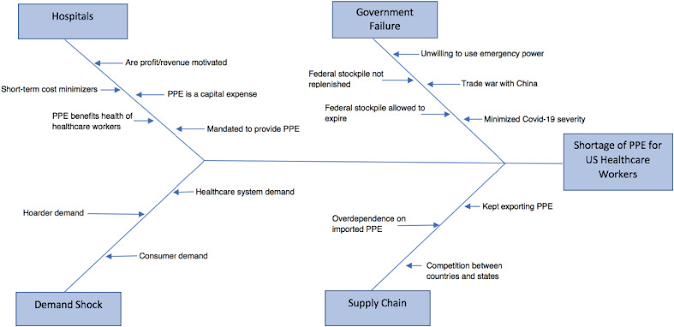
    And this predictable lack of PPE is due to a well known multitude of forces that are not aligned to ensure health care workers are guaranteed protection. 

    Recreated Figure 1 from Cohen J, Rodgers YVM. Contributing factors to personal protective equipment shortages during the COVID-19 pandemic. Prev Med. 2020;141:106263. doi:10.1016/j.ypmed.2020.106263


    Of note, 
    • Hospitals: work off a budget (profit) model; administrators make short term decisions, rather than long-term vision and goals. PPE is not charged/billed to patients or insurance companies. It is simply a cost to hospitals. Therefore they have no motivation to have updated stockpile.
    • Demand shock: common during pandemics, leading to hoarding affected PPE, increased cost
    • Government: Trump admin in trade war with China, slow to enact defense production act, federal stockpile inadequate (3 million masks, if 30% of population sick we would have needed 3.5 billion masks). Noted, expired federal stockpile, not restocked by prior administrations
    • Supply Chain: US is an exporter of health goods, importer of goods from China. Cost 6x Nn5, gowns doubled cost

    Duty to care
    Healthcare workers have a great social contract with the public: we have a duty to care. 

    But it's not that simple. The Joint Centre for Bioethics Pandemic Work group states, "The Healthcare worker enters into a broad social contract that not only creates their duty to care, but places obligations on society to keep them as safe as possible" 

    In this instance society did not keep us safe. And as this social contract disintegratedour duty to care was undermined.

    Race in medicine, racism in medicine. 
    Of note, Dr. Carmen points out, there were so many people not cared for during the pandemic. 
    We all remember the widespread demonstrations around the world after the murders of George Floyd and Breonna Taylor-- due to ongoing police violence toward people of color. 

    There is the reality that medical education and training and medical practice are ripe with racism. Examples Dr. Carmen provided:
    • Medical schools continue teach racial inferiority theories-- leading to inequitable management of HF, kidney disease, VBAC. For more information, see this NEJM paper. 
    • There is the widely-known Tuskegee Syphilis study and its repercussions, where respected clinicians and scientists intentionally harmed black bodies. 
    • Pediatric ED study from 2019, in which providers less likely to order tests/admissions for Latinx and Black children
    • And widely held beliefs amongst medical students and resident trainees measured in 2016 that black people  literally have thicker skin than white people and therefore feel less pain. 
    Race and COVID
    Physicians of color are more likely to care for patients of color. They are also more likely to experience discrimination during patient care, have limited financial safety nets for themselves. And, of course, be more impacted by COVID-- both personally and professionally-- during this pandemic. 

    There is the plain fact that COVID disproportionately affected Latinx and Black people all over the US. This applied to our local cases as well.  Physicians of color-- our own trainees here at SRFMR struggled in the winter with their own sense of transference and countertransference as patients of color died before their eyes (see quote below).


    Global Inequity
    And inequities abound, including in distribution of these highly effective vaccines against COVID-19. Much of the world is anxiously still awaiting access to a vaccine that many Americans are outright rejecting.
    What about reciprocity?
    In return for accepting personal risk in fulfilling our duty to treat, healthcare workers expected reciprocal social obligations. We wanted people to be careful: to social distance, to wear masks, to limit travel and parties. These obligations would demonstrate support and acknowledge our work in difficult conditions. Unfortunately, however, many in our society-- many of our own beloved patients, in some cases our beloved family members-- have not done a great job of reciprocity. 

    In fact, basic public health orders: social distancing, masks, and vaccine recommendation have been flaunted. And, yet again, as people have chosen to not be compliant with public health orders, we healthcare workers watch these numbers rise again. And we continue to go to work and care for our patients. 

    This lack of reciprocity leads us to compassion fatigue. Many of us care for patients all the time who make poor decisions-- watching those intentionally make the decision to NOT get vaccinated adds insult to injury. At this point in the pandemic, it makes us tired. Tired of caring for those who are choosing not to care for themselves.

    And, then there is the notion of  moral injury, defined as psychological harm caused by transgressing one's deeply held values (altruism, do no harm). We are literally living an allostatic load (getting hit over and over), moments of harm that cause neurologic changes to our brain and, for some, will cause PTSD. Physicians already have higher rates of suicide than general population. We already stink at searching out help. Covid adds to these risks-- making us more socially isolated, reducing our access to support (families and friends) in a profession that does little to seek mental health services

    Those of us in Sonoma County who lived through the Tubbs Fire of 2017 and the fires that have since ensued, recognize deeply this graphic on the phases of collective trauma: a sudden impact--> heroic phase--> disillusionment (where we see limitations)--> restoring/rebuilding phase--> wiser living phase.

    But, Dr. Carmen points us, COVID feels more like this. Like we might never get to the wiser living phase and are maybe stuck in the disillusionment phase forever. . .


    So, says Dr. Carmen, the hero narrative isn't enough. It leaves us feeling let down because it
    • fails to address limitations of budget centered hospital model
    • is a poor reflection of government inaction
    • removes a sense of reciprocity and their responsibility during a global crisis
    • centers discussions of racial inequality on individual patients and not institutional change
    • did not protect our public health initiatives
    • only superficially addresses the mental health efforts of providers 
    And so, Dr. Carmen proposes, we need to reject the narrative of the healthcare hero and consider one of  the rhetorical triangle-- a NEW narrative in which we use our physician experience, our facts and our credibility to share our stories about COVID-19 about healthcare about social inequities and push toward institutional and systems change. here's how:
    • Logos: dissect our fact to convince our audience
      • public health over profit: with regards to PPE, remove profit motive. Strengthen local and state government to have stockpiles, Change industry policy to less foreign alliance, innovative/reusable PPE. Increase physician training pipelines. Change the way we deliver healthcare (e.g. concierge for safety net, wraparound services), explore models of innovative healthcare
    • Ethos: build on ethics, sense of credibility
      • Address racism in medicine. Redesign curriculum to eliminate race-based science, support physicians of color, all healthcare workers of color. Support public health initiatives that use community-based participatory tools to target racial inequality (e.g. Promotora models)
    • Pathos: being vulnerable with our emotions
      • Work collectively to build resilience. Support unionized healthcare workers who are most vulnerable (RNs, EVS, resident physicians), build a stronger telemedicine curriculum, normalize time to access mental health resources (encourage healthcare workers to go to those mental health visits), pay appropriately for work/hazard we have experienced. CA AB650 Retention Bonus (hazard pay), and more.
    Can we?
    Can you?

    Human Trafficking (Lisa Fatu, 4/7/2021)

    Thanks to Lisa Fatu, director of Youth Crisis Services at Social Advocates for Youth (SAY), who spoke to us this week about Human Trafficking. A video recording of her presentation is available HERE

    Human trafficking is the use of force, fraud or coercion to obtain some type of labor or commercial sex act; it is a multi-billion dollar international industry. Human trafficking can occur in any industry, including agriculture, construction, domestic service (housekeeper, nanny), restaurants, salons, commercial sex work, massage parlors, and small businesses. 

    Between 2011 and 2018, the Sonoma County District Attorney pursued over 200 cases of human trafficking-- it is certain that many more were events were not reported. SAY provides crisis intervention, food, shelter, trauma-informed counseling, and much more. 

    Lisa's goal for Grand Rounds was to teach health care providers how to keep our eyes out for victims of human trafficking-- recognizing that health care settings may be the only outside place where victims are allowed to be seen by their perpetrators. 

    Things to look out for that may be indicative of a human trafficking situation:

    • 80% of people trafficked are under 23 years old; average age 14
    • Most victims are women, but men can also be trafficked
    • Be suspicious if you see a young person with another female/male companion who is doing all the talking
    • A trafficking victim may have their head down, make poor eye contact, make minimal interaction
    • They may not know there address or have a PO Box (many traffickers take victims to clinics away from their home)
    • They may not agree to be seen alone, don't want to be left in a room alone
    • They may have bruises, burn markings, small cuts on the inner arm/feet (not generally visible without a full exam)
    • They may have "branding tattoos" (e.g. behind ear, on neck)
    • A victim may be coming only for a vaginal exam, but merit further questioning e.g. "Are you eating?"
    • Victims may be particularly scare of needles
    Lisa acknowledged that many of these "red flags" have overlap with insecure youth, youth who are inflicting their own self harm, a young person with poor self esteem, mail away brides, etc. Providers must use your judgement if you suspect the situation is not right, and take the next steps.

    Things to consider:
    • Educate your front desk employees (they are most likely to see who a patient arrives with, notice that they do not know their address, act oddly, etc)
    • Always ask for a few moments alone with the patient, have their companion leave the room
    • Consider having the patient leave a urine sample so you can see the patient away from the people that accompany him/her
    • Have a game plan if you identify someone who you think is being trafficked
    • Make relationships with local law enforcement (SRPD, SoCo sheriff's)
    • Always make a follow-up appointment to give victim another chance to be offered services
    • Consider having "nail cards" that have fake nail ad on them but actually have a phone # where help can be available
    Aftercare

    Unfortunately, 40% of human trafficking victims will return to their trafficker without intense intervention. Victims need therapy, safe living situations, wraparound services, money (they are used to having things paid for) and family education/services (consistency, monitoring relationships, internet activity, clothing)

    Did you know SoCo has a multidisciplinary Human Trafficking Task Force?

    For more information, contact lisa at: 707-546-3432 or lfatu@saysc.org
    Or see SAY's website: https://www.saysc.org/

    Nursing leadership at Sutter Santa Rosa Regional Hospital are currently working on a program to educate employees on Human Trafficking in our community. Let me know if you have questions/ideas. Thanks!


    What Language do you Prefer: Care of Patients with Limited English Proficiency (Jordan, 11/2020)

    Limited English Proficiency (LEP) refers to anyone above the age of 5 who reported speaking English less than “very well,” as classified by the U.S. Census Bureau. Though most LEP individuals are immigrants, nearly 19 percent (4.7 million) were born in the United States, most to immigrant parents

                The US Department of HHS  defines LEP as “individuals who do not speak English as their primary language and who have a limited ability to read, write, speak, or understand English.”


    • Overall, the LEP population represents about 8% of the total US population ages 5 and older.

    • Between 1990 and 2013, the LEP population grew 80% from 14 million to 25.1 million.

    • California has a high proportion of people with LEP, almost 20%

    • Sonoma County is higher than the national average, at 10.5-11.5%. The overwhelming majority of people with LEP in SoCo speak Spanish.

    Medical interpreters are trained to interpret the spoken word, whereas translators work with written words. Although the two professions are often confused, they require different skill sets, with interpreters working in live situations.


    Professional Medical Interpreter: An individual who has been assessed for professional skills, demonstrates a high level of proficiency in at least two languages and has the appropriate training and experience to interpret with skill and accuracy (certification varies).

    A bilingual individual is a person who has some degree of proficiency in two languages. A high level of bilingualism is the most basic of the qualifications of a competent interpreter, but by itself does not ensure the ability to interpret. A bilingual employee may provide direct services in both languages but, without additional training, is not qualified to serve as an interpreter.

    LEP impacts health.

    • Lower likelihood of having a regular source of care
    • Lower rates of preventive services (mammogram, colonoscopy, paps)
    • Less likely to receive standard care for chronic medical illnesses
    • Increased rates of medication complications
    • Higher acuity of illness at presentation to the hospital
    • Longer length of hospital stay
    Medical Interpretation impacts health. 
    • Access to medical interpretation improves patient experience
    • Patients who need but do not get interpreters have a poor self-reported understanding of their diagnosis and treatment plan and frequently wish their provider had explained things better
    • Ad hoc interpreters
      •     misinterpret or omit up to half of all physicians’ questions
      •     are more likely to commit errors with potential clinical consequences
      •     have a higher risk of not mentioning medication side effects
      •     ignore embarrassing issues (esp when children are interpreting)

    Who are our patients at SSRRH?
    • 13.8% of ALL patients prefer a language other than English
    • 12.6% of ALL patients prefer Spanish
    • In addition to Spanish, languages include Vietnamese, Khmer (Cambodian), Tigrinya, Laotian and Mandarin
    How are we doing on interpreter use?
    • In 2020, 88% of minutes used were Spanish
    • 5.7% American Sign Language (ASL), 2% Cambodian, 2% Lao
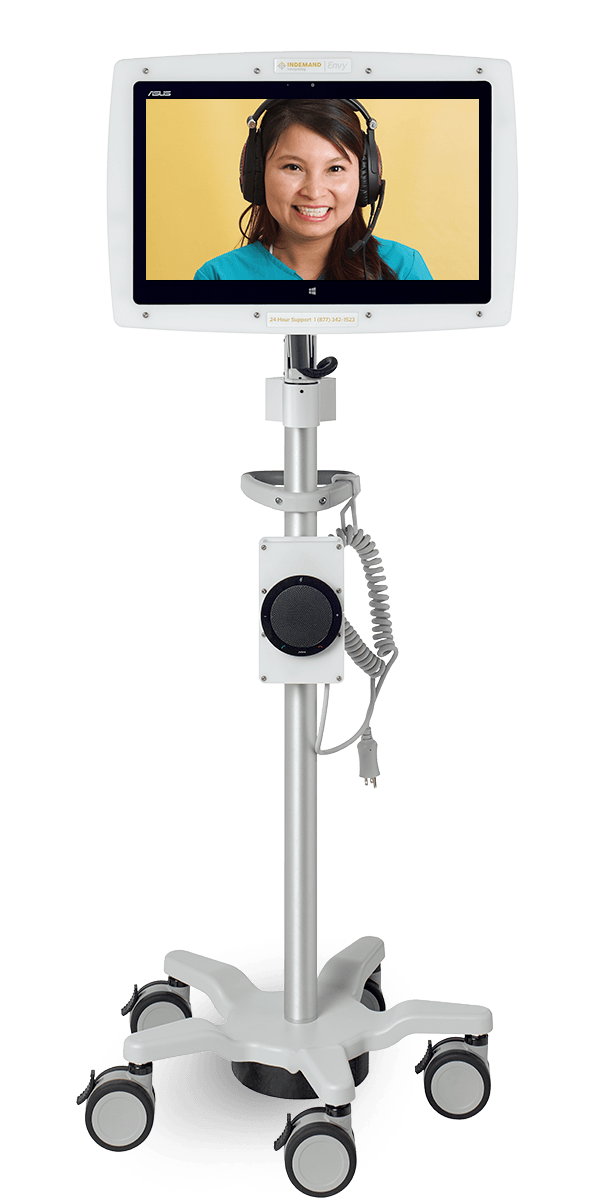
    • Some departments in the hospital use interpreters more than others. Specifically L&D has increased their use of interpreters over the last year due to intensive interdepartmental work and the placement of an interpreter device in every room.
    • ED and Women's Services also have high number of minutes
    That being said, our documented of use of interpreters is pretty depressing.
    See graphic below which shows which percentage of patients with LEP have documented use of interpreter at least ONE time on their chart.
    Some questions to ponder with regards to interpreters:
    • Identification of language preference: How should we ask? How do we document that we asked? How do we not miss this? 

    • Ad hoc Interpreter: When is it appropriate to use a family member as interpreter? Who decides? How can we best use family?

    • Medical error and/or adverse outcome: Who is responsible for communicating medical error or bad outcomes? How should that be done for LEP patients?

    • Family Meetings, Family with mixed language status: How should complex conversations with interdisciplinary teams  and multiple family members be conducted? When should bilingual staff be used vs. VRI vs. both?

    We need to cultivate the expectation that we use the interpreter just like we use hand sanitizer. Every. Single. Time.


    HIV Update for Primary Care (Toub 9/2/2020)

    Dr. Danny Toub, our local HIV expert, gave an information-packed grand rounds presentation this week on HIV.  In the 1990s, HIV was the #1 cause of death among US persons ages 25-44. Great strides have been made over the last two decades. While HIV death rates continue to downtrend, there are still 1.17 million people living with HIV in the US. There are 149,500 people living with HIV in California and about 2,000 in Sonoma County. 

    Unfortunately, rates of new infection are disproportionately highest in black and brown men who have sex with men (MSM). In fact, the lifetime risk of acquiring HIV for an African American MSM is 1 in 2!

    The Basics:

    CD4 counts are used to stage disease

    • normal CD4 >500
    • HIV (not AIDS) > 200
    • AIDS: <200 or Opportunistic infection (OI)/Cancer
    HIV Viral Load is used to monitor response to antiviral therapy 
    • normal: undetectable
    • goal: unmeasurable
    • high: >200K
    Take home point #1: Viral suppression is KEY KEY KEY in HIV management
    • 2018 viral suppression rates now reach 81-90% in most populations (lower in youth and patients with unstable housing, but much better than a decade ago)
    • The US Government has rolled out a program with the goal of reducing HIV new diagnoses by 75% in 5 years and 90% in 10 years using the FOUR Pillars of ending the HIV epidemic:
        • Diagnose all people with HIV as early as possible
        • Treat people with HIV rapidly and effectively to reach viral suppression
        • Prevent new HIV transmission by using PrEP and syringe services
        • Respond quickly to new HIV outbreaks
    Take home point #2: There are so many HIV Resources for you to rely on for help. Here are Dr. Toub's recommendations
    • Team VIDA MD on call 707-583-8823 (24/7)
    • National HIV curriculum: www.hiv.uw.edu
    • CCC (Clinical Consultation Center): http://nccc.ucsf.edu
    • Pacific AETC Quick Guide (26 page): http://paetc.org/
    • Podcasts: https://thecurbsiders.com/tag/hiv
    • Crushing and Liquid formulations of ART: https:/hivclinic.ca

    Take home point #3: Antiviral Therapies (ART) are so much simpler than they used to be. Many regimens are just one pill once a day!

    • Current ART Guidelines include an initial regimen of 2 NRTIs + INSTI (now available in combination forms)
      • Nucleoside Reverse Transcriptase Inhibitors (NRTIs) are in: abacavir, emtricitabine, lamivudine, and tenofovir (AF or DF)
      • Integrase inhibitors (INSTI) are in: bictegravir, dolutegravir, raltegravir
    • Protease inhibitors (PIs) are out
    • Boosters are out
    Take home point #4: Start ART in anyone diagnosed with HIV as soon as possible (within 2 weeks in anyone with OI), call team VIDA for any questions.
    • HIV replication increases mortality
    • Benefits of early treatment outweighs risk (ACTG A5164 Study)
      • this is particularly true in PCP but also in cryptosporidiosis, microsporidiosis, PML, Kaposi's sarcoma and serious bacterial infections
        • possible exceptions: cryptococcal meningitis, TB, CNS toxoplasmosi
    Take home point Point #5: Ambulatory Care of stable patient with HIV is much like care of all our patients with any chronic disease:
    • Chronic Disease 101 (a la Danny Toub)
      • Is the medicine you are taking effective? (--> viral load)
      • Are you able to take your medications? (access ($$, pharmacy issues), adherence, tolerance)
      • Can we do better? (i.e. side effects, pill burden, etc)
    • Routine labs (DHHS ART Guidelines table 3: www.aidsinfo.nih.gov/guidelines)
      • HIV Viral load and CMP q 6 months
      • HbA1C, lipids, urinalysis (if CKD), RPR, GC/CT (3 site),, +/- HCV, CBC (CD4)
    • Health Care Maintenance: www.hiv.uw.edu/go/basic-primary care
      • Vaccination
      • Cancer Screening
    Take home point #6: Treatment=Prevention
    • "People who take ART daily as prescribed and achieve and maintain an undetectable viral load have effectively NO risk of sexually transmitting the virus to an HIV negative partner"
    • Undetectable= Untransmittable (U=U)         U=U taking off in 2017 - The Lancet HIV
    Take home point #7: Pre-exposure prophylaxis (PreP) is an amazing and underutilized HIV biomedical prevention tool. If you do reproductive services in your primary care practice (i.e. birth control and STD testing), you should also be doing PrEP
    • PrEP is safe 
    • PrEP is effective 
      • if men take  >4x/week
      • if women take 6-7 times per week
    • PrEP is patient centered 
    • PrEP is paid for! (as a Grade A USPSTF recommendation
    • However, only 1% of African Americans and 3% of Latinos who would benefit are on PrEP
    • We should be offering PrEP to ALL:
      • Sexually active adults and adolescents who have had any anal or vaginal sex in the past 6 months AND 1) have an HIV+ sexual partner OR 2) Recent bacterial STI OR 3) Hx of inconsistent or no condom use with partners
      • Person who injects drugs AND has a HIV+ injecting partner OR shares drug prep or injection equipment
    • Just need negative HIV test before rx, no s/sx of acute infection, normal renal function, no contraindicated meds
    • Rx TDF/FTC OR TAF/FTC once daily
      • Monitoring visit q90 days: check HIV status, pregnancy test, renal function, STI screen, risk reduction counseling
    • Online Prep learning opportunities:
      • Quick HIV clinical guide
      • National HIV curriculum
      • HIV prevention Certified Provider ProgramPrEP4Love. One Pill. Once a Day. Protect Against HIV
    And finally, my own personal reflections from working with Danny and listening to him speak:
    be strength based
    be non-judgemental
    be kind
    be there for patients ALWAYS


    Diagnosis and Management of Osteoporosis (Hamann 7/23/2026)

     A recording of this presentation is available HERE .  *** Thanks so much to Dr. Kendal Hamann, SMGR Endocrinologist, for an outstanding Gra...