Showing posts with label inclusion. Show all posts

Ethical Deviations and Inequities in the Delivery of Health Care (Matthews, 2/11/26)

A recording of this presentation is available HERE.

***

Special thanks to Dr. Adora Matthews, Sutter's CME of Inclusion and Belonging. She gave an important presentation on Inequity in the Delivery of Health Care-- as a celebration/reminder of Black History Month and a reminder of our commitment to delivering equitable and excellent care to every patient we serve. 

Dr. Matthews reminded us of four important historical occurrences that still contribute to fractured trust in the medical system for black Americans:

1) Dr J. Marion Sims, often referred to as "the father of modern gynecology", a white man, who operated on black slaves without anesthesia, perfected his hysterectomies and vesico-vaginal fistula repair on black slaves without consent, and contributed to a long-held notion in medicine that "black people don't feel pain the same as white people". After  all surgical assistants resigned due to discomfort with his work, he ultimately forced three black slave women (named Anarcha, Betsy, and Lucy) to assist him in these experimental surgeries.

A statue to honor these three women, the "Mothers of Gynecology" stands today in Montgomery, Alabama. 

2) The Tuskegee Syphilis experiment, which took place from 1932-1972, in which 400 black male sharecroppers were knowingly observed to study the natural history of syphilis, even after cure/treatment for syphilis was widely available (in the form of penicillin!). Spouses were infected, babies were born with congenital syphilis, extreme pathology was documented. This is widely considered the greatest failure of medical ethics in our country. This experiment didn't end until it was leaked to the press in 1972. A formal apology rendered by President Bill Clinton in 1997, calling the experiment "shameful and racist". 

3) Henrietta Lacks was a black woman who was treated in 1951 for cervical cancer at John's Hopkins University. After she died that same year, her cell line (HeLa) was used (without consent) for countless projects, including vaccine development, medical research, most recently for the COVID vaccine development. 110,000 publications are attributed to her cell lines, which are still in use today. The Lacks family was unaware of this use of her cells until 1973, when they were approached by a scientist who wanted to study them. 
These historical truths (and many others) contribute now to systemic inequity and mistrust. We must be aware of these histories, warned Dr. Adora Matthews, when we are caring for black American patients. We must be aware of them when we see current inequities. And while being aware isn't enough, it's a start.

Four current inequities for Black patients:
1) Healthcare access: black and brown patients have higher rates of being uninsured, are less likely to have preventive care, and less likely to have a regular PCP.
2) Chronic disease management: black American women have some of the highest rates (40%) of metabolic syndrome, which doubles CV risk, increases all cause mortality, and is associated with DM, CKD and stroke.
3) Maternal and fetal health outcomes: black women have highest rates of maternal mortality and fetal mortality, even when controlling for SES (see graphs below)


4) Pain management: Biased beliefs about black patients and pain tolerance dating back centuries with no evidence-- still exist today. There is literature from emergency rooms, hospitals and clinics that black patients are less likely to receive pain medication for the same painful condition.

Dr. Matthews reminded us that knowing the history (and the current inequities) is where we begin-- from here we begin to look at systems and address systemic racism in the daily work we do. We turn our grief, sadness, anger and despair into hope for our patients. We confront our own biases by attending lectures like these and participating in unconscious/implicit bias assessment ( Harvard's can be found HERE). 


To understand and to be understood: language interpretation in medicine (Slater, 5/1/2034)

Many thanks to Dr. Allison Slater, our final resident from the class of 2024 to give her senior Grand Rounds presentation this week. She gave a really important and thought-provoking presentation on language and language interpretation in medicine. It was titled "To Understand and be Understood", a title she borrowed from a March 2017 AMA Journal of Ethics that focused on language, literacy and hierarchy in medicine.  

A recording of her presentation can be found HERE.

My notes:

Dr. Slater began with a review of words:

  • interpretation: spoken language being repeated in an alternate language
  • translation: written language being repeated in an alternate language
The distinction between the two is important because trained interpreters have special training and skill in being able to perform live and capture the meaning of the discussion, whereas written translators have the tincture of time and the ability to be more precise. In the healthcare setting, we are generally using live interpretation with patients during patient encounters, though document translation is also important issue, particularly with regards to clinic after visit summaries and hospital discharge summaries.
  • limited English proficiency (LEP): US Census distinction based on an individual's response to the question: "How well do you speak/read/write English".  LEP is considered anyone who responds anything other than "very well"
  • Non-English language preference: upon closer examination, the term LEP is a "deficit-oriented" distinction and in no way recognizes a person's proficiency in languages other than English. Thus, this may be the preferred term. 
Professional interpretation in the healthcare setting is the law. 
This legal protection comes through various acts and executive orders, but which has not always been accepted:
  • 1964: Civil Rights Act codifies "national" origin as a protected class for all programs or activities receiving federal funds
  • 2000: President Bill Clinton signs an executive order designed to improve access to services for patients with limited English proficiency (LEP) from all federally-funded agencies
  • 2003: AMA president makes public statement that he sees "no need for professional interpreters"
  • 2010: The Affordable Care Act (aka ACA/Obamacare) added protections for patients, including regulation around signage in 15 top languages for each state
  • 2019: Trump rolls back and narrows protection
  • April 26, 2024 (last week!): a federal appeals court reinstates the 2010 ACA protections that had been repealed in 2019
Despite the regulation requiring healthcare institutions to provide no-cost language interpretation for patients with non-English preference (and the real risk of malpractice vulnerability) we are al aware that what happens in real life is not always what should happen. Many healthcare providers "get by" with inadequate language skills, physicians in particular are well-documented to overestimate their language skills, and patients with LEP are known to have more adverse outcomes, longer hospital length of stay, have more tests, higher rates of readmission, and feel discriminated against in the places they are receiving health care.

Unfortunately, ad hoc or informal interpretation is often used -- including patient family members and/or non-trained staff. Ad-hoc interpreters -- i.e. anyone who isn't trained and certified-- introduce a range of possible challenges: the potential for role confusion, may not have adequate language abilities for the content, insufficient attention and recall, not following standard interpretation protocols, subjectivity and biased interpretation, breach of confidentiality, missed conversations, and the possibility of limited scope of inquiry (e.g. intimate sexual issues). In fact, one study found that 1/4 to 1/2 of questions asked by a clinician were misinterpreted or omitted by ad hoc interpreters

While "routine conversation" between LEP patients and clinicians who self-identify as being language proficient may be acceptable, clinicians should really be subject to a proficiency certification to ensure that vital medical conversations (e.g. diagnosis, surgery plans, medical treatment plans, procedural consents, and discharge plans) are correctly communicated. Medical communication requires precision -- and this is even more important with sensitive topics, e.g. mental health, options counseling, substance abuse, trauma, and sexual assault. 

In addition, official interpreter roles can include exploration and explanation of culturally relevant features of a conversation. 

Okay, deep breath. As I myself said at the end of her presentation, there are many ways in which much of what Dr. Slater shared has me feeling bad about myself. Even as someone who considers herself a champion for the best care for our patients with LEP, I often find myself acting badly: acting as an interpreter (myself without formal training), using family members for interpretation (twice in the last 2 weeks, interpreters in patient's preferred language were not readily available), failing to give an interpreter context, not ensuring that every person in the room has access to the same information.

Let's do better!
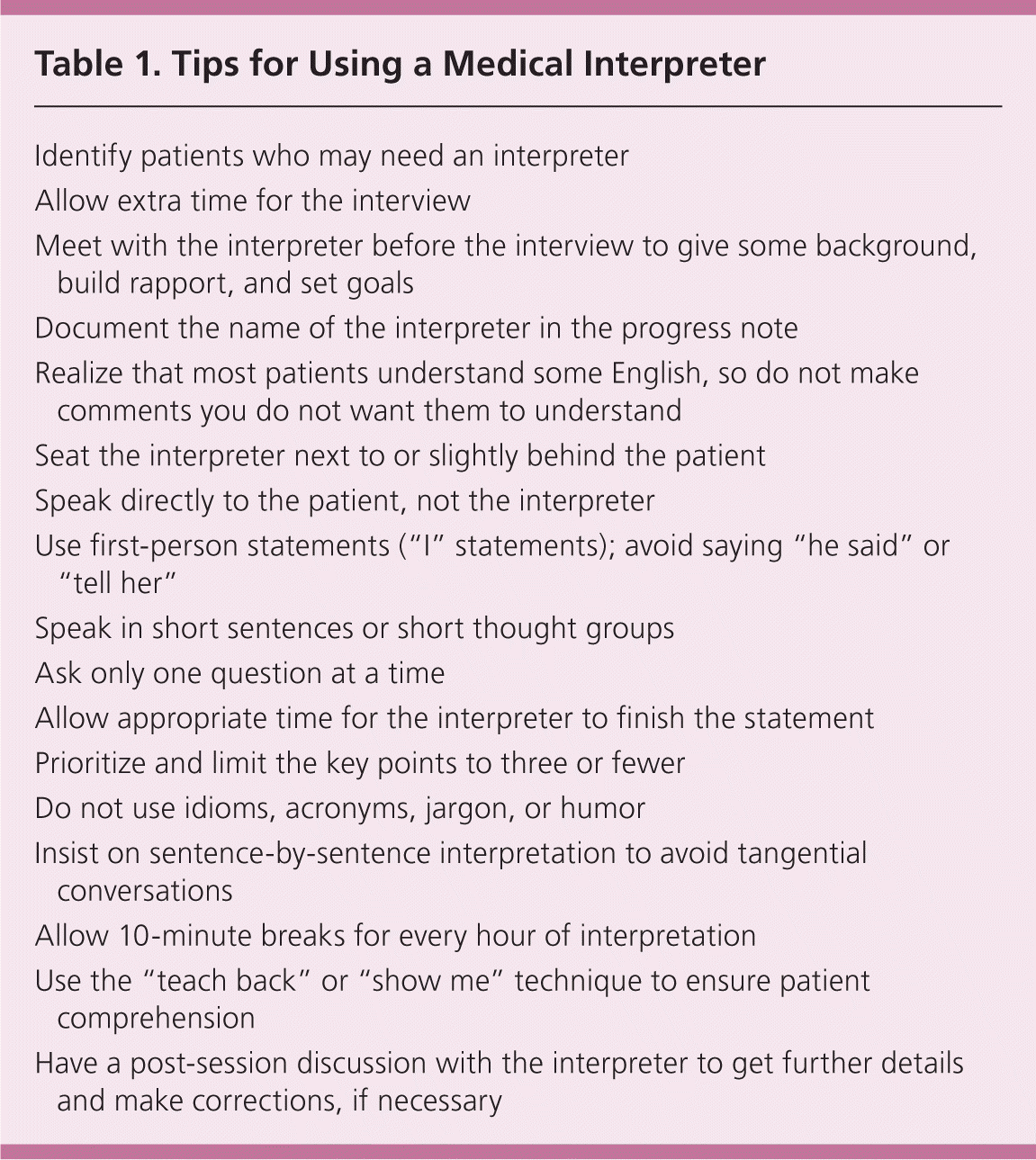
Best practices, my favorites: 1) Make sure you allow extra time 2) Always write down the ID# of the interpreter you are using 3) huddle with the interpreter before the conversation whenever possible 4) look for red flags (e.g. confusing answers, confusing questions, long statements that are not being appropriately interpreted) and 5) if you don't use an interpreter, document why. For more, see the Table below from the 2014 AAFP article, Appropriate Use of Medical Interpreters

Healing through Strengths, Movement, and Culture (Fleg, 1/10/2024)

 A recording of this presentation is available HERE.

***

Deep gratitude for today's Grand Rounds, an impactful presentation by Dr. Anthony Fleg from  University of New Mexico in Albuquerque, about changing the way we assess and treat patients by assessing for their strengths, rather than their deficits. 

I would say this is a presentation better watched and absorbed than summarized, but here are my notes for those of you who prefer them.

Dr. Fleg encouraged us from the beginning of his presentation to consider how we are trained in medicine to assess and manage patients by understanding their "problems" or "deficits" rather than to understand their strengths. 

To begin, he asked us to consider one of the patients we may have struggled to serve effectively in recent weeks and to list out their problems. After about a minute, he then asked us to list out this same patient's strengths. Once we were done with the exercise, he made us do a self-assessment.

  • What was our ratio of problems to strengths for our patient? (on average, he said, physicians are able to list 6 problems to 1 strength)
  • Did we have trouble thinking of strengths? It wouldn't be surprising, we aren't trained to look for them.
  • How might we care for our patients differently if we ask "what is right with you?" instead of always "what is wrong with you"?          
  • How can we possibly ask patients to use those strengths if we do not know what they are? 
  • How can we change even very complex medical situations into achievable goals for patients -- particularly for historically marginalized patients, e.g. BIPOC patients, but really for everyone?    

Dr. Fleg spoke about how social workers are trained to do something called "asset mapping" with their clients, which is exactly what it sounds like -- looking for people's strengths, even under challenging conditions. The idea is that, by understanding assets, we  empower people in communities to build on what they do well in order to improve their health. 

Take, for example, Dr. Fleg's wife's 95 year old Navajo grandfather, a traditional medicine man, who died of COVID early in the pandemic. This person, Grandad Bahe Manybeads, looked at from a traditional medical model -- a deficit perspective -- had many things stacked against him: low English proficiency, low educational attainment, minimal eye contact, hard to communicate with, doesn't share, geriatric. But what happens if we flip his deficits into strengths: he is Navajo speaking, culturally competent and highly educated in Navajo culture, a recognized community healer, humble and modest, stoic and strong, wise elder, a physical strong healer who still performs all night healing ceremonies well-into his nineties. How does that lens change how we treat his medical illness?


By not focusing on strengths, Dr. Fleg argues, we perpetuate racism, lose key chances to empower patients to heal from within, dehumanize patients and ourselves, and feed into our own burnout. Deep breath. Take that for consideration. Consider how focusing on patient strengths may actually feed you and sustain your practice.

***


Dr. Fleg ended his thought-provoking presentation on leading with strength on a reminder of  the decimation of the Indigenous people in California (from the state of CA court's website):

  • From 1840-1870, the California indigenous population decreased from 200,000 people>> 12,000 due to disease, removal and death. This was not accidental.
  • Even still, CA has the largest Native American population in the country (12% of all Native Americans in the US live in California)
    • Over 1/2 of California's indigenous people are descendants of those displaced due to mass relocation to urban centers (SF and LA)
  • Systematic oppression, codified by law:
    • Any Indian declared vagrant could be thrown in jail 
    • Indian children were allowed to be sold as slaves
    • Laws explicitly prohibited Indians from testifying in court against a white person
  • While there are currently >100 tribes recognized in CA, there are also tribes that were erased by federal policy. Be careful with each individual's identity and passing value judgements without understanding
In summary, while we may be medically proficient, we may also be culturally and historically deficient in understanding people's contexts. Be sure to consider be peoples contexts and make an effort each day to care for people, rather than treat patients.

I'll end on a state from Dr. Fleg that was particularly poignant for me: "We decolonize ourselves when we are strength-based and that is good for ourselves and for every single person we care for."

Race-Based Affinity Caucusing as a Tool for Promoting Equity and Inclusion (Washington, 1/19/2022)

Many thanks to Dr. Sharon Washington for an important presentation on Race-Based Affinity Caucusing as a Tool for Promoting Equity and Inclusion

It is always worth your time to listen to Dr. Washington. She has been a tremendous resource and teacher for our anti-racism work at Santa Rosa Family Medicine Residency. A recording of her presentation is available HERE

Dr. Washington opened with two recent articles from the medical literature exploring racial harms in the healthcare setting and recommended that leadership teams could explore caucusing as a tool to support community, connection, and racial healing and equity in the health care setting

Paper #1: Racism as Experienced by Physicians of Color in the Health Care Setting, Serafina et al, Family Medicine 2020, exploring racism as experienced by physicians of color

  • 71 physician participants, 88% family medicine physicians
  • 72% female, 1.4% gender non-binary
  • 34% black, 34% Asian, 24.7% Hispanic/Latinx, 1.4% Native American/Alaskan Native
  • 33% English as a second language (ESL)
  • Dr. Washington notes two caveats
    • we know that physicians are higher in medical hierarchy, and this study doesn't take into account experiences of nurses, support staff, that are also BIPOC
    • the study also doesn't include color/lightness of skin (which we know plays a role in the experience of racism), and which we know from previous studies is likely to be lighter than those of staff lower in medical hierarchy
Findings from this study
Experiences offered by Physicians of color (POC):
  • more likely to experience racism from colleagues than from patients
  • 23% POC reported a patient refused their care because of their race/ethnicity
  • ESL POC report more incidents of racism than those with English as first language
  • Experiences of micro-aggressions are associated with secondary trauma/stress with ongoing implications in the mental and physical health of these POC
    • surprisingly, not statistically significantly associated with compassion fatigue or burnout
Qualitative themes from this same study:
How has institutional racism affected you?
  • exclusion from leadership advancement (treated differently than non-black counterparts)
  • assumptions discounting abilities or expressing stereotypes
  • being held to higher standards than white counterpart
  • numerous microaggressions in the workplace without response from the institution
Incidences of racism from a colleague. . .
  • many did not have an example of experience of racism from colleague 
  • microaggressions from colleagues: assumption they are not a doctor because of race, general lack of respect, homogeneity bias
  • assumptions: e.g.  about medical knowledge in context of accented English
  • invalidation: lack of trust
Instances of racism from a patient. . .
  • microaggressions
  • assumptions
  • patient refusal of care
  • adaptation: comments on "where were you born and how how well I speak English"
  • psychological burden of patient questions "where are you from", "Are you Korean"
  • patients reacting differently to the same advice when offered by a colleague
  • differential treatment: non-verbal, body language
Dr. Washington remarks: above are the experiences that POC revisit (and hyper-revisit), struggle to let go of, not for lack of conscious effort, experiences that can cause physical and chemical reactions when these types of instances happen with patients, colleagues, staff, etc. have weathering/long term effects on physical and mental well-being, ability to stay in the work place

Recommendation for promoting inclusion includes listening to POC, offer diverse representation in leadership, staff and recruitment, empowering BIPOC leadership

  • learners (students, residents) and lower level health care staff are more vulnerable to racial trauma, particularly during pandemic
    • seeing selves in the disparities, seeing structural and interpersonal practices
  • creating a safe and trusting environment where staff can share their racial trauma
  • training managers and supervisors (skills, time)
  • engage in deep listening to the trauma stories
  • provide concrete support, if needed (e.g. escort at night to the car, restorative time off)
Note from Dr. Washington: while the title includes "health care staff" this is actually another paper about physicians. Researchers need to be reflecting on the power hierarchy and be sure to extend beyond physician experience when reporting on this topic

Racial Affinity Group Caucusing is approach to bring people together, based on shared mindset, identities, orientation (e.g. physicians come together, nurses have meetings)
  • allow group to focus on manifestations of how we internalize racial oppression in a system that is hierarchical, promotes dominance, and is inherently racism
    • identify where behaviors originate
    • collectively find new behaviors that stop self-perpetuation of cycles of these concepts
  • allows groups that identify as white to come together, people who identify as black (or African descent), groups who identify as Latinx (or Hispanic)
    • the bigger the group, the more specific these groups can be
    • allows people to be in "safer space", grounded in "shared experiences" to explore structural racism, how we contribute to perpetuation
    • seek to explore ways in which we contribute in unintentional ways
  • build communication skills to stay present and effectively navigate cross-racial dynamics
    • our bodily reactions can make it hard to stay present if we don't have the racial literacy to stay present in our bodies
  • allow for creation of community of dialogue, accountability, support institutional growth of equity and racial inclusion
  • challenges white folks to do their own work (and not rely on BIPOC to do the work)
    • allow white people to develop a racial identity, own one's racial identity (just like BIPOC do every day)
    • leverage the sense of self to be committed to growing together in anti-racism
  • within BIPOC spaces caucusing allows be understood, collaborate, not have to explain or be believed
    • have more nuanced, deeper more complex conversations about intersection and deeper identities, how BIPOC perpetuate other forms of bias and dominance in other identities
What does caucusing look like?
Priming content: e.g. podcast, readings, video content
Groups (as defined by the institution) but self-selected by the participant
Planned curriculum discussion, agenda with a trained facilitator/moderator
Engage in dialogue and discussion during the session
Have some sort of report out: sharing, transparency, accountability to the other caucus groups

What is caucusing is NOT?
not place to whine/complain, not hate fest, hot pot for racism
people are not assigned for multi-racial or mixed race person (they can be fluid), people self-identify and choose the group 


A final note: Caucusing is NOT "the only answer" to solving racism in the health care setting.
Caucusing must be combined with a comprehensive PROGRAM of equity and inclusion, including DEI leadership, committees, curriculum and trainings, policy, metrics of accountability, dashboards, and a concrete commitment of the organization to anti-racism work. 


Mental Health Disparities in Latinx (Flores, 7/29/2020)

A big thanks to CEDAWG and Dr. Yvette Flores, clinical psychologist and professor of Chicano/a studies at UC Davis, who gave a powerful and heartfelt Grand Rounds presentation this week on how to consider and approach the mental health of marginalized groups, particularly Latinx , in this time of COVID. Again, it is hard for me to give her words justice in summary, but the following is my attempt.

Dr. Flores started with "stating the obvious": 1) That racism, sexism, homophobia and other forms of discrimination affect the mental health of those who experience them, 2) That stress affects well-being and 3) That yes, in fact, we are all in this together.

If I don't wear a mask, I affect you.
If my grandchildren don't wear a mask, it affects me.
We are all a little anxious, depressed, and experiencing past traumas as we live this pandemic.
We all need to be in this together, including in mental health.

Dr. Flores spent some time reviewing the important effects of stress on mental health.

Social stress: stress is produced not only by personal events but also by the social conditions that surround us-- and for all our patients, their intersectional identities (gender, class, nativity, immigration status, length of residence in the US). 

Minority stress: high levels of stress faced by members of stigmatized minority groups (race, gender, sexuality, linguistic ability, physical/mental abilities), including:
  • lacking proper social supports
  • socioeconomic status (SES)
  • interpersonal discrimination
Marginalized status affects physical and mental health.

Good stress vs. bad stress: a little stress has been found to improve performance, but a lot of stress can become problematic. In what ways is minority stress a risk factor? And how may minority stress also be a protective factor?

I love considering the possibility that the very minority stress our patients are experiencing may make them simultaneously vulnerable and resilient. 

What has COVID-19 Revealed?
1) Health disparities have been made more visible
2) Xenophobia and hate crimes against Asian Americans
3) Disregard for these disparities from politicians at the highest levels
4) People of color disproportionately work in front line jobs
5) Disproportionate unemployment rates for Latinx and African Americans
6) Ageism (are old people important enough?)

How can we translate scientific data in a way that people can understand?
How do we frame the message?

"There is no one to blame here, but we all have responsibility."

Role of Gender: For the working class, life and work are often synonymous. How does unemployment affect men? How does unemployment impact women who are single parents and have to work? People of  color will often go to work despite the risk because of their gender or cultural mandate that it is their obligation to provide. But this is also a class issue (always need to think intersectionally).

What are the protective factors in communities of color that might mitigate the crisis?
  1. Resilience: Immigrants are tremendously resilient. It takes incredible courage to make the journey that many immigrants (particularly undocumented immigrants) make.
  2. Stoicism:  coping, "it's alright, I am fine", challenging for healthcare professionals to care for someone who says they are fine (when they clearly aren't). Dr. Flores' rec: Bring in partner if there is one/
  3. Religious faith: "Si Dios quiere" God willing. Can be frustrating because seems fatalistic but is also protective. How can we leverage this?
  4. Networks of support:  Overcrowded and/or Multi-generational households, which make them more vulnerable are also the very support structures that allow people to survive. How do we mobilize the 
  5. Positive ethnic, racial and gender identity: reaffirm their identification (whatever they may be). Call them what they want us to call them. 

Remember that mediational factors may ADD to minority stress
  • Internalized racism
  • Controlling images (often propagated in the media-- more serious and perverse than stereotypes), many are gender specific (angry black woman, loud Latino, Latino male as criminal or rapist). How does this affect internalized perception of people of color?  How are people in power speaking about these controlling images?
  • We must uphold the identities of the people with whom we work: we need to counter these controlling images (mental health workers)

And finally, on coping: how to potentiate coping, so we can be better healthcare providers and caretakers. 

Dr. Flores called this digging into our ancestral well: we have all learned lessons from our family that can help us to serve our patients. In times of crises, we can draw from the stories/legacies that the elders and ancestors have shared with us (and with each of our patients), which can help transform our fears into opportunities

Where do you draw your strength to continue to care for your patients?

Self care is essential during COVID-19:
It is important for us to promote self-care and resilience as we do this work.
Gendered expectations (nurture ourselves in order to refill the well)
Remember to check out and disconnect in order to connect to ourselves 
Cultural traditions can offer balancing and healing: including prayers, smudging, meditation, mindfulness, exercise, baking, cooking

Preparing for Passover during a Plague:

Allies and Accomplices: How Health Care Providers Can Cultivate Equity (Washington 7/15/2020)

Well, Dr. Sharon Washington did it again. And this time on Zoom (which is no easy task). She pushed us. And moved us. To think differently. To act. To do better. To question the insidiousness of race and racism embedded in our society and in medicine. To not be not racist, but rather to be ANTI-racist. She is such a tremendous speaker and incredible teacher, and we at the Santa Rosa Family Medicine Residency are so lucky to have had her with us this last year and a half. 

A summary cannot really do Dr. Washington's work and words justice. I highly recommend you watch the Grand Rounds if you did not attend live, but nevertheless, here are some highlights. . .

Racism is not merely one individual's negative thoughts about another person of a different race. Racism is more layered and complex. It includes:
  • internalized: the devaluing of one's own identity and culture according to societal norms
  • interpersonal: the way in which we perpetuate racism on an individual basis
  • institutionalized: the way in which institutions perpetuate racism
  • structural: system of public policies, institutional practices, cultural representations, and other norms work in various, often reinforcing ways, to perpetuate racial group inequity
Dr. Washington highlighted the legacy of inequity for African Americans in the US dating back 401 years (see image)

Dr. Washington reminded us that:
  • There is racial bias built into almost every aspect of healthcare.
  • Significant health disparities exist for people of color in chronic disease (diabetes, cancer, heart and kidney disease), infant and maternal mortality, stroke, addiction and mental illness.
  • People of color receive fewer/less breast cancer screenings, kidney transplants, vaccinations, eye exams cardiac care, cancer pain meds, revascularization procedures, and mental health treatment.
In order to not be part of the problem, health care providers have a responsibility to be ANTI-racist: the active process of identifying and eliminating racism by changing systems, organizational structures, policies and practices, and attitudes so that power is redistributed and shared equitably.


What is allyship? 
Allyship is a person of one identity group standing in support of another identity group 
  • allyship is not a noun, it's an action
  • allyship is about listening
  • allyship is not a proclaimed identity--> trust is earned
  • allies don't take breaks
  • allies educate themselves (and don't expect marginalized people should teach you)
  • allies don't need the spotlight
  • allies focus on those who share their identity
  • when criticized or called out, allies listen, apologize, act accountable, and act differently going forward
What is an accomplice? 
"While an ally will mostly engage in activism by standing with an individual in a marginalized community. An accomplice will focus on dismantling the structures that oppress that individual or group-- and such work will be directed by the stakeholders in the marginalized group" (Teaching Tolerance)
  • accomplices assess an organization for inequities in hiring, promotion, pay, evaluation, termination, etc
  • accomplices encourage major institutions benefiting from inequities to invest in marginalized communities
  • accomplices engage in anti-racist assessment of laws, policies, institutions, and systems
  • accomplices divest institutions from (private) prisons, detention centers, and institutions engaged in systems harmful to BIPOC
  • accomplices promote self care for BIPOC
  • accomplices create systems of accountability for supporting hate speech and behavior

Examples of what allies and accomplices can do in medicine:
  • Petition the laboratory you use to stop reporting GFR differentiated by race
  • Hold a fellow physician accountable if they send a racist email or make a racist comment
  • Interrupt micro-aggressions when they are happening
  • Don't vote to appoint someone to the board unless they divest from investments that perpetuate racist structures
  • Pass the microphone to the marginalized person next to you whose voice is not often heard
Questions to ask yourself:
  • In what ways can you be an ally?
  • In what ways can you be an accomplice?
  • In which institutions do you have agency to create structural change?
  • What is holding you back from taking action?
  • What commitment can you make to move you toward meaningful action?

Diagnosis and Management of Osteoporosis (Hamann 7/23/2026)

 A recording of this presentation is available HERE .  *** Thanks so much to Dr. Kendal Hamann, SMGR Endocrinologist, for an outstanding Gra...