A recording of the presentation can be found HERE.

View/download supporting documents:
Get Healthy Action Plan Questionnaire - English Spanish

Many thanks for an excellent Grand Rounds year-- we covered a wide range of topics from Drowning Prevention to Moral Distress, from CKD to Gender Expansive Care, from Racism in Medicine to Bias in Documentation, from Breast Cancer Reconstruction to Alcohol Withdrawal. And more!
Also thanks to our last Grand Rounds speaker of the year, Dr. Vanessa Pinto, who gave an excellent talk on Marijuana (MJ) in pregnancy and postpartum.
A recording of her presentation is available HERE.
My notes:
Many thanks to Dr. Alec Ludwig for an excellent presentation about liver and biliary abnormalities in pregnancy. It was jam-packed with good information.
A recording of his presentation is available HERE.
My notes:
Remember that what we typically call "liver function tests" is actually a misnomer. In fact, there is no test that reliably demonstrates the liver's function. Elevation of AST and ALT -- the liver enzymes-- indicates liver injury, not liver dysfunction. Albumin and prothrombin time are factors that are produced by the liver and may be better markers of function.
In normal pregnancy, you can see elevated alkaline phosphatase (up to 3x normal), as well as elevated cholesterol, triglycerides, and fasting gallbladder volume. Note that many measures we use to evaluate the liver (AST/ALT, T Bili, PTT, liver size, bile acids) don't change in pregnancy.
Hepatocellular injury as measured by elevation in AST/ALT:
Gallstone disease in pregnancy
Gallstone disease is much more prevalent in pregnancy for several reasons. 1) Increased estrogen levels increase cholesterol, thereby supersaturating bile with cholesterol. 2) Progesterone slows contraction of gallbladder, disrupting the excretion of bile acids. AND 3) Increased fasting gallbladder volume.
Generally treat GB disease in pregnancy with IV antibiotics, surgery if indicated. Laparoscopic cholecystectomy is safe in pregnancy, safest in the second trimester. Should occur within 24-48 hours conservative management. ERCP is also safe in pregnancy; minimize radiation by shielding, fetal monitoring.
Viral Hepatitis (A-E)
Many thanks to our SoCo Public Health Officer, Dr. Sundari Mase and our SoCo Vaccine Chief, Dr. Urmila Shende for an excellent Grand Rounds this week on Pandemic Pearls and Pivots: A Public Health Perspective.
A recording of their presentation is available HERE.
As we all know, COVID-19 has taken a great toll on our world, our nation, and our county. As of this week, there have been 6.28 million deaths worldwide (probably an underestimate), >1 million US deaths (more have died from COVID-19 than HIV/AIDS, the 1918 influenza pandemic), 90,000 deaths in California, and 491 deaths in Sonoma County. This has led to the largest drop in life expectancy since WWII. And we know that there have been disproportionate numbers of cases, hospitalizations, and death among people of color.
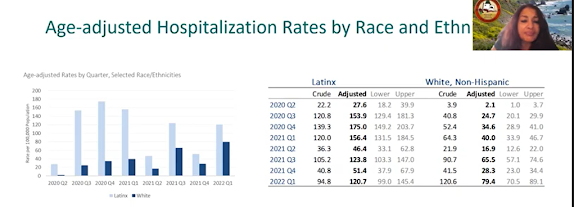
 Vaccines work! The reduce infection, hospitalization, and deaths.
 |
| from https://socoemergency.org/ |

If you are interested in this week's Grand Presentations Be Curious: Cultivating Curiosity in Learners, Teachers, and Practitioners of Family Medicine, a recording is available HERE.
I will be brief with my notes:
I presented Dr. Todd Kashdan's model for the 5 Dimensions of Curiosity:
“Curiosity is fundamental to our physicianship, and serves both the art and the science of medicine. (How do you do? What’s your name? Where do you come from? How do you feel? Tell me more about this pain you’re having…). Curiosity is how we explore the world, this primal “wonderment” that stimulates exploration, engages both the human imagination and human intelligence. Both are integral to the humanities and science, as well as the synthesis of the two, which is clinical medicine.”https://www.bumc.bu.edu/facdev-medicine/files/2010/09/Fitzgerald_AnnInternMed_1999_130_70_Curiosity.pdf
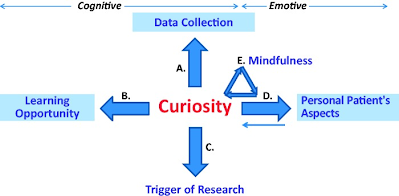
I also shared with you a model created by an Israeli hematologist, Dr. Shattner, in his essay from 2015 on Curiosity in medicine. His model (which I don't love aesthetically but adore in its core tenets) espouses that curiosity is good cognitively and emotionally, and it's good for patients and physicians.
You can see his model below and an updated rendition below (by yours truly)
 |
Shattner, https://www.ncbi.nlm.nih.gov/pmc/articles/PMC4484215/ |

Thanks to our speaker this week, cardiologist Dr. Joanne Tsai, for an excellent review of cardiology topics for outpatient care of cardiology patients, particularly regarding Atrial Fibrillation and Atrial Flutter.
A recording of her presentation is available HERE.
My notes:
 |
| pseudo atrial flutter |

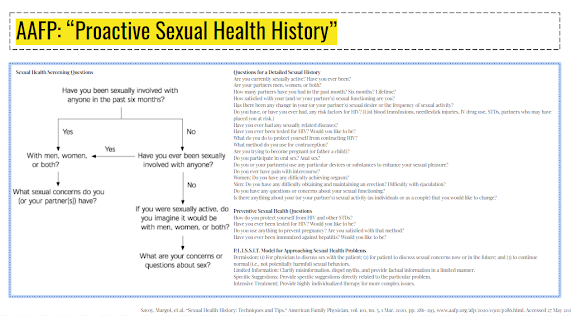
Big thanks to Dr. Sophie MacArthur for her excellent presentation on a topic that we could ALL use a little education on-- Sex. And specifically how we talk about it with patients.
The recorded presentation is available HERE.
Link to her slides is HERE.
My notes:


STIs: Not just condoms - frequent testing, PrEP or PEP, etc.
Contraceptives: RHAP Birth Control Options Fact Sheet; bedsider.org
Consent: Yes, No, Maybe Inventories
Painful sex: Mayo Clinic resources
BDSM/Kink safety: San Francisco Aids Foundation S&M and Kinky Sex Resources; NCSF Kink Aware Professionals Directory
Legal: National Coalition for Sexual Freedom Incident Report; safewordtax.com
I am personally feeling very grateful to Dr. Onna Lo for a really lovely presentation this week on Gratitude, Happiness and Resilience. I have already integrated some of her techniques. . .priming my day and granting myself a "celebration" list (what I have accomplished in the last 24 hours) rather than a "todo list" (all the things I feel bad about not accomplishing).
If you are interested in watching her presentation-- and you should be -- it is available HERE .
Here are my notes. sorry they are brief:
Dr. Lo encouraged us to start every day and every encounter with the ABCs:
A: Awareness (ground yourself)
B: Body/breath (be in your body, find your breath)
C: Connection (with your surroundings, yourself, your patients)
People are struggling
Something to strive for -- Dr. Lo recommends in our own lives and for patients. To be: Empowered, Engaged, Excited, and Embodied
Some definitions:
Lesson #1: A positive mindset sets you up for better learning
A positive mindset leads to better learning, improved performance, better problem solving
In The Happiness Advantage, author and researcher Shawn Achor, proposes that personal happiness leads to professional success (not vice versa). Happiness is a choice. Happiness spreads. Happiness is an advantage. Read more about his work here.
The happier you are, the more successful you will be (Horn & Arbuckle).
Gratitude predicts hope and happiness more than forgiveness and patience.
How can YOU build happiness? 21 days in a row x 2 minutes >> 3 gratitudes, positive journaling
Lesson #2: Our brains tend to get stuck in negativity
Half glass full or half empty?
Dr. Lo showed us a series of sociological experiment in which people consistently chose the negative response consistently after being primed with a negative response, even when the outcome was quite positive. If primed with the positive response, people were more likely to choose positive.
We can unstick ourselves by "priming"-- that is, retraining the mind first thing in the morning with gratitude. That is, starting the day positive allows for the day to be more positive.
Exercise: Draw a triangle, write down 3 gratitudes (these must be heartfelt!)

2) what I am grateful for in others
3) what I am grateful for in my current situation
Exercise: Draw a triangle, write down 3 wonderful things that you accomplished in the last 24 hours (this is your celebration list)

Exercise: Draw a triangle: write down 3 things that will make today great

Lesson #3: There is science supporting positivity and gratitude
Coherence=optimal coordination between the heart and the mind ==> heartrate variability is a really beautiful sinus curve in someone who is completely in a coherent state. Being in this mindset is better for your whole body.

Much more information about coherence and Heart Math at the Heart Math Institute Website found here.
Exercise:
1) Heart focused breathing: 5 breaths in/5 breaths out (requires nothing more than the breath)
2) Inner coherence: use positive emotions or feelings of gratitude to establish a coherent beat (using heart math monitor)
And finally, keep a gratitude journal. Even in these hard times, there are big and small things to be grateful for.
A recording of this presentation is available HERE . *** Thanks so much to Dr. Kendal Hamann, SMGR Endocrinologist, for an outstanding Gra...