A recording of the presentation can be found HERE.

Marijuana Use in Pregnancy and Post Partum (Pinto 6/7/2022)
Many thanks for an excellent Grand Rounds year-- we covered a wide range of topics from Drowning Prevention to Moral Distress, from CKD to Gender Expansive Care, from Racism in Medicine to Bias in Documentation, from Breast Cancer Reconstruction to Alcohol Withdrawal. And more!
Also thanks to our last Grand Rounds speaker of the year, Dr. Vanessa Pinto, who gave an excellent talk on Marijuana (MJ) in pregnancy and postpartum.
A recording of her presentation is available HERE.
My notes:
- In 15-44 year old pregnant patients, 4.9% reported MJ use in the last month during pregnancy (compared to 11% when not pregnant)
- Use during pregnancy has increased since 2015, with significant increases during pandemic
- 44.6% of patients who reported smoking MJ before the pregnancy continued use during pregnancy
- Risks of MJ use during pregnancy include low birth weight, preterm birth (when combined with tobacco), still birth, and long term neurodevelopmental issues
- There are some women that believe that MJ is helpful for hyperemesis and nausea/vomiting of pregnancy. However, there is no data to support this. And we know MJ use is associated with cyclic vomiting syndrome.
- The only state with legislation to caution use of MJ in pregnancy in Oregon
MJ in Pregnancy
MJ crosses the placenta; it also influences the physiology of the placenta. THC crosses most readily. Can enhance permeability to other substances, has an influence on uterine blood flow, increases placental resistance, reduces circulation, and impairs gas exchange.
There are two large systematic reviews looking at effect of MJ on the neonate. Unfortunately, the few studies we have did not exclude patients with polysubstance use. It is believed that MJ use is associated with anemia, low birthweight, and increased rate of NICU transfers
Newborns exposed to MJ display altered arousal, increased excitability, tremors, exaggerated startle reflex, abnormal sleeping patterns. However, there is no data to support MJ withdrawal syndrome (like we see in opiates). Endocannabinoid receptors are seen as early as 5 weeks gestation.
MJ in Breastfeeding
MJ gets readily into breastmilk. It is a small lipid-soluble molecule and readily passes. There are not large studies looking at effect on infants, but many mothers using MJ are also using alcohol, other illicit substances and/or tobacco.
ACOG (2017): "Insufficient data to evaluate the effects of marijuana use on infants during lactation and breastfeeding and in the absence of such data, marijuana use is discouraged."
AAP (2012): "Street drugs such as PCP, cocaine, and cannabis can be detected in human milk, and their use is. . . of concern, particularly regarding the infant's long-term neurobehavioral development, and thus are contraindicated."
The Academy of Breastfeeding Medicine: "A recommendation of abstaining from any marijuana use is merited. At this time, although the data are not strong enough to recommend not breastfeeding with marijuana use, we urge caution."
Counseling and education
Substance use counseling changes behavior. Clinicians/providers should be counseling women who use MJ during pregnancy and postpartum period of the risks and advise them to stop.
1) Advise patients that MJ should not be used during pregnancy.
2) IF patients screen positive for MJ, counsel and refer to treatment, if indicated.
3) Emphasize purpose of screening is to allow treatment, not punishment.
4) Pregnant patients with MJ use can be subject to CPS investigations.
5)Discourage MJ use while breastfeeding.
Abnormal Liver Function in Obstetrical Patients (Ludwig, 6/1/2022)
Many thanks to Dr. Alec Ludwig for an excellent presentation about liver and biliary abnormalities in pregnancy. It was jam-packed with good information.
A recording of his presentation is available HERE.
My notes:
Remember that what we typically call "liver function tests" is actually a misnomer. In fact, there is no test that reliably demonstrates the liver's function. Elevation of AST and ALT -- the liver enzymes-- indicates liver injury, not liver dysfunction. Albumin and prothrombin time are factors that are produced by the liver and may be better markers of function.
In normal pregnancy, you can see elevated alkaline phosphatase (up to 3x normal), as well as elevated cholesterol, triglycerides, and fasting gallbladder volume. Note that many measures we use to evaluate the liver (AST/ALT, T Bili, PTT, liver size, bile acids) don't change in pregnancy.
Hepatocellular injury as measured by elevation in AST/ALT:
- acute viral/toxic hepatitis: AST/ALT 25x upper limit of normal
- ischemic hepatitis: AST/ALT 50x upper limit of normal
- chronic HCV/HBV: slight elevation of AST/ALT (2x normal), rarely greater than 10x normal
Gallstone disease in pregnancy
Gallstone disease is much more prevalent in pregnancy for several reasons. 1) Increased estrogen levels increase cholesterol, thereby supersaturating bile with cholesterol. 2) Progesterone slows contraction of gallbladder, disrupting the excretion of bile acids. AND 3) Increased fasting gallbladder volume.
- acute cholecystitis: blockage of the cystic duct causing inflammation in the gallbladder
- fever, WBC count, can have slightly elevated AST/ALT (if large stone)
- choledocholithiasis: stone in CBD or hepatic duct, causing backup into liver, injury to liver
- definite elevation AST/ALT
- acute cholangitis: can be emergency due to severity of illness
- Charcot's triad (RUQ pain, jaundice, fever)
Generally treat GB disease in pregnancy with IV antibiotics, surgery if indicated. Laparoscopic cholecystectomy is safe in pregnancy, safest in the second trimester. Should occur within 24-48 hours conservative management. ERCP is also safe in pregnancy; minimize radiation by shielding, fetal monitoring.
Viral Hepatitis (A-E)
- HAV: most common acute hepatitis in general population, but infrequent in pregnancy.
- Acute infection (only care about IgM).
- Generally mild (malaise, HA, fever, jaundice, RUQ pain), supportive treatment.
- HAV vertical transmission rare but has been documented. Associated with preterm birth, neonatal cholestasis.
- Breastfeeding okay, HAV vaccine safe in breastfeeding
- HBC: surface Ag used to screen everyone in pregnancy, core Ag, e Ag indicated infectivity/vertical transmission to 80-90% if occurring in the 3rd trimester.
- Major causes IVDU, sexual intercourse with people w/HBV, vertical transmission.
- can present with asymptomatic acute phase, can pick up infection even prior to symptoms
- if mom has chronic HBV in pregnancy: need to check viral load, 1 million to 100 million is elevated, may need treatment during pregnancy w/Tenofovir after 28-32 weeks (to prevent vertical transmission)
- Babies born to mothers with HBV needs HB IVIG and first dose of vaccine within 12 hours, don't determine delivery method
- Breastfeeding is safe as long as infant got IVIG and HBV vaccine
- HCV: can be acute and chronic
- HCV on the rise in the last few years (2009-2019 2x increase of patients with HCV), likely due to IVDU
- vertical transmission 3-5%
- 75% HCV infections are asymptomatic
- ACOG does have some recommendations of Category B meds that could be used to treat HCV in pregnancy to decrease vertical transmission (Ribavirin is teratogenic)
- Vertical transmission increases if co-infection w/HIV, invasive surgical procedure, ROM >6 hours, conflicting data but discourage fetal scalp electrode
- Breastfeeding okay w/HCV
- HDV: coexists with HBV only, anyone with chronic HBV should be tested for HDV. Supportive treatment, monitor symptoms. If treat HBV, clears HDV.
- HEV: can be acute and chronic, based on genotype
- some areas in Mexico, Asia, Africa and South America endemic (travel recommendations not to travel to endemic areas in 2nd and 3rd trimester)
- believed to be water born
- pregnancy women are particularly susceptible to severe liver damage and liver failure, 20-30% mortality
- rare vertical transmission
- breastfeeding okay
Other viral hepatitis: HSV hepatitis (rare but high mortality), CMV hepatitis (also rare, more common in organ transplant pts): most common hearing loss
Cirrhosis in Pregnancy: it is more difficult to get pregnant if cirrhotic (due to secondary amenorrhea), but can still get pregnant. High risk for bleeds, aneurysms and acute on chronic liver failure. Need variceal screening DURING pregnancy. Increased mortality with pregnancy (should calculate MELD, do HCC screening even during pregnancy). Can use beta blockers (e.g. propranolol) but can cause some side effects to baby. Octreotide okay. Mode of delivery unclear, should be individualized.
Autoimmune hepatitis in pregnancy generally improve during the 2nd trimester BUT can flare post partum.
Hyperemesis Gravidarum: 50-60% of patients hospitalized with hyperemesis demonstrate some abnormal liver tests: hyper bilirubin, elevated AST/ALT. Generally don't get fever, jaundice.
Cholestasis of Pregnancy (ICP) is the most common liver disorder unique to pregnancy. Generally presents as pruritis without a rash. Even though palms and soles are most common places, can be in other places as well. May see abnormalities in AST/ALT. Increased serum bile acids confirm a diagnosis (>10=cholestasis dx, >100=severe, should be induced after 36 weeks, earlier other indications).
- Elevated ALT 30x normal, elevated conjugated bilirubin
- generally not jaundiced
- start antenatal testing right away
- treatments (all grade C): ursodiol improved labs and symptoms but no data that improves still birth. Other treatments: Hydroxyzine, cholestyramine
- Some data on PO vitamin K (evolving evidence)
- Can progress: 2-5x risk of progression to preE, if bile acids >40
Pre-Eclampsia is diagnosed by blood pressure criteria: SBP >140, DBP >90, 2 x, 20 minutes apart after 20 weeks AND either proteinuria (>0.3 microalbumin/creatinine ratio) OR lab abnormalities (platelets <100K, SCr>1.1 or double baseline, impaired liver tests (2x normal). Symptoms-based diagnosis is NOT recommended. Antenatal testing twice weekly. Deliver at 37 weeks
Pre-E with severe features:
- BP >160/110 (2x, 4 hours apart) OR
- thrombocytopenia, elevated SCr or liver test abnormalities (regardless of BP)
- Antenatal testing daily, deliver at 34 weeks
HELLP syndrome is considered a complication of PreE even though 15% of patients don't have elevated BP or proteinuria. 10-20% of women with severe PreE progress to HELLP. Diagnosed with signs of hemolysis (LDH>600, platelets <100, AST/ALT 2x normal). High mortality. Can lead to hepatic rupture/hematoma, placental abruption, acute renal failure, etc. Treatment is magnesium sulfate, treat BP and delivery. Hepatic hematoma and rupture (stretching of Gleason's capsule) -- pts often have severe RUQ pain.
Acute Fatty Liver of Pregnancy has a lot of similarities with HELLP, Severe PreE and acute fatty liver. Originates from genetic defect in fetus and a susceptible mother. Presents with n/v, pain, jaundice, fever. Generally don't present with elevated BP. Swansea criteria to make diagnosis. Can add ammonia, uric acid to help classify. Imaging may demonstrate hypoechoic liver with lots of fatty deposits.
Pandemic Pearls and Pivots: A Public Health Perspective (Drs. Mase & Shende, 5/25/2022)
Many thanks to our SoCo Public Health Officer, Dr. Sundari Mase and our SoCo Vaccine Chief, Dr. Urmila Shende for an excellent Grand Rounds this week on Pandemic Pearls and Pivots: A Public Health Perspective.
A recording of their presentation is available HERE.
As we all know, COVID-19 has taken a great toll on our world, our nation, and our county. As of this week, there have been 6.28 million deaths worldwide (probably an underestimate), >1 million US deaths (more have died from COVID-19 than HIV/AIDS, the 1918 influenza pandemic), 90,000 deaths in California, and 491 deaths in Sonoma County. This has led to the largest drop in life expectancy since WWII. And we know that there have been disproportionate numbers of cases, hospitalizations, and death among people of color.
Key SoCo public health interventions during the COVID-19 Pandemic
- Building Public Health testing capacity
- SoCo regional lab has done 206,000 (of 1.6 million PCRs total) to date in SoCo
- State of California and FQHC partnerships
- Focus on equity
- bilingual messaging
- pop up testing sites (using local data to determine neighborhoods for sites)
- bilingual/bicultural testing/contact tracing
- With increase in Ag testing (no longer have a denominator), we are beginning to pivot toward wastewater surveillance
Public Health Mitigation Measures
- Communication campaigns, outreach, press conferences
- re. masking, hygiene, social distancing, gathering size limitations
- reaching so many different sectors, subgroups was VERY challenging (e.g. reaching the elderly: age, transportation, low tech)
- local radio, social media: FB, instagram, etc, flyers
- work with community based organizations, promotoras essential
- Shelter in place (averted huge surge/disaster early on)
- Alternate care site/non-congregate site (for people with unstable housing, served thousands of people, SSU>>hotels)
- State, local and Bay Area health orders to protect vulnerable populations
- Vaccines
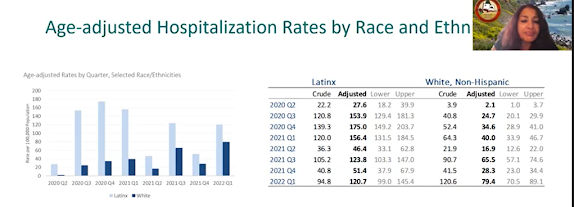
Disproportionate impacts of COVID
- Magnification of underlying/pre-existing disparities
- Latinx residents: largely essential workers, hardest hit
- 27% of our population is Latinx, accounted 45% of all cases
- at one point, case rate was 9X higher for Latinx
- In 2020, life expectancy decreased by 2.1 years in Latinx population (compared to 0.7 years in White SoCo population)
- Addressing these inequities, THE PUBLIC HEALTH CHALLENGE of this pandemic
- Health Equity Working Group helped get services to vulnerable population
- trusted messengers (community health workers, promotoras)
- vaccines, masks/PPE, rental assistance
- CURA: important partner to reach community, ensuring financial assistance provided to people who needed it ($8 million)
- FQHC network for collaboration--> 13 different vaccine sites to prioritized populations
- Special shoutout to Dr. Jenny Fish and Dr. Panna Lossy for uplifting the voices of vulnerable communities
COVID-19 Deaths
- 75% of SoCo deaths were in people >65
- residents of skilled nursing facilities were particularly vulnerable prior to the introduction of vaccines
Vaccine Rollout
- SoCo PH chose to prioritize the most vulnerable residents for vaccine roll out
- older adults (65+, 75+)
- SNF and residential care facility patients (RCF)
- Essential workers and marginalized communities (health workers, farm workers, food service workers, homeless)
- We have very high degree of vaccination in our elders: 93% of those >65 are fully vaccinated
- Vaccination of vulnerable elders reduced deaths at SNFs and RCFs
Vaccines work! The reduce infection, hospitalization, and deaths.
 |
| from https://socoemergency.org/ |

In summary, Drs. Mase and Shende highlighted this list of pearls in public health management of this pandemic: data-driven decision making, constant pivoting, expanded communication, collaboration with all the health care entities in SoCo, importance of community outreach and trusted messengers, and ultimately active listening.
Be Curious (Jordan, 5/18/2022)
If you are interested in this week's Grand Presentations Be Curious: Cultivating Curiosity in Learners, Teachers, and Practitioners of Family Medicine, a recording is available HERE.
I will be brief with my notes:
I presented Dr. Todd Kashdan's model for the 5 Dimensions of Curiosity:
- Joyful exploration: pleasurable, knowing for the simple sake of knowing
- Deprivation sensitivity: the itch you must scratch, can be uncomfortable, even painful
- Social curiosity: interest in knowing what makes people tick
- Stress tolerance: discomfort with novelty, mystery, unknown
- Risk tolerance/thrill seeking: desire for thrill, adventure
We discussed how these different dimensions come into play in different people at different times. How curiosity is dynamic, often pleasurable (but definitely not always); how our tolerance for novel, mysterious and uncertainty play a role.
What does this have to do with Medicine?
I introduce you to the work by Dr. Faith Fitzgerald, a long time teacher and internist at UC Davis, who wrote extensively about curiosity. My favorite of her writings is a 1999 reflection from the Annals of Internal Medicine on curiosity in medical education. If you haven't read it, please do. Just click on the caption to the image below, and you will be taken straight to it. It's a beautiful piece, definitely worth your time!
Dr. Fitzgerald writes that in order to be curious, you must have 1) competence (otherwise answers fill up the space instead of questions) and 2) time. She also writes that medical education and medical practice suppress curiosity.
“Curiosity is fundamental to our physicianship, and serves both the art and the science of medicine. (How do you do? What’s your name? Where do you come from? How do you feel? Tell me more about this pain you’re having…). Curiosity is how we explore the world, this primal “wonderment” that stimulates exploration, engages both the human imagination and human intelligence. Both are integral to the humanities and science, as well as the synthesis of the two, which is clinical medicine.”https://www.bumc.bu.edu/facdev-medicine/files/2010/09/Fitzgerald_AnnInternMed_1999_130_70_Curiosity.pdf

I also shared with you a model created by an Israeli hematologist, Dr. Shattner, in his essay from 2015 on Curiosity in medicine. His model (which I don't love aesthetically but adore in its core tenets) espouses that curiosity is good cognitively and emotionally, and it's good for patients and physicians.
You can see his model below and an updated rendition below (by yours truly)
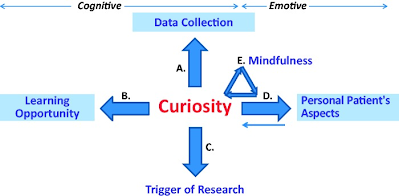 |
Shattner, https://www.ncbi.nlm.nih.gov/pmc/articles/PMC4484215/ |
And below my own rendition of his work:

As a medical educator, I am also interested in the way that -- as Faith Fitzgerald writes-- medical training can negatively impact one's curiosity. This can happen in countless ways.
Things we know suppress curiosity: haste, efficiency, fatigue, ignoring/suppressing feelings, overconfidence, rigid structures, depression/anxiety.
Ways in which teachers could enhance curiosity in the learning environment: promoting responsibility for one's own learning, welcoming diverse opinions, offering space for reflection, modelling effective management of emotions, confronting both uncertainty and overconfidence, using inquiry based learning, helping students see familiar situations as novel, maximizing small group discussions.
Are you, medical educators, using these techniques? How could you infuse the work you do with curiosity?
A final word on burnout, defined as a condition of physical and mental exhaustion pertaining to caregiving activities and arises from chronic exposure to interpersonal stressors at work. Very common in residency training, very common in primary care practice. Characterized by 3 traits: emotional exhaustion, depersonalization, and lack of personal accomplishment.
I pose this final question to you: How might we use curiosity as a mindfulness exercise to prophylax against burnout AND an advocacy tool to work toward systems changes?
Some examples:
- What happens if you are truly curious about a patient’s chronic pain?
- Or their itchy scalp?
- Or their dietary habits?
- What happens if you are curious about a surgeon’s outburst?
- Or an administrator’s edict?
- What happens if you are curious about your own wrist pain?
- Or why it is that physicians don’t take lunches?
More to come on curiosity and a proposal I have for Curiosity Rounds.
In the meantime, I encourage you all to tend to your curiosity-- it's good for patients, learners, AND for you.
Cardiology Potpourri (Tsai, 5/11/2022)
Thanks to our speaker this week, cardiologist Dr. Joanne Tsai, for an excellent review of cardiology topics for outpatient care of cardiology patients, particularly regarding Atrial Fibrillation and Atrial Flutter.
A recording of her presentation is available HERE.
My notes:
- When in doubt, get a 12 lead EKG
- That being said, accuracy of EKG interpretation is shockingly poor:
- 42% for med students, 55% residents, 69% primary care, 75% cardiologists
- It is super important to provide clinical framework for the EKG reader; clinical information definitely increases accuracy
- The most common errors with computerized EKG interpretation occur with sinus arrhythmia (computer only accurate 55% of the time) and AV nodal conduction disturbances (2nd, 3rd degree AV block)
 |
| pseudo atrial flutter |
CHA2DS2-VASc scores
CHA2DS2 stands for (Congestive heart failure, Hypertension, Age ( > 65 = 1 point, > 75 = 2 points), Diabetes, previous Stroke/transient ischemic attack (2 points). VASc stands for vascular disease (peripheral arterial disease, previous myocardial infarction, aortic atheroma), and sex category (female gender) is also included in this scoring system.
Reliability of CHA2DS2-VASc scores
- "C"=in the CHA2DS2 stands for CHF; however, guidelines are quite vague in the case of HFpEF and whether CHF should be considered if pt history vs. symptomatic
- Of note, people with OSA have higher risk of stroke (compared to people without OSA), so assessment for OSA is of utmost importance
CHA2DS2-VASc scores predict MACE=Major Adverse Cardiac Events (whether or not you have Atrial fibrillation). In fact, CHA2DS2-VASc score >4 puts you at particularly high risk for cardioembolic stroke, even in the absence of AFib.

Atrial Fibrillation
- Lifetime prevalence of developing AFib for a 40 year old in the US is 1 in 4 (compared to breast cancer 1 in 8)
- overlap between Afib and OSA is 80-90%
- it's really important to get patients with HFpEF into sinus rhythm (and out of AFib)
- even though the AFFIRM trial found that rate control> rhythm control, Dr. Tsai argued that most of these trials excluded people with HFpEF
- that for patients with AF and HFpEF, we really need to put them into sinus rhythm, including anti-arrhythmics
- weight loss is associated with decreased CV mortality in A Fib
- TTE (looking for ejection fraction, evidence of genetic disorder e.g. hypertrophic cardiomyopathy), EKG (looking for prior infarct, LVH, evidence of genetic disorder), sleep study (looking for OSA), ischemia evaluation
- Don't forget exogenous toxins (e.g. alcohol-- direct cardiogenic effect at the level of the atria)
Who should get oral anticoagulation regardless of their CHA2DS2-VASc score?
- hypertrophic cardiomyopathy
- hyperthyroid (especially when actively thyrotoxic; once no longer some will stop anti-coagulation; others continue because still hypercoagulable)
- moderate-severe mitral stenosis
- mechanical heart valves
Syncope: history building (vs. history taking)
- getting a good history regarding the loss of consciousness can determine cause 90% of the time without any testing
- face to face conversation, ask open ended questions
- "How many times have you passed out/lost consciousness?"
- Calculators for syncope evaluation:
- San Francisco Syncope Rule
- Dr. Tsai prefers the EGSYS (Evaluation of Guidelines for Syncope Study)
Let's Talk about Sex (MacArthur 5/4/2022)
Big thanks to Dr. Sophie MacArthur for her excellent presentation on a topic that we could ALL use a little education on-- Sex. And specifically how we talk about it with patients.
The recorded presentation is available HERE.
Link to her slides is HERE.
My notes:
- The Sex Ed most of us had in school wasn't any good
- a meta-analysis of 48 different studies in 10 countries (including US) in BMJ found high school students believed their sex ed to be impractical, out of touch, sexist, heteronormative, and embarrassing
- And. .. let's face it. Physicians aren't very good at talking about sex with patients.
- While 88% of primary care physicians say they take a sexual history, only 25% of charts have said history recorded
- A study from the 1990s-- height of the AIDS epidemic-- found providers didn't take sexual history because they didn't feel it was relevant, didn't feel well-trained, and felt embarassed
- We are inadequately trained
- We tend to discuss sex only when patients ask
- But. . .patients want to talk about sex!
- In one large study from Europe, 91% of patients want their physicians to ask about their sexual history and sexual health
- Even of the 15% who would feel embarrassed talking about sex, 75% still wanted their doctor to ask
As part of sexual history and STI screening, many of us were trained to ask the following question: "Do you have sex with me, women or both?"
Dr. MacArthur asked us to consider a better question: "When you have sex, what parts of your body come in contact with what parts of someone else? And how?"

Two reasons this question is a better question than the men, women or both question:
- it is not heteronormative
- it allows us to screen people for STIs at appropriate sites (e.g. for rectal, oral GC/CT)
There are several different ways we can approach the topic of discussing sex with our patients. All of them promote using open ended questions.
3 options:
1) CDC "6Ps"
- Permission ("May ask you a few questions about your sexual health and sexual practices?")
- Partners ("Do you have any new partners in the last 12 months? How many? Do your partners have any risk factors?"
- Practices ("When you have sex, what parts of your body come in contact with what parts of someone else? And how?")
- Protection from STIs ("Do you and your partners discuss protection from STIs? "What methods do you use? How often do you use them?")
- Past history STIs ("Have you ever been tested for STIs? Have you ever had an STI?")
- Pregnancy intention ("Do you think you would like to have (more) children some day?")
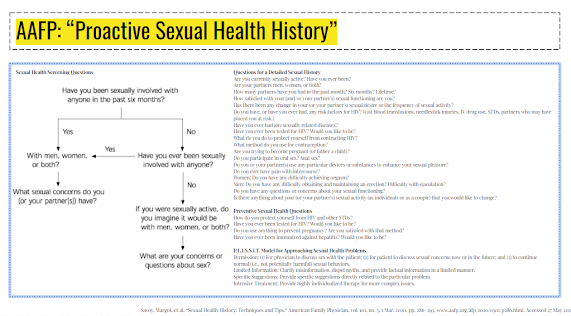
- Ask routinely, confidentially and free of assumptions
- Do it often (you will get better at it)
- Explain why it's important to know what you are asking
- Ask about function and satisfaction (not just about STI risk)
- Use open ended questions (e.g. "what types of sex do you have?"), at least initially
- Normalize less desired responses (e.g. many people don't consistently use condoms; how often do you find yourself not using a condom?")
- Mirror patient's language if possible
- Make the interaction as natural as possible (not robotic)
- Give patients the option to answer questions indirectly (e.g. I recommend screening for GC/CT in all the sites that may have been exposed; for example, the throat, the anus, the penis, the vagina. Which of these sites should you have tested today?)
- Tone and rapport matter, at least as much as the questions
Risk reduction is an important part of sexual history, but risk extends beyond our traditional view of STIs and unwanted pregnancy.
Risk=anything that is not sexual health and/or sexual well-being
This can include non-consensual sex, painful sex, bad sex, legal repercussions of sexual behavior (e.g. consent is not sufficient to protect someone), nerve damage (S&M practices)

Risk reduction Resources
STIs: Not just condoms - frequent testing, PrEP or PEP, etc.
Contraceptives: RHAP Birth Control Options Fact Sheet; bedsider.org
Consent: Yes, No, Maybe Inventories
Painful sex: Mayo Clinic resources
BDSM/Kink safety: San Francisco Aids Foundation S&M and Kinky Sex Resources; NCSF Kink Aware Professionals Directory
Legal: National Coalition for Sexual Freedom Incident Report; safewordtax.com
Strategies to Build Resilience and Happiness: The Art and Science of Gratitude (Lo, 4/27/2022)
I am personally feeling very grateful to Dr. Onna Lo for a really lovely presentation this week on Gratitude, Happiness and Resilience. I have already integrated some of her techniques. . .priming my day and granting myself a "celebration" list (what I have accomplished in the last 24 hours) rather than a "todo list" (all the things I feel bad about not accomplishing).
If you are interested in watching her presentation-- and you should be -- it is available HERE .
Here are my notes. sorry they are brief:
Dr. Lo encouraged us to start every day and every encounter with the ABCs:
A: Awareness (ground yourself)
B: Body/breath (be in your body, find your breath)
C: Connection (with your surroundings, yourself, your patients)
People are struggling
- 36% of Americans are cognitively tired
- 44% of Americans are physically tired
- Depression rates have increased over the last decade from 8% to 22% to 32% in 2022
Something to strive for -- Dr. Lo recommends in our own lives and for patients. To be: Empowered, Engaged, Excited, and Embodied
Some definitions:
- Reactive gratitude: appreciation for a gift received
- Active gratitude: seeking out gifts occurring in life that are appreciated
- Happiness: enjoyment of the present good
- Hope: desire for valued future
- Resilience: the ability to prepare for, recover from, adapt in the face of adversity, stress or challenge
Lesson #1: A positive mindset sets you up for better learning
A positive mindset leads to better learning, improved performance, better problem solving
In The Happiness Advantage, author and researcher Shawn Achor, proposes that personal happiness leads to professional success (not vice versa). Happiness is a choice. Happiness spreads. Happiness is an advantage. Read more about his work here.
The happier you are, the more successful you will be (Horn & Arbuckle).
Gratitude predicts hope and happiness more than forgiveness and patience.
How can YOU build happiness? 21 days in a row x 2 minutes >> 3 gratitudes, positive journaling
Lesson #2: Our brains tend to get stuck in negativity
Half glass full or half empty?
Dr. Lo showed us a series of sociological experiment in which people consistently chose the negative response consistently after being primed with a negative response, even when the outcome was quite positive. If primed with the positive response, people were more likely to choose positive.
We can unstick ourselves by "priming"-- that is, retraining the mind first thing in the morning with gratitude. That is, starting the day positive allows for the day to be more positive.
Exercise: Draw a triangle, write down 3 gratitudes (these must be heartfelt!)

1) what I am grateful for in myself
2) what I am grateful for in others
3) what I am grateful for in my current situation
Exercise: Draw a triangle, write down 3 wonderful things that you accomplished in the last 24 hours (this is your celebration list)

Exercise: Draw a triangle: write down 3 things that will make today great

Lesson #3: There is science supporting positivity and gratitude
Coherence=optimal coordination between the heart and the mind ==> heartrate variability is a really beautiful sinus curve in someone who is completely in a coherent state. Being in this mindset is better for your whole body.

Much more information about coherence and Heart Math at the Heart Math Institute Website found here.
Exercise:
1) Heart focused breathing: 5 breaths in/5 breaths out (requires nothing more than the breath)
2) Inner coherence: use positive emotions or feelings of gratitude to establish a coherent beat (using heart math monitor)
And finally, keep a gratitude journal. Even in these hard times, there are big and small things to be grateful for.
Surviving Residency: The Professional Socialization of Family Physicians (Addison 4/20/2022)
Many many thanks to Dr. Ritch Addison for his wonderful Grand Rounds this morning (and his 40+ years of teaching and mentorship at Santa Rosa Family Medicine Residency. It felt like a warm cup of perfectly brewed tea to sit and listen to Ritch share his observations from the professional socialization of family physicians.
For those of you who missed it, the recorded presentation is available HERE and is definitely worth watching!
I have jotted down just a few notes. The talk is definitely best absorbed by listening/watching.
To start, Ritch asked us to consider what resonates with you?
- How do physicians get trained?
- How is residency a process of habit formation?
- How is residency a "stress test" of emotional capacity?
A long time ago (40+ years) in a galaxy (not so) far far away, Dr. Ritch Addison followed nine family medicine interns around for three years-- "I wanted to see what they did." His notebook always in hand, Ritch took call with them, observed them delivering babies, suturing folks in the ER, race to clinic, etc. For three years, he watched them live and process their entire residency training experience.
Today's talk was a summary of observations and models derived from that research. Ritch highlighted a number of important themes:
Surviving residency involves a TON of immediate issues that new R1s are confronted with
- information overload
- work overload
- dying patients
- control
- time pressures
- sleep deprivation
- inexperience
- responsibility
Working relationships are a complex piece of residency identify formation. Relationships with:
- patients
- nurses
- providers
- attendings
- private doctors
- faculty
- other residents
- AND. . . family (which often takes a back seat because residency can be totalizing)
Asking for help >> too late, too early
When?
Who?
How?
Learning the ropes>> equates to decoding local customs
where to sleep
when to cry
who to ask
how to put in orders
how to write notes
Spheres of existence evolve over time
work education life outside
initial purpose/weight take care of patient learn family medicine maintain some QOL
evolves into GET done do procedures whatever is left
There is an inherent conflict and contradiction between a resident's ideals/goals/visions (expectations) and the everyday practices of being a resident.
Ritch finished off with his assessment of the "modes of surviving"
Over-reflecting: too much self reflection (favorite patient dies, yelled at by attending, make a mistake)
Covering over: using little self-reflection, so focused on what you are doing you cannot see what is happening to you
Moving between these two takes wide movements and is extremely jarring. How do residents learn to move between these modes? Ritch said clearly that it's really NOT about finding the sweet spot of reflection, but rather being able to smooth out the space and integrate these two forms of being.
Finally, Ritch introduced the birth of the Personal and Professional Development groups (P&PD) that really were birthed from the desire of residents to facilitate the movement between these two spaces-- to smooth it out. After all, everybody feels the same way. What happens when we talk about our experiences? We start to resolve the two modes. . .
Ritch ended with an excerpt from The Heroes Walk, by Anita Rau Badami on the physician-patient relationship. Listen to him read it at the end of the recording. That is what family medicine is all about, right? The most meaningful way we can bring health to people.
Subscribe to:
Posts (Atom)
Why Prescribe Single Pill Combinations? (Toub, 10/14/2026)
A recording of this presentation is available HERE . Thanks so much to Dr. Danny Toub, core faculty, family doctor, and HIV specialist, who...

-
A recording of this presentation is available HERE . Many thanks to Dr. Andrew Brown, who gave an excellent Grand Rounds presentation this w...
-
 Great thanks to Dr. Jose Maldonado, a Stanford psychiatrist and neuropsychiatrist, who literally wrote the benzodiazepine-sparing alcohol wi...
